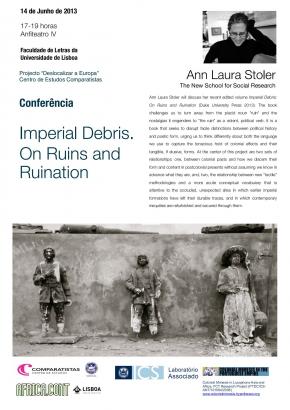
 Ann Laura Stoler will discuss her recent edited volume Imperial Debris: On Ruins and Ruination (Duke University Press 2013). The book challenges us to turn away from the placid noun “ruin” and the nostalgias it engenders to “the ruin” as a violent, political verb. It is a book that seeks to disrupt facile distinctions between political history and poetic form, urging us to think differently about both the language we use to capture the tenacious hold of colonial effects and their tangible, if elusive, forms. At the center of this project are two sets of relationships: one, between colonial pasts and how we discern their form and content in postcolonial presents without assuming we know in advance what they are, and, two, the relationship between new “tactile” methodologies and a more acute conceptual vocabulary that is attentive to the occluded, unexpected sites in which earlier imperial formations have left their durable traces, and in which contemporary inequities are refurbished and secured through them.


The New School for Social Research
Posts com a etiqueta The New School for Social Research
Arquivo
Autor
- administrador
- adrianabarbosa
- Alícia Gaspar
- arimildesoares
- camillediard
- candela
- catarinasanto
- claudiar
- cristinasalvador
- franciscabagulho
- guilhermecartaxo
- herminiobovino
- joanapereira
- joanapires
- keitamayanda
- luisestevao
- mariadias
- marialuz
- mariana
- marianapinho
- mariapicarra
- mariaprata
- martacacador
- martalanca
- martamestre
- nadinesiegert
- Nélida Brito
- NilzangelaSouza
- otavioraposo
- raul f. curvelo
- ritadamasio
- samirapereira
- Victor Hugo Lopes
Data
- Outubro 2026
- Setembro 2026
- Agosto 2026
- Julho 2026
- Junho 2026
- Maio 2026
- Abril 2026
- Março 2026
- Fevereiro 2026
- Janeiro 2026
- Dezembro 2025
- Novembro 2025
Etiquetas
Mais lidos
- Trace
- Começa hoje a Festa do Cinema Francês
- Conferência & Homenagem a Christine Messiant
- Conferências e Conversas Para Além do Apocalipse: À Procura de Respostas por Álvaro Vasconcelos
- “Meu nome António”, exposição de fotografia dedicada a António Variações no Centro Cultural das Caldas da Rainha
- Funaná, African avatar in a pluralistic Cape Verde
- NA MARÉ, de César Schofield Cardoso no CNAD
- Ájax de Sófocles
- Luis Firmino e Banda
- Agadá regressa a Lisboa: dança, música e saberes da diáspora africana