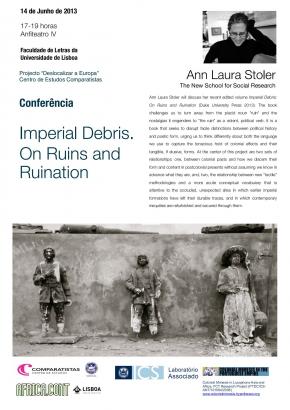
 Ann Laura Stoler will discuss her recent edited volume Imperial Debris: On Ruins and Ruination (Duke University Press 2013). The book challenges us to turn away from the placid noun “ruin” and the nostalgias it engenders to “the ruin” as a violent, political verb. It is a book that seeks to disrupt facile distinctions between political history and poetic form, urging us to think differently about both the language we use to capture the tenacious hold of colonial effects and their tangible, if elusive, forms. At the center of this project are two sets of relationships: one, between colonial pasts and how we discern their form and content in postcolonial presents without assuming we know in advance what they are, and, two, the relationship between new “tactile” methodologies and a more acute conceptual vocabulary that is attentive to the occluded, unexpected sites in which earlier imperial formations have left their durable traces, and in which contemporary inequities are refurbished and secured through them.


The New School for Social Research
Postes avec la étiquette The New School for Social Research
Archives
Auteur
- administrador
- adrianabarbosa
- Alícia Gaspar
- arimildesoares
- camillediard
- candela
- catarinasanto
- claudiar
- cristinasalvador
- franciscabagulho
- guilhermecartaxo
- herminiobovino
- joanapereira
- joanapires
- keitamayanda
- luisestevao
- mariadias
- marialuz
- mariana
- marianapinho
- mariapicarra
- mariaprata
- martacacador
- martalanca
- martamestre
- nadinesiegert
- Nélida Brito
- NilzangelaSouza
- otavioraposo
- raul f. curvelo
- ritadamasio
- samirapereira
- Victor Hugo Lopes
Data
- septembre 2026
- août 2026
- juillet 2026
- juin 2026
- mai 2026
- avril 2026
- mars 2026
- février 2026
- janvier 2026
- décembre 2025
- novembre 2025
- octobre 2025
Étiquettes
Les plus lus
- FIC Luanda 2026 apresenta primeiros filmes da Competição Internacional e reforça ambição de Angola no circuito africano de cinema
- Novela gráfica «Caderno de Memórias Coloniais»
- Intimate Distance, Uncaptured City, Edson Chagas
- Mário Lúcio de Sousa à conversa
- ROOFTALK Conversa, Música e Artes
- ILUMINAÇÕES DA ALA OCIDENTAL DA RELAÇÃO DE LISBOA, de Sancho Silva
- Contemporânea leva a Lisboa e ao Porto um programa de performances sobre memória resistência e transformação
- O Cinema por Dentro, em Monsanto
- MEU SEMBA, de Hugo Salvaterra. hoje no Cinema Ideal
- Não Resta Nada, de André Godinho