Explain again what it means to be Portuguese? Dino D' Santiago's opera
Photographs by Bruno Simão
It is remarkable that, on the same weekend, two of the city’s most renowned venues presented (completely sold-out) performances by artists with ties to Cape Verde: Marlene Monteiro Freitas, born in São Vicente, with the show “Nôt,” and Dino D’Santiago, whose parents are from the island of Santiago, with the opera “Adilson.” Both, particularly admirable, strike at the heart of the great issues of our time — immigrants, war, and storytelling.
It is important to correct the information that some newspapers have been repeating: Dino D’Santiago was not the first to create a Creole opera. Already in 2008, the magnificent Ópera Crioulo, by choreographer António Tavares and music by Vasco Martins — both Cape Verdeans — premiered at the CCB, featuring Sara Tavares.
It was a good omen to start the year listening to Dino D’Santiago in Sines. Dressed in white, he radiated positive energy from the stage by the sea into the land where his father lived when he first arrived in Portugal. To a vibrant audience of Cape Verdeans, he recalled the many islanders who came to work at the port of Sines. Sines is an eleventh island of Cape Verde, just like Cova da Moura, Quarteira, and so many places in the world where kind Creoles preserve and transform cultures.
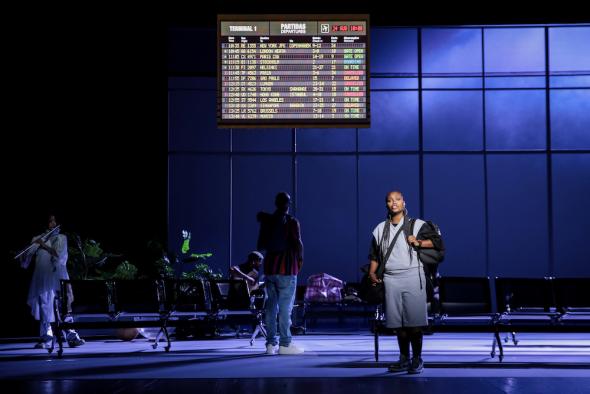
I saw the general rehearsal of the opera Adilson, whose aesthetics and staging are visually powerful, which reinforces the narrative. From a technical standpoint, I highlight the cohesion between music (with orchestra), voice, and stage, which is not easy in these large-scale productions. But it was the show’s motto that captivated me the most, a subject that reflects the great shame of the Portuguese system: placing people in a disadvantaged position based on racial markers. And the lack of maturity in acknowledging the necessary reparations in the face of an unfair present for the children of bastards of the empire.
Adilson is the story of a rootless Creole. A childhood friend of Dino’s, the dancer Adilson Correia Duarte, known as Bonny and in the neighborhood as Dafos, arrived in Quarteira at eleven months old but remains a stranger in the country where he learned to walk and from which he has left only once. Adilson has never tasted the pitanga of Angola, never set foot in Cape Verde, and belongs to all three places at once without any formal ties to any of them. Angola, Cape Verde, and Quarteira are, thus, a triple belonging without recognition. Like so many other children of immigrants, he lives in this paradox: “I’ve never been there, I’ve always been here, where I’m a stranger.”
The play explores this limbo, a direct legacy of the law proposed by Almeida Santos in 1981, which began to give more weight to the principle of jus sanguinis (right of blood) than to jus soli (right of soil), closing the doors to Portuguese nationality to many people, especially mixed-race and black individuals from the former colonies, and to their children born and raised here. This legal past still echoes in precarious affiliations and current barriers, even though the law only changed — ONLY! — in 2020, the result of a long fight by the anti-racist movement. Until then, all those who were not recognized as Portuguese experienced social and bureaucratic exclusion, treated as foreigners in the country where they had always lived and denied access to basic rights (scholarships, social programs, healthcare, travel, and job opportunities). This exclusion, in turn, fueled racial and institutional discrimination, because nationality served as an additional barrier in a context already marked by structural racism. Many obtained citizenship as adults, following lengthy processes, including the expiry of residency permits, institutional changes (SEF – AIMA), and countless unexpected events.
When we hear on stage the bureaucratic mantra “passport, birth certificate, application denied,” we realize how life can be crushed by paper, amid system errors, paperwork confusion, and a saga involving embassies, border police, AIMA agents, official speeches that promote integration while simultaneously rejecting it, agencies that promise help but exploit vulnerability, and changes in regulations. A single mistake in filling out a form is enough to send everything back to square one, in a game that drains patience and robs vitality. The Adilsons of this world live by waiting.
The play exposes the subtle and ruthless violence of bureaucracy: when one problem is solved, another arises. And it repeatedly satirizes: “We’re here to make things difficult” or “our purpose is to turn useless work into a procedure.”
In Portugal, it’s everyone for themselves, not always God for all, sings old man Bonga. And it is possible for a person of African descent to have lived there for over 40 years without ever obtaining the much-desired Portuguese citizenship, which is accessible to the wealthy through money and home ownership.
We are in the Departures Terminal of an airport. It is interesting to choose an airport as the scenery. It is a non-place, but also a space of love, anxiety and fear. The stage is made of invisible borders, of counters that decide destinies, of border police who know the schemes, of agencies that exploit desperation, of fake documents that cost fortunes. The money circulates in trafficking, in fraud, in clandestine entries.
We watch a dialogue between Angolans, in a Mangolé dialect laden with candengues, avilos, and cumbú. Throughout the play, the label of “other” is deconstructed, at the geographical and emotional crossroads and intertwined identities. It is impossible not to feel outrage at the indignity, xenophobia, and racism that immigrants and children of Africans and Brazilians have to face in a country that has always been one of emigrants, which now sends the most vulnerable “back to their land.” Whether born here or not, the insult is pure ignorance because we are all from everywhere, we are made of what we bring, of the curves of the neighborhood. Our bodies are our homeland, says one of the characters, dismantling the petty idea of identity linked to specific places. In fact, the phrase “I am not Portuguese, I am Portugal” earned Dino D’Santiago several comments from far-right “haters” and “bots”.
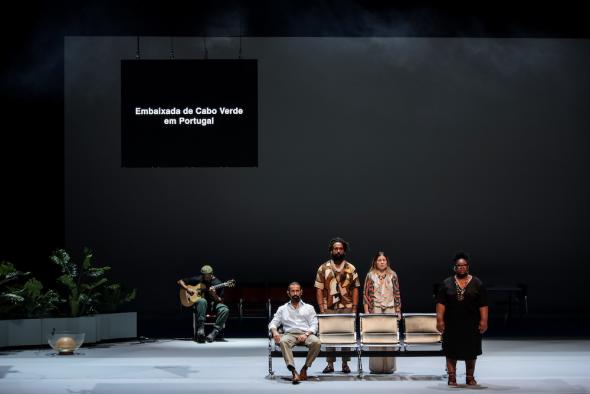
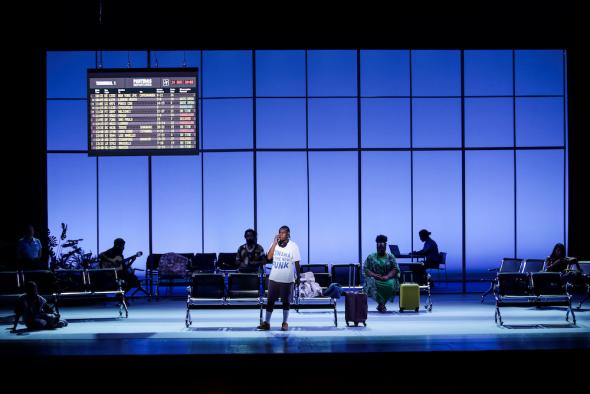
The everyday violence is exposed in poetry and irony: “Are you going by train or by air?”, “Give me a morna to forget this pain,” “I dreamed you were friends with a policeman,” and even the t-shirts say “Funaná is the new Funk.” The text is all in rhyme, like a slow-burning song of resistance in revolt. The show thus breaks with the myth of integration: reality is made of waiting, refusals, silences, and mothers who die of heartbreak before seeing bureaucratic processes resolved.
This personal story reflects that of many landless Creoles, who carry Portugal on their backs, always indebted for nothing, never fully belonging.
The play poses many questions: What awaits me on the other side of the sea? The struggle calls, should I go? Which side am I on? And, in a somewhat threatening tone, But after all, do you want to be Portuguese or not?
I was reminded of the band Miss Universe, who seem to answer this question with another, more interesting one: “Explain again what it means to be Portuguese?”
The State insists on drawing boundaries it did not choose, and to which it does not know how to respond.
The questions are sung by the performers, like passersby in a place between departures and arrivals. Dino opens the door to those who cannot leave, gives voice to those that Portugal insists on pushing out, and exposes a country that is waiting. Waiting for justice, for political courage, for decent housing, for education for all, for an end to the segregation of neighborhoods where the State is absent, waiting for a future of equality.
The play almost ends with raised fists by the two actresses playing Dino and Adilson, Soraia Morais and Koffy, whose luminous, clear, and intense voice of the first one contrasts with the deeper, more textured voice of the second, both very clean and serene. The raised fist is a gesture of fight, a symbol and an invitation. Adilson is embedded by a political and poetic tone that compels us to revisit the recent history of those living on the margins of the law. It exposes the wounds of racist laws and administrative violence, showing how the migrant body, in all its vulnerability and power, is also the measure of the country, in the resistance of those who insist on existing, even when the system denies it.
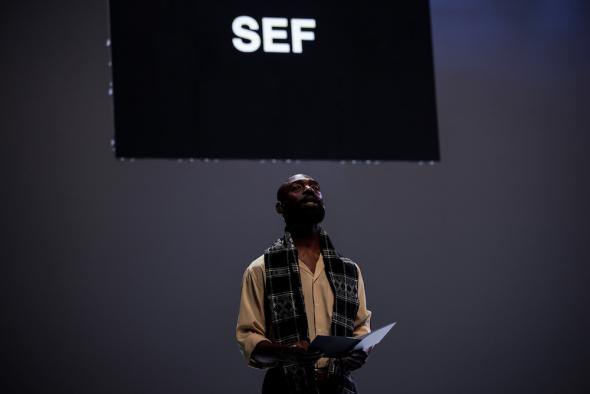
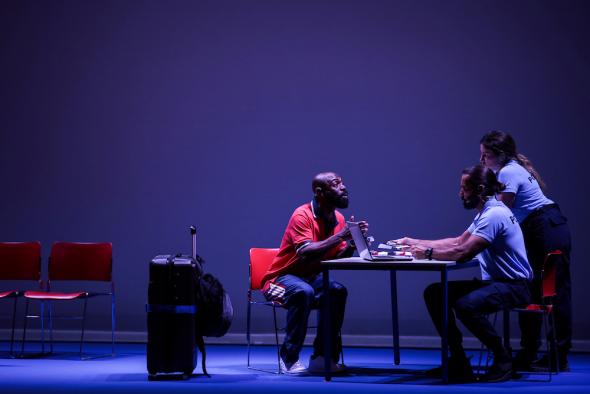
This five-act opera was commissioned by BoCA — Bienal of Contemporary Arts, with a libretto by Rui Catalão (based on interviews with the migrant community) and musical direction by Martim Sousa Tavares. Musically, Adilson is rich and diverse: Dino chose that all the clefs, from beginning to end of the opera, came from Portuguese speaking countries. There is a great sound fusion of Lusophone instruments mixed together, traditional rhythms — morna, funaná — interspersed with classical orchestra, with moments of contemporary and electronic beat. And the most beautiful part is a reference to Palestine, as one cannot fail to do, with Mais, a Palestinian from Nazareth, singing in Arabic and playing the flute. A beautiful moment.
The presence of the Portuguese-São Toméan rapper and soul singer NBC, singers Michele Mara, Cati, Rebeca Reinaldo (known from The Voice Portugal), and Rúben Gomes adds strength to the play. It coincides with the launch of Dino de Santiago’s emotional autobiography, entitled Cicatrizes.


