Everyday is 25th of April
It is thrilling to feel the wave of diverse people “going out into the streets (avenues, I`m sorry) with carnations in their hands at set times”. I am a cell from this mass of water and flesh for decades, and it has been exciting to see the revolution day reactivate, gain pulse and multitude, more cause and watchwords. I recognize the 25th of April on my path, as if I practiced every day, and I have been thinking in our generation’s place: the children of the 25th of April, that came after the end of the dictatorship to put in practice freedom, with so many possibilities to blossom and always so complaining. We went through the analogical to the digital, from heroin to amphetamine, from post-Cold War to global crises, between celebrating and the fear of losing… the social State, the work, the home, the spirit.
Our history starts in the hangover of the most beautiful and poetic revolution of Europe - a revolution without blood, huh? And the napalm? And millions of dead and explored people in Africa? - mine, to be more precise, when the Constitution gave form to the promises of April (many of which remain unfulfilled). It was Peace, Bread, Housing, Health and Education but, half a century later, the social contract is under strain, or even in crisis. “Appreciate what you have, look how many people have made sacrifices for this!”, our parents would say. Then, it is worth remembering a few social achievements that reflect life in this so-called democracy, and a handful of events that have shaped us.
(We are the fruit of all that, but we have also flourished in the contexts we have found ourselves in and which we seek to unfold.)…
In the first place, the Serviço Nacional de Saúde which, since 1979, became one of the most important infrastructures of equality, ensuring universal access to health care. Secondly, the democratisation of education: public school for everyone, mandatory education until the age of 18, and increasing access to superior education, where we graduated, how lucky! My teenage years extended from the fall of the Berlin Wall to the end of apartheid with the election of Nelson Mandela, after we had watched his release on TV, teaching us that history can, in fact, change course. I was 10 when we joined the European Community, which opened up borders, funded roads, and allowed, to some of us, to play like Europeans, to travel, study and buy fruits in accordance with European regulations. We experienced, with some reservations, the urban euphoria of Expo 98, without forgetting the “other stories to be told” that progress always erases. In 2002, we adjusted to the euro, which changed our currency and mental scale - everything became more expensive without us realizing. We witnessed the highly publicised events of 11 September 2001, that transformed global politics and caused security paranoia. We started to distrust each other and the security industry was grateful for that.
We were taken into the expansion of the internet and social media, and the way we communicate, work and even date has changed. We survived the financial crises of 2008 and the austerity of Troika in 2011, between mass emigration and overflowing manifestations, sit-ins and heated debates that attempted to find new ways of doing politics. We belong to collectives and opened self-managed spaces dedicated to cultural programming and “critical thinking”. We produced magazines, publishers and websites, and films. We reinforced movements of feminism and anti-racism, dismantling many of our sexist and racist culture; we have fostered discussions on colonial memory, representation and the recognition of structural racism in public debate. With admiration, we witnessed the rise of climate groups that are shouting out the planet’s urgent need for action.
We surrendered to the collective shutdown in the pandemic of 2020 and 2021 in which, inside our homes, we shared the fear and interior discoveries, making predictions about the future, laying bare the division between those who are protected and those who are disposable. But as soon as “normality” returned, subhumanity and brutality increased even further. When we got out of confinement, I threw a birthday party at Monsanto, a day before Russia brought war back to the center of Europe. (In reality, the war never ended, even though there is mention of a post-war Europe). We never stopped seeing the massacre in Palestine, but in 2025 we see the live genocide. In the last few years we stopped being surprised by the reckless behaviour of Trump and other pathologically powerful figures, and a handful of big tech billionaires are driving the whole world to collapse, perpetuating an imperialist and extractivist agenda as old as modernity itself.
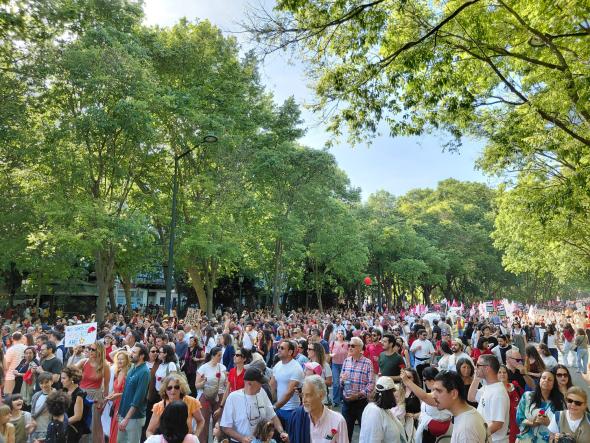 25 April 2026 in Lisbon, photo by JP George
With gender issues, domestic violence became public crime in 2000; we got the decriminalisation of the voluntary termination of pregnancy in 2007, and same sex marriage in 2010; the gender identity law was approved in 2011; parental leave was extended, and many of us can live parenthood in a more balanced way. At work, legal limits on working hours have been established; temporary work is now more strictly regulated, and legislation has been introduced covering digital platforms and remote working, but job insecurity remains a tough nut to crack, as much as the four-day week and the 15-minute city are praised in the “forums”. We grew up in this ever-changing country, even though we left and almost gave up on life here, where the food isn`t that bad and we have so many good friends. We overcame crises, delusions and reinventions. We saw walls come down and others go up, such as the rise of the far right; we saw racists and sexists shedding all restraint, spewing fascist venom into the air on a daily basis. But thousands of people marched in the streets, shouting with immigrants “don`t push us against the wall”, and other thousands demanding housing and to put a stop to labour practices that swallow up rights and normalise inequality, all in one sitting. And many more on continuous fights for public schools, culture, bogeyman that still scares young and old ghosts, but which every now and then offers us glimpses of courage.
We have come to realise, through experience, that the freedom of April and democracy are not something that is simply granted, but rather a constant struggle; and the more we read and understand, the clearer it becomes that democracy and the rights enshrined in law are not enough. Liberal democracy is, in fact, an ally of the structural inequality of the capitalist system. And if we want a full and just life, one that cherishes and practises the spirit of 25 April every day, that is not the path to follow. When we celebrated the 50th anniversary of the 25th of April, there were 60 elected representatives of a far-right party, sitting there to validate laws. One of them said we should have stormed into the neighbourhoods and killed people when the Lisbon metropolitan area was burning in revolt against socio-racial injustice and the police state. (However dissident the uprising may be, there is an intellectual class that observes it from a distance, treating it as a “subject” and a means of exchange). The 52 years since April mark a turning point in our journey of progress, setbacks, achievements and new concerns. We have built friendships that have stood for decades, and others that are tied to specific stages of life. More or less turned towards one another, but together somewhere, in a moment that was well worth it and shaped us into who we are. We have adapted our ideas and convictions as reality hit us head-on, and here we still are: questioning, insisting, making children, raising them, to note that they still face greater difficulties with employment and housing, with emigrating, returning home, burying their parents, suffering, doing nothing, feeling afraid, and toasting drinks again to forget the wars that concern us, and the apocalyptic rhetoric that dwindle our spirits. A large part of life is lived in common, amongst friends and all those with whom we grew up—people we last saw half a century ago at the 25 April parade—and the new faces who join us.
Independent worker in various languages in the field of culture, such as programming, translation, journalism, investigation, cinema. Since 2010, she edits the BUALA website.


