From resistance and fantasy, interview with Luísa Queirós and Shipwrecks and Abandoned Boats
Luísa Queirós was born in Lisbon and died in Mindelo in 2017, city where she lived since 1975. She graduated in Painting from Lisbon Faculty of Fine Arts and arrived in Cape Verde a few months before Independence. She started one of the most significant projects for the visual arts in this country with Manuel Figueira and Bela Duarte: the Resistance Cooperative. They were the driving force of the National Centre for Art, Crafts and Design (CNAD) in 1978, being responsible for material collections, techniques (weaving and batiking), and training, helping to create an important cultural heritage. She created puppets, wrote books for children (having been awarded the Gulbenkian Grand Prix for children’s literature), and illustrated magazines and disc covers. In 2000, she was awarded the first class of the Vulcan Medal, from the Republic of Cape Verde. In 1992, with the artist Bela Duarte, she created the Gallery Azul+Azul = Verde.
Her figurative painting fills the space with vivid colors and shapes that make us follow the course of stories and emotions.
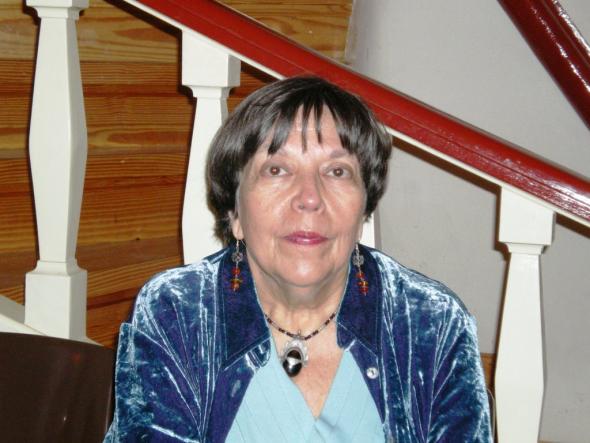 Luísa Queirós
Our conversation takes place at Mindelo in 2005, in the dream of light that is the view of the Figueira atelier over the sea, and the bustling Rua da Praia. A conversation about her art with buzz on the background: market, fishermen, sellers, street vendors, and cars. But still the coziness of quiet boats and the opening of the port city to the world.
In addition to the collective and popular root effort, you identify with a figurative and highly symbolic painting.
In Portugal, I had already chosen to express myself through figuration but very much linked to a magical symbolism. During the dictatorship period, when reporting injustices, I did so using poetic and colorful “metaphors”. In Cape Verde, I have been faithful to this form of expression by building my plastic universe through images.
I would like you to talk about some of its recurring elements, namely the mermaid figure. Is she meant, in a way, to represent the woman who has been stripped of her expressiveness?
The first time this figure appeared in my work, it was when I was making the “The Island Universe” with Vasco Martins (poetry, him with music and me illustrating, painting, doing batik, around 1987). It was a mermaid inside an egg-like water bubble, desperate with that prison and deprived of her legs and sex, which diminished her it a lot. By instinct I was exposing the situation of women in Cape Verde in their position as decorative beings, without access to great tasks and resolutions. Later, the mermaid figure appears in other stories, such as the comic “As Ilhas da outra face da Lua” (The Islands on the other side of the Moon), in which the mermaid regains her enchanting power and is happy.
Your painting have many narratives, it combines fiction and stories, could it be related to this popular research, and inspired in some beliefs?
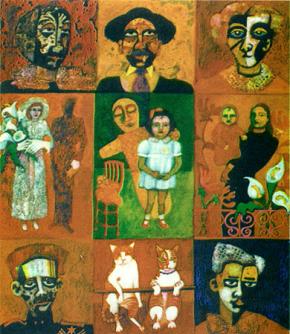 eu e a minha família
Every now and then my painting has this intervention nature. If anything that is bothering me, I work in a way that reports it or exorcises it, it is the case of this chart “O genocídio entre Hutus e Tutsis” or the series I exhibited at Mabooki in Lisbon, “Burrocratas com sumo de limão”. But I really like to connect with words and music as sources of inspiration. Stories told by women from Santo Antão about women-cats-witches and midwives of mermaids that go to the bottom of the sea, to the palace of the “enchanting” to provide their services by receiving three stones that will turn into gold. I really like this universe, and I take the opportunity to create characters for my art. Today, I work on a series based on the abandoned boats that existed in Galé (Cova da Inglesa) and the shipwrecked boats in the seas of Cape Verde. I believe that each artist should look within themselves for authenticity and get “contaminated” with the atmosphere around them: so they will reach a universal projection. Sometimes, I go to Portugal and other countries, and I always seek, through books, exhibitions, and museums, to be aware of what is going on in contemporary art, I admire many experiences, others I hate, and since I don’t go after trends, I feel good again on my skin and with what I do.
Another theme you frequently explore is racial mixing and the subversion of racial categories, of black mothers with white children and vice versa.
For some time I’ve dedicated myself more to batiking, to this extraordinary thing of Cape Verde being an authentic laboratory of blending races, colors, cultures, loves, and abandonments. Also of contrasts, because it is common to see black women with white, blonde children with blue eyes and vice versa and this is particularly good because it fades the racist ideas that that are growing around the world. Also the Cape Verdean woman, creator of many children of the “fathers of fidje” who do not support them, do not recognize the children and “absent” from their elementary obligations, deserve admiration and I usually represent them as victims of an exacerbated sexism of many men in this country. I exhibited these works in Belgium and Luxembourg in 2002.
Have you felt any discrimination as an artist because you are a woman and Portuguese? When you do something remarkable about Cape Verdean artists, do your work appear?
At national level, there are no art critics with formal academic and cultural training who can serve an educational role for an audience that is still very “green” when it comes to artistic matters, and that is why certain people set themselves up as critics and go on, even though they don’t understand a thing… how to express opinions, write them down, and thereby make history! Pseudo-artists, amateurs, are placed in books or magazines as Michelangelo(s), Leonardo(s) da Vinci(s), Polok(s) of Cape Verde – geniuses. And what’s worse is (perhaps fortunately) they discriminate against female artists. This has happened to me several times. They came to this building, Figueira house – where three artists work. Interviewed the two male painters, barely greet me, of course, for them I don’t exist! Now, in magazines and books by writers, galleries managers or directors of foreign cultural organizations, the behavior is quite different. Reproductions and articles are made about my work, which gives me much more visibility and credibility and that’s great.
Color is a very strong element in your painting.
Yes, I use a lot of contrasting colors. Sometimes, as a practice, I start a work in black and white, brown, etc., but suddenly it’s all orange, violet, blue, and green.
Living on this island helps you have a bright, life-filled perception.
Yes, Cape Verde is a paradise for visual artists: the sun, sea and sky are always changing color from minute to minute, the imposing rocks reflecting these variations and even people are intensely colored.
The place where you live highly influences the way you paint, the painting`s state of mind. To what extent has the Cape Verdean culture interfered with your aesthetic, color, shapes?
I believe that both our collective experiences already described, as well as personal artwork, demonstrate that if I were in Finland, Australia or elsewhere, my art – painting, tapestry, etc. would be completely different. I believe I am a Cape Verdean painter, although I also find myself as an artist of the world, but it is Cape Verde and all of its culture that are at the base of my work.
People tend to deny what might be interesting in their land.
Many years ago, at a round table of Cape-Verdean intellectuals, it was even affirmed that Cape-Verdeans were almost unable to be artists, and it was also said that our landscapes were not inspiring because of the lack of color!!
This is negative, in this education self-love is very little developed, even in the family.
I believe, also based on the vast experience I had as a teacher, that schools continue to not have life as a basis for teaching, and the Cape Verdean family is fragile in its constitution (many parents are absent!).
You made some paintings from Saramago’s book “The Stone Raft”. How was the relationship with this writer’s work?
I admired him as a person, his position takings, the courage to start his career as a writer in his sixties, when everyone says that at that age you’ve already hung it up. I like who gives these examples of vitality. Then I had access to this book, and I was excited, that way of writing is exciting. At first, it doesn’t seem so bright, but it leaves some “mental spaces” for us to fill, and then we interspersed our personality with the things he writes, and we become very connected to the work. It is a major criticism of Europe, which always turns its back to the peninsula, especially Portugal. I only worked on magical moments of the work, then I sent him the photographs of the works to offer him two paintings in exchange for the pleasure he gave me when reading the book. He wrote me an extremely friendly and encouraging letter that I put in the exhibition catalog.
What is it like to be the wife of a painter (Manuel Figueira)?
Being a woman of a painter, a colleague in the Fine Arts, the Resistance Cooperative and the National Centre for Art, Crafts and Design (15 years), co-workers in the same atelier, is a lifetime of great courage and patience for both. It also means that it is very interesting as a coexistence experience of two people who have always had common goals and projects, both artistic, political, and human.
Isn’t it sometimes a bit excessive to share so much?
It is stressful, especially when in the CNAD we brought the problems of work home, especially the conflicts, disappointments, terrible tensions with the Ministries, which always took place, but since we had interesting projects to materialize there, we stayed excited and kept going together.
What do you think of Manuel Figueira’s paintings?
Manuel has, since the Fine Arts, a work that has already been distinguished by originality, safe technique, and creased personality. Over these 30 years in Cape Verde, his painting, going through several stages, was acquiring new values, sense of humor, great compositions. A personal aesthetic without concessions. His extensive exhibition curriculum, especially abroad, speaks for itself and for its great value.
Do you share ideas and techniques?
There is no sharing, we each explore and discover our own paths and techniques suited to what we mean to express.
You two have very different aesthetics.
Yes, we have always preserved this, even at CNAD, with the same themes, we worked differently every time. Each one expresses its inner world. I seek a more poetic language.
And feminine.
[points to a picture of her mother with a cat in the window]
This is my mother, many years ago, in the only window of the house where we lived in Bica, Lisbon. The window was so small that she has to set herself aside for the cat to sit in front of her. The street and the neighborhood pulsed with life, fadistas, sailor fights, popular marches, and many children to play and draw! These childhood memories are fuel for a book I will one day make – words and images.
**
At a structural level, in this cultural policy or in the absence of it, what would you like to see changed regarding respect for the work of artists?
It is absolutely necessary for governments, whatever the regimes in power, to see the culture of these people and their arts and crafts as an indispensable part of the whole of the country. An area that requires significant investment and the meager 1% allocated in the State budget is simply not enough. That higher education studies and facilities include arts education (music, visual arts, theater, dance, literature, etc.), that municipal councils establish galleries for temporary exhibitions and a permanent museum collection featuring works by artists from the islands and the diaspora, with the help of twinning agreements and by “modeling” these twin councils’ commitment to cultural tourism (tourists cannot come to Cape Verde just to wash their feet). That the Culture departments of City Councils be staffed not by activists from one party or another who are only interested in “filling the gap”, but rather by cultured and dynamic individuals who compile inventories of the artists and artisans on their islands, their training, workshops, studios, or ateliers, who visit them to understand their challenges, and who can thus manage funds with informed judgment and fairness. That governments install on the delegated islands of Culture with their minimally dignified offices (with employees and funds), not only with powers to solve local problems but also to help decentralize the very concentrated, and almost absent, power in the capital. There should be open public contests for the creation of monuments in the country or any other artistic works or cultural events, instead of always handing opportunities on a silver platter to the same artists aligned with the ruling party, giving others the chance to showcase their skills and knowledge. May the members of the National Assembly account for the time they spend insulting one another and use that precious time instead to discuss culture and patronage laws, and to propose to the minister new ways to promote and dignify a field that is the very soul of a nation. That the Ministry of Culture promotes in all possible ways the dissemination of the works of artists (all areas) and artisans, through embassies, consulates, national representations at UNESCO, UN, etc. so that it is not confined to the borders of the sea surrounding us.
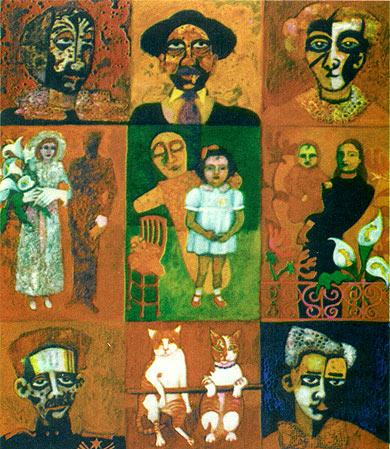 eu e a minha família
How do you briefly define your life in two phases: before and after Cape Verde? What changed with coming here in 75?
In fact, my life is divided into these two phases. I took 30 years of fascism in Portugal, and my life there was a constant fight against the regime, in all ways but not connected to political parties; I was never able to join because it would be against my principles of independence. I talk about fighting seriously, with strikes and everything subversive we could do (except placing bombs). In the Fine Arts we have already tried to introduce different things other than what was usually done. The fight was accompanied by a great dislike, a feeling that it would never end, many people were exhausted, young people who could no longer do anything, neither in the theater, nor in poetry, visual arts, etc.
A dark phase.
Yes. My father died without seeing the April 25th, he who had helped me fight and taught me some exceptionally good principles. April 25th marks a turning point, a moment of tremendous liberation, which was followed by the possibility of liberation for the former colonies as well, and thus the dream of coming to Cape Verde began to take shape.
Did your first encounter with Cape Verde come through the painter Manuel Figueira?
Yes, we were classmates for four years in the Fine Arts and he talked a lot about the paradise that was Cape Verde. The political side was also interesting: Whoever liberated Portugal also liberated the rest, and at the same time, the liberation fights of the African people also made a major contribution. And I joined Manuel back to his land, with a lot of hope, utopia, and certainty that we could help. In fact, I started a different life. When I got here, I was completely involved in the problems of the Cape-Verdean people, the news from Portugal were very blurred and I was shutting down. And then began our other struggle that was to make the Cape Verdean culture have visibility and projection, everything that was popular or traditional art, revitalizing what was dying, giving the notion that it was a capable people, along with our personal journey as pioneering painters.
You soon realized that in Cape Verde there was a lot of talent and creativity.
Yes, all peoples have great cultural and artistic potentials. We need to encourage them, cheer them up, and demonstrate their creativity in every way. In Portugal, there had been great persecution of intellectuals and anti-fascist artists. Many fled to Paris and other destinations and only in 1974 began to return to dignify Portuguese culture and arts.
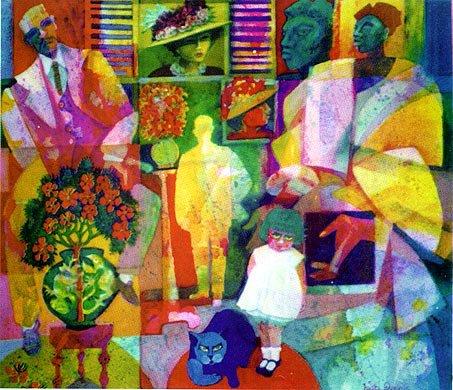 Mãe de Fidje
How did the research on popular art and the idea of forming a cooperative begin?
Since we were art teachers, Bela Duarte and I in middle school and Manuel Figueira in high school, we took advantage of the fact that we had students from all the islands to launch an awareness campaign, an appreciation of everything Cape Verdeans knew how to do in the field of crafts, and, through them, to gather valuable knowledge, even of skills that were already on the verge of disappearing and in the possession of elderly relatives. It was extremely useful. News emerged from all the crafts and rare objects which we were using in our exhibitions. Also, Belle and I joined the classes and, with the sea as the generating theme, we came to teach the fishermen at the Rua da Praia. We learned how to make fishing nets and heard many stories about the harsh life at sea and its wonders. Based on this knowledge, I taught my geometry classes, and some remarkably interesting works emerged in what is known as “free drawing,” with students letting go of their inhibitions and being creative. Naturally, while these experiences were immensely popular with the students, there was some open and unpleasant resistance from certain teachers. Due to the innovation, to the change of attitudes, etc. But the curriculum kept changing, and there was a period of complete renovation. Later, the idea of forming the Resistance Cooperative emerged, inspired by the cultural resistances of these people, the work of Amílcar Cabral, which, although involved in the armed fight, wrote about the cultural resistance of the peoples of Guinea and Cape Verde and our own experience of having to resist mediocrity and the prepotency of the “powers”.
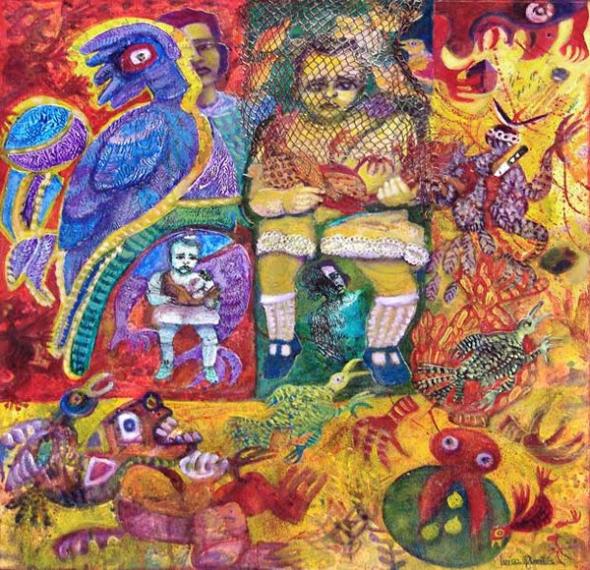 Passá Korbu
Who were the people who formed the Resistance Cooperative?
The people who formed it in 1976: me, Manuel Figueira, Bela Duarte, Alexandrina Freitas, Mercedes Leite and Clementina Chantre. We had with us the great weaver Nhô Griga of Santo Antão, from which we learned everything about traditional weaving, from building the looms and accessories to washing the wools. Later Manuel brought another great weaver from Cutelo Gomes in Santiago, Nhô Damásio, who came to teach the tradition of the fine cloth – “bitcho” and “Obra”, as well as the carders and spinners Nha Joana and Nha Antónia, also from Santo Antão. Young people joined us and so we started a remarkable experience that was to combine the erudite knowledge we brought from Portugal with the popular and traditional ones from Cape Verde, which we would deepen later, in the National Centre for Art, Crafts and Design.
Therefore, did the cooperative involve training artisans, providing education, and cataloging pieces and techniques?
Yes, we settled in the old house that had once been the first English consulate, we established statutes and shared all the tasks — sweeping, teaching, learning, etc. Not only did we revitalize the tradition of weaving, but we also introduced two new arts, the batik and tapestry, as well as disciplines such as Art History, Painting Technologies, and drawing. The Cooperative was the foundation, the birthplace of many ideas such as the museum, library, design, etc.
It is very noticeable that people here tend to remain within their own field. Anything that is even slightly different is immediately rejected, leading to a general lack of interest.
It is true, it resists innovation a lot, especially if they are in a regime of cultural militance as was our case. The political power itself is immediately suspicious.
Could it have something to do with 500 years of brainwashing that tells us everything from Africa is bad? People here are in limbus between two influences: Africa and Europe.
Throughout the colonial period, many complexes and myths were created that conditioned behaviors, but after Independence we expected a different attitude, more enthusiasm from teachers, and even a more pronounced patriotism. Our initiative was transparent and culturally and economically very valid.
Interview originally published in Dá Fala magazine nº4, Mindelo, 2005
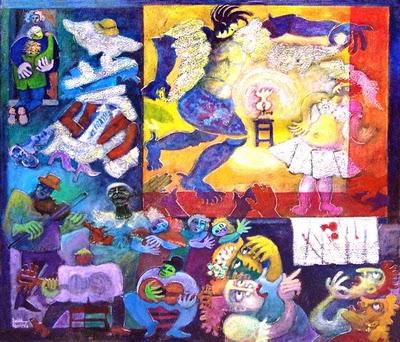 Lumdum
SHIPWRECKS and ABANDONED BOATS
How did all this start?
1941 Perhaps it all started on a first trip, my great crossing of the SPACE, sailing the blue, violet, green, yellow, and red waves… and then, with the help of MATERNAL WATERS, draining into this world, born as PISCES my protective, creative, and LIQUID sign.
1972 Much later, leaving my country, it was WATER once again that led me, aboard the Niassa ship, to reach the red land of Manuel Figueira – the island of S. Vicente.
That same year, on a trespassing adventure, I saw myself on my way to St. Antão in a boat called Carvalho, a little bit more than a dinghy, a surfboard riding the turbulent waves of the canal sea. From that emotion verging on PANIC, I would years later create my first painting of a pre-shipwreck, titled “Dona, ca bocê senti medo, a hoje mar stá calmo!” (Ma’am, you are scared, but today the sea is calm!), in tribute to the man who kept repeating this phrase to me throughout the journey to ease my distress.
1984 But the first SHIPWRECK, inspired by the poetry of Ovídio Martins, “Nôs Morte”, emerged in the eighties. Poetry and painful longing sung by Nhô Balta, revived my feelings, fears, and solidarity and, with the title of “Quem é q’ morrê?”, some works were born. Tapestry, painting, batik and engraving remembering that “qond quel bôte tcheu de pêscador perdê na nôte – NÔS TUDE MORRÊ UM C’ZINHA” (When that boat full of fishermen got lost in the night, we all died a little).
1992 A childhood passion – comics – forced me to agree to participate in a contest sponsored by UNESCO and the NATIONAL CULTURE CENTER, with the comic “As Ilhas da outra face da Lua”. On this adventure I wrecked a small vessel of the caravel commanded by Diogo Afonso, who was heading to a newly discovered island (1460). The three shipwrecks plus the cats, seeds and doves were saved by the CREATURES or ENCHANTED BEINGS who lived at the bottom of the seas around the islands, and they stayed with them, LIVING FOREVER.
1993 More dramatic and real, it was the shipwreck of the Celina boat with the fishermen Tomé, Eusébio and José. Lost while traveling from Maio Island to Pedra Badejo – S. Tiago (1991), they experienced a terrible odyssey, crossing the Atlantic in 45 days, suffering from hunger, thirst, hallucinations, and despair (the death of José), and were eventually rescued by Brazilian fishermen off the coast of Ceará – Brazil! Tomé, in an interview, said about a Warrior who refused their help… People?! NO… THEY WERE DEMONS! This sentence gave the title to the painting I performed based on the history of these brave sailor fishermen.
1996 Also dramatic and kind of true, kind of fiction was the wreck of a massive swarm of locusts that attempted to travel from Mauritania to any land of refuge. The drowned formed a makeshift raft, onto which the remaining survivors climbed and set off on a series of adventures until they reached S. Vicente, the “dream land.” This was a tale that I created and illustrated with the title of Saaraci, the last grasshopper in the Desert, paying tribute to all those who risked their lives to make their dreams come true… even when facing death.
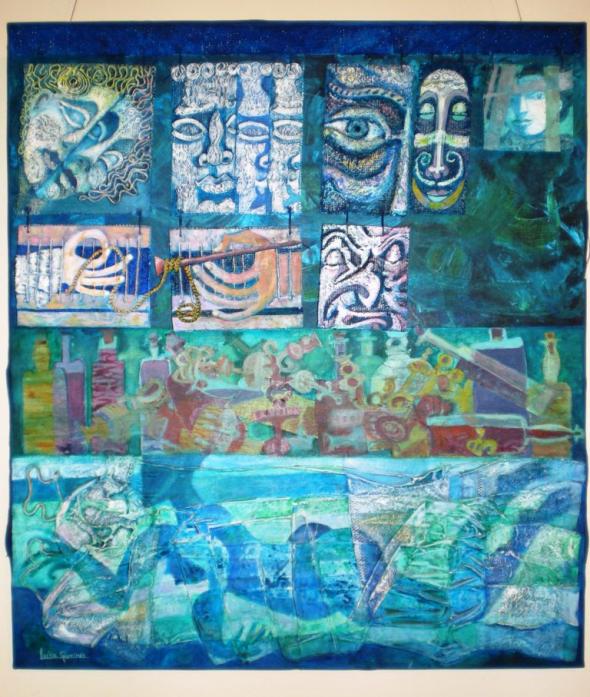
2004/2008 These specific shipwrecks, scattered across time, were followed by a series of works with a common and planned theme which, accompanied by my interest in the abandoned boats at Cova d’Inglesa or Galé, would come to encompass photographs, drawings, sketches, paintings, and a few sculptures, to which I gave the general title “Shipwrecks and Abandoned Boats”.
For the creation of large-scale works with no canvas, contributions to historical details came from the documentary “Tesouros de Cabo Verde” (Treasures of Cape Verde), broadcast on RTP 2’s Bombordo program, based on the work of the Arqueonautas team, which classified and collected artifacts from many shipwrecks in the waters off Cape Verde.
Later the appearance of the book “Cape Verde – On the Shipwreck Trail” by Emanuel C. D’Oliveira – “Monaia” ― who was part of the Arqueonautas team, enriched my knowledge, and new works emerged. I also sign the book by Artur Vieira, “Matilde – viagi di distino” that inspired me for the painting “Matilde – night of pain and prodigies”.
2008 Two different works, called Soul Wrecks, complete this cycle. The first work, titled *The Fragile Boat of Shipwrecked Children*… with the eternal hope of finding them again in a safe harbor, is dedicated to all the children of the world, victims of VIOLENCE, and features Maria, a six-year-old girl who, in Lisbon, gave me a tiny, fragile little boat made of dried petals and half a fruit pit, which I incorporated into my canvas as one of the main characters.
The other painting – The Old Boat of the Wrecked Women – is a protest and a condemnation of violence against women. The main figure is the face of Hajara Ibrahim, a Nigerian woman sentenced to death by stoning who was saved by international petitions. This face features collages of other dead or suffering women, as universal symbols, as well as the old boat of those who, unfortunately, have already been wrecked.
1992/2008 As for the ABANDONED BOATS, which I visited for years, witnessing the profound transformations caused by the winds, the tides, and ultimately the destruction of their remains, they evoked aesthetic reactions in me, revealing new shapes, colors, textures, and emotions, feeling the life of the boats as the life of people who gradually lose parts of themselves, growing old and dying, full of hidden stories to offer to those who know how to understand and LOVE them.
The most emblematic case is the Vaporim d’aga of Cova d’Inglesa, that for almost fifteen years I followed, photographed, and saw it die.
2006/2008 THE SCULPTURES. New forms of expression, an escape from the flat canvas to capture the depth required for my underwater discoveries, when I go diving (virtually) off the coast of Grã Praia, where, in the depths, lie the remains of the Dromadaire, which sank in 1762. They are the Big bird of the blue egg; Romeo; Juliet; and Giordano Bruno. They inherited the textures of the old boats, the rusts, the small animals encrusted, the colors of the algae…
Luísa Queirós
S. Vicente, Cape Verde, October 2008


