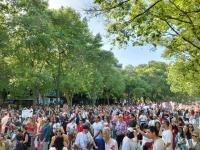
 It is thrilling to feel the wave of diverse people “going out into the streets (avenues, I`m sorry) with carnations in their hands at set times”. I am a cell from this mass of water and flesh for decades, and it has been exciting to see the revolution day reactivate, gain pulse and multitude, more cause and watchwords. I recognize the 25th of April on my path, as if I practiced every day, and I have been thinking in our generation’s place: the children of the 25th of April, that came after the end of the dictatorship to put in practice freedom, with so many possibilities to blossom and always so complaining. We went through the analogical to the digital, from heroin to amphetamine, from post-Cold War to global crises, between celebrating and the fear of losing… the social State, the work, the home, the spirit.
Mukanda
19.05.2026 | by Marta Lança
 In contemporary Portuguese cinema, the question is to know how to represent the revolution. How can the revolution’s temporality be reconfigured in the present? How can it be made present and not past? How can the archives of the revolution’s political strength be restored? If the crossing of history is always a critical operation and if the historical approach implies a process of identification with past events, for contemporary Portuguese filmmakers — especially the children of the revolution — these vast archives and this impressive cinematic corpus place the question outside of the reach of any historicism.
Afroscreen
27.10.2013 | by Raquel Schefer
 While some commentators and journalists have dismissed Occupy Wall Street as carnival, lawmakers and policemen did not miss the point. Carnival per se, the Shrovetide festival, hardly exists in the United States anymore, save for Mardi Gras in New Orleans and the West-Indian American or Labor Day Parade in Brooklyn, a pan-Caribbean celebration.The carnivalesque, however, as medium of emancipation and instrument of political protest, is alive and well. (...) Carnivalesque protests are a staple of the anti-corporate globalization movement.
City
18.10.2011 | by Claire Tancons
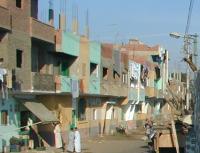 The virtual space of communication through social networks took part in the square’s new configuration, as in some way participated the space created by the window that we all opened. Even more determinant was the physical and real presence of the demonstrators and their capacity for resistance. The occupation of the square leads us to rethink public space, but the question that is imposed is what will then have to change so that Tahir Square can maintain the new configuration it conquered, a place of intervention, communication and meeting, and that it doesn’t go back to its old condition of museum space for tourists and road circulation?
City
28.04.2011 | by Cristina Salvador