CPPD Festival »Voices Rising: Memory Unsilenced«
After the Carnations – Cycles of Decolonisation and Democratic Futures
24 & 25 April 2026 | Biblioteca de Alcântara – José Dias Coelho, Lisbon
Am 24. und 25. April 2026 findet in Lissabon das 2. CPPD Festival »Voices Rising: Memory Unsilenced« statt. Höhepunkt des Festivals ist die Eröffnung des Dynamic Memory Lab „Cycles of Decolonisation“, gemeinsam mit den Kurator*innen Dr Cátia Severino und André Soares. Das Eröffnungsprogramm umfasst Performances, musikalische Beiträge sowie eine Podiumsdiskussion. Die Veranstaltung findet auf Portugiesisch und Deutsch statt.
PROGRAMM
CHORPERFORMANCE
24. April 2026 | 18 Uhr
Ein Chor interpretiert zentrale politische Lieder u. a. von José Afonso, José Mário Branco und Adriano Correia de Oliveira, die eng mit der portugiesischen Diktatur und der Nelkenrevolution verbunden sind. Die musikalische Performance macht Geschichte hörbar und schafft einen kollektiven Raum des Erinnerns und Widerstands.
PANEL DISKUSSION
After the Carnations – Cycles of Decolonisation and Democratic Futures
24. April 2026 | 18:30 Uhr
mit Dr. Iolanda Évora, Dr Ibou Diop & Dr Cátia Severino
Lange Zeit wurde Sichtbarkeit in Erinnerungskulturen und -politik als etwas verstanden, das institutionell durch Museen, Lehrpläne und offizielle Gedenkfeiern gesteuert wurde. Dieses Modell wird zunehmend in Frage gestellt. Heute entfaltet sich das Gedenken auf dezentrale und kollaborative Weise, geprägt von Gemeinschaften und gemeinsamen Praktiken. Dieser Wandel ermöglicht zwar neue Stimmen und neue Formen der Sichtbarkeit, wirft aber auch wichtige Fragen nach Legitimität, Verantwortung und Solidarität auf: Wessen Erinnerungen stehen im Vordergrund? Welche bleiben ungehört? Und wie kann kollektives Gedenken jenseits institutioneller Kontrolle aufrechterhalten werden?
In diesem Zusammenhang ist es entscheidend, sich mit dem Erbe des europäischen Kolonialismus auseinanderzusetzen. Es bedarf langfristiger und gesellschaftlich wirksamer Strategien der Dekolonialisierung, und sowohl künstlerische als auch partizipative Ansätze können eine Schlüsselrolle bei der Gestaltung dieser Prozesse und der Förderung einer widerstandsfähigen Erinnerungskultur spielen. Die Podiumsdiskussion findet am 24. April, am Vorabend des Jahrestags der Nelkenrevolution, statt und reflektiert über die Rolle der Erinnerungskultur im heutigen Europa. Sie bringt Mitglieder des europäischen CPPD-Netzwerks und portugiesische Expert*innen zusammen. Dr. Ibou Diop wird „Kolonialismus erinnern“ vorstellen, ein stadtweites Gedenkkonzept für das Land Berlin, das sich für die kritische Einbindung der Kolonialgeschichte in die Bildungs- und Bürgerpraxis einsetzt. Dr. Iolanda Évora bringt Perspektiven aus ihrer Arbeit im europäischen Projekt Democracy in Action, insbesondere im Bereich Race, Ethnicity and Civic Participation, ein und greift dabei auf ihre vorherige Tätigkeit als Koordinatorin des Projekts Afro Port zurück. Die Diskussion wird von Cátia Severino moderiert.
PERFORMATIVE LESUNG
»The Notebook of Colonial Memories«
24. April 2026 | 19:30 Uhr
mit Isabela Figueiredo
In einer szenischen Lesung werden Auszüge aus dem autobiografischen Werk von Isabela Figueiredo performt, das koloniale Gewalt in Mosambik aus der Perspektive eines jungen Mädchens erfahrbar macht. Die Lesung verbindet persönliche Erinnerung mit politischer Geschichte und beleuchtet die Ambivalenzen kolonialer Machtverhältnisse.
ERÖFFNUNG
Dynamic Memory Lab »Cycles of Decolonisation«
24. April 2026 | 20 Uhr
Das Dynamic Memory Lab „Cycles of Decolonisation“ lädt seine Besucher*innen ein, sich mit einem zentralen Thema unserer Erinnerungskultur auseinanderzusetzen: der europäischen Kolonialgeschichte und der Entkolonialisierung. In einer immersiven und interaktiven Ausstellung werden die Besucher*innen mit dem Erbe des europäischen Kolonialismus und seinen heutigen Erscheinungsformen konfrontiert. Die Ausstellung legt einen besonderen Schwerpunkt auf die Strukturen der Entmenschlichung, die bis heute wirksam sind. Sie versucht, die mit der Entmenschlichung verbundene Unsichtbarkeit aufzubrechen und rückt den menschlichen Aspekt in den Mittelpunkt unserer Aufmerksamkeit.
»Cycles of Decolonisation« wurde unter der Kuration von Cátia Severino und André Soares entwickelt, mit Beiträgen von europäischen Künstler*innen, Aktivist*innen und Wissenschaftler*innen des CPPD. Die Kurator*innen lenken unseren Blick auf die Kontinuitäten des europäischen Kolonialismus. Am Beispiel von Lieferfahrer*innen zeigen sie uns die heutigen Erscheinungsformen, in denen das Erbe des europäischen Kolonialismus bis in die Gegenwart fortbesteht. »Cycles of Decolonisation« veranschaulicht, wie zeitgenössische Wirtschaftssysteme koloniale Dynamiken wiederholen können, auch ohne die direkte Gewalt und territoriale Besetzung, die mit der historischen Kolonialisierung verbunden sind.
Nach Stationen in Berlin und Madrid wird das DML „Cycles of Decolonisation“ in der Biblioteca de Alcântara – José Dias Coelho in Lissabon eröffnet und ist dort bis September 2026 zu sehen.
PERFORMANCE
Ribbons
24. April 2026 | 18-21 Uhr
mit Renee van Bavel
In der Live-Performance RIBBONS näht die Künstlerin gesammelte Gedenkschleifen aus internationalen Erinnerungsorten zu einem fortlaufenden, kollektiven Kunstwerk zusammen. Die Arbeit verbindet unterschiedliche Geschichten, Perspektiven und Formen des Gedenkens zu einer gemeinsamen, transnationalen Erzählung. Als offene und wachsende Praxis lädt RIBBONS dazu ein, über Erinnerung, Gegenwart und die Möglichkeiten von Zusammenhalt und Frieden nachzudenken.
*Das gesamte Programm am 24. April ist öffentlich zugänglich.
> Anmeldung für das Programm am 24.4.
WORKSHOP & FÜHRUNG
From Revolution to Reflection: Embodying April 25 in Collective Memory
25. April 2026 | 13-17 Uhr
Mehr als fünf Jahrzehnte später besteht der jährliche Marsch am 25. April als eine Form verkörperter Erinnerung fort, in der Erinnerung nicht nur erinnert, sondern durch kollektive Präsenz im öffentlichen Raum praktiziert wird. Diese performative Kontinuität zeigt, wie die Revolution über Generationen hinweg gelebt, weitergegeben und neu gedeutet wird. Zugleich artikulieren und beanspruchen unterschiedliche gesellschaftliche Gruppen den 25. April auf jeweils eigene Weise, wodurch Spannungen, Leerstellen und konkurrierende Narrative darüber sichtbar werden, was die Revolution war und was sie bis heute einfordert.
Der Workshop und die Führung werden von den CPPD-Mitgliedern Dr Cátia Severino und André Soares durchgeführt.
*Das Programm am 25. April richtet sich an CPPD-Mitglieder.
CPPD Festival »Voices Rising: Memory Unsilenced«
After the Carnations – Cycles of Decolonisation and Democratic Futures
24 & 25 April 2026 | Biblioteca de Alcântara – José Dias Coelho, Lisbon
On 24 and April 2026, the 2nd CPPD Festival “Voices Rising: Memory Unsilenced” will take place in Lisbon. Together with CPPD members Cátia Severino and André Soares, the Dynamic Memory Lab “Cycles of Decolonisation” will be opened at the Biblioteca de Alcântara – José Dias Coelho, following its previous stations in Berlin and Madrid. The opening programme includes performances, musical contributions, and a panel discussion. The event will take place in Portuguese and German with simultaneous translation.
PROGRAMME
CHOIR PERFORMANCE
24 April 2026 | 6 pm
The choir performs key political songs by José Afonso, José Mário Branco and Adriano Correia de Oliveira, closely associated with the Portuguese dictatorship and the Carnation Revolution. The musical performance makes history audible and opens a collective space for remembrance and resistance.
PANEL DISCUSSION
After the Carnations – Cycles of Decolonisation and Democratic Futures
24 April 2026 | 6:30 pm
with Dr Iolanda Évora, Dr Ibou Diop & Dr Cátia Severino
For a long time, visibility in memory cultures and politics was understood as something institutionally managed through museums, curricula, and official commemorations. This model is increasingly being challenged. Today, remembrance unfolds in decentralised and collaborative ways, shaped by communities and shared practices. While this shift enables new voices and new forms of visibility, it also raises important questions of legitimacy, responsibility, and solidarity: Whose memories are foregrounded? Which remain unheard? And how can collective remembrance be sustained beyond institutional control?
Within this context, addressing the legacy of European colonialism is crucial. Long-term and socially effective strategies of decolonisation are needed, and artistic as well as participatory approaches can play a key role in shaping these processes and fostering a resilient culture of remembrance. Taking place on 24 April, on the eve of the anniversary of the Carnation Revolution, the panel reflects on the role of remembrance culture in Europe today. It brings together members of the European CPPD network and Portuguese experts. Dr Ibou Diop will present Kolonialismus erinnern (Remembering Colonialism), a city-wide remembrance concept for the state of Berlin, which advocates for the critical integration of colonial history into educational and civic practice. Dr Iolanda Évora contributes perspectives from her work in the European project Democracy in Action, particularly in the field of Race, Ethnicity and Civic Participation, and draws on her previous role as coordinator of the project Afro Port. The discussion will be moderated by Cátia Severino.
STAGED READING
»The Notebook of Colonial Memories«
24 April 2026 | 7:30 pm
with Isabela Figueiredo
In a staged reading, excerpts from Isabela Figueiredo’s autobiographical work are performed, rendering colonial violence in Mozambique tangible through the perspective of a young girl. The reading interweaves personal memory with political history and highlights the ambivalences of colonial power relations.
OPENING STAGED READING
Dynamic Memory Lab »Cycles of Decolonisation«
24 April 2026 | 8-9:30 pm
The Dynamic Memory Lab »Cycles of Decolonisation« invites its visitors to engage with a central topic of our remembrance culture: European colonial history and decolonisation. In an immersive as well as interactive exhibition, visitors will be confronted with the legacy of European colonialism and its contemporary manifestations. The exhibition places a special focus on the structures of dehumanisation that remain effective in the present. It seeks to dismantle the invisibility associated with dehumanisation and places the human aspect at the centre of our attention.
»Cycles of Decolonisation« was developed under the curation of Cátia Severino and André Soares, with contributions by European artists, activists and academics of the CPPD. The curators direct our gaze to the continuities of European colonialism. Using the example of Food Delivery Riders, they show us the contemporary manifestations in which the legacy of European colonialism persists in the present. »Cycles of Decolonisation« illustrates how contemporary economic systems can repeat colonial dynamics, even without the direct violence and territorial occupation associated with historical colonisation.
After stations in Berlin and Madrid, the DML “Cycles of Decolonisation” will be opened at the Biblioteca de Alcântara – José Dias Coelho in Lisbon.
PERFORMANCE
Ribbons
24. April 2026 | 6-9 pm
with Renee van Bavel
In the live performance RIBBONS, the artist sews together commemorative ribbons collected from memorial sites around the world into an ongoing, collective artwork. The piece brings together different stories, perspectives, and forms of remembrance into a shared, transnational narrative. As an open and evolving practice, RIBBONS invites reflection on memory, the present moment, and the possibilities of togetherness and peace.
> Registration for the 24 April here
*The entire programme on 24 April 2026 is open to the public.
WORKSHOP & GUIDED TOUR
From Revolution to Reflection: Embodying April 25 in Collective Memory
25 April 2026 | 1-5 pm
More than five decades on, the annual April 25 march endures as a form of embodied remembrance, where memory is not only recalled but enacted through collective presence in public space. This performative continuity reveals how the Revolution is lived, transmitted, and re-signified across generations. At the same time, different social groups articulate and claim April in distinct ways, exposing tensions, silences, and competing narratives about what the Revolution was, and what it still demands.
The workshop and the guided tour will be conducted by CPPD members Dr Cátia Severino and André Soares.
*The programme on 25 April 2026 is intended for CPPD members.
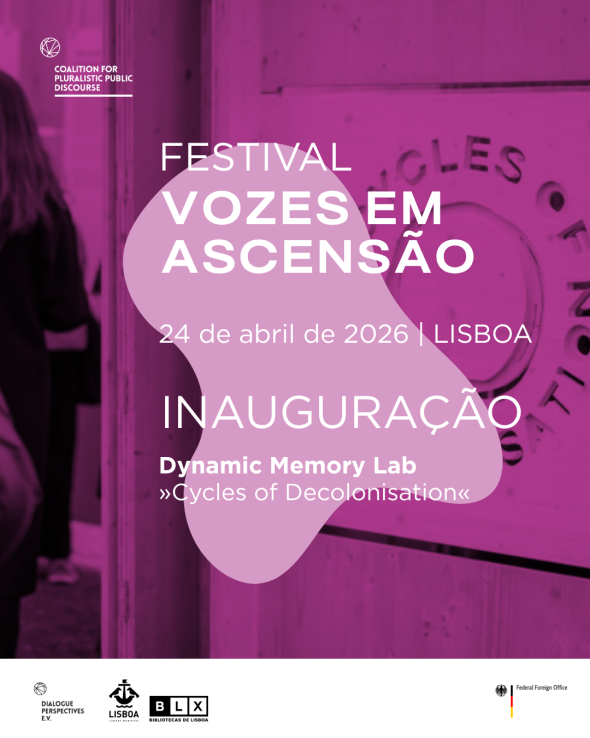
Festival CPPD »Vozes em Ascensão: Memória Sem Silenciamento«
Depois dos Cravos – Ciclos de Descolonização e Futuros Democráticos
24 & 25 de abril de 2026 | Biblioteca de Alcântara – José Dias Coelho, Lisboa
Nos dias 24 e 25 de abril de 2026, terá lugar em Lisboa a 2.ª edição do Festival CPPD “Vozes em Ascensão: Memória Sem Silenciamento”. Um dos destaques do festival será a inauguração do Dynamic Memory Lab “Cycles of Decolonisation”, juntamente com os curadores Dr.ª Cátia Severino e André Soares. O programa de abertura inclui performances, momentos musicais e um painel de discussão. O evento decorrerá em inglês, português e alemão.
PROGRAMA
PERFORMANCE DO CORO
24 de abril de 2026 | 18h
Um coro interpreta canções políticas centrais de, entre outros, José Afonso, José Mário Branco e Adriano Correia de Oliveira, estreitamente ligadas à ditadura portuguesa e à Revolução dos Cravos. A performance musical torna a história audível e cria um espaço coletivo de memória e resistência.
PAINEL DE DISCUSSÃO
Depois dos Cravos – Ciclos de Descolonização e Futuros Democráticos
24 de abril de 2026 | 18h30
com Dr Iolanda Évora, Dr Ibou Diop e Dr Cátia Severino
Durante muito tempo, a visibilidade nas culturas e políticas de memória foi entendida como algo gerido institucionalmente através de museus, currículos escolares e comemorações oficiais. Este modelo tem vindo a ser cada vez mais questionado. Hoje, a memória desenvolve-se de forma descentralizada e colaborativa, moldada por comunidades e por práticas partilhadas. Embora esta mudança permita novas vozes e novas formas de visibilidade, levanta também questões importantes de legitimidade, responsabilidade e solidariedade: Que memórias são colocadas em primeiro plano? Quais permanecem por ouvir? E como pode a memória coletiva ser sustentada para além do controlo institucional?
Neste contexto, é fundamental abordar o legado do colonialismo europeu. São necessárias estratégias de desconstrução colonial a longo prazo e socialmente eficazes, e abordagens artísticas e participativas podem desempenhar um papel importante na construção desses processos e no fortalecimento de uma cultura de memória resiliente.
Realizado a 24 de abril, na véspera do aniversário da Revolução dos Cravos, o painel reflete sobre o papel da cultura de memória na Europa contemporânea. Reúne membros da rede europeia CPPD e especialistas portugueses. Dr. Ibou Diop apresentará Kolonialismus erinnern (Remembering Colonialism), um conceito de memória à escala da cidade para o estado de Berlim, que defende a integração crítica da história colonial nas práticas educativas e cívicas. A Dra. Iolanda Évora traz perspetivas a partir do seu trabalho no projeto europeu Democracy in Action, em particular na área de Race, Ethnicity and Civic Participation, e baseia-se na sua anterior função como coordenadora do projeto Afro Port. A discussão será moderada por Cátia Severino.
LEITURA PERFORMATIVA
»The Notebook of Colonial Memories«
24 de abril de 2026 | 19h30
com Isabela Figueiredo
Numa leitura encenada, são apresentados excertos da obra autobiográfica de Isabela Figueiredo, que torna tangível a violência colonial em Moçambique a partir da perspetiva de uma jovem rapariga. A leitura articula memória pessoal e história polltica, evidenciando as ambivalências das relações de poder coloniais.
INAUGURAÇÃO
Dynamic Memory Lab »Cycles of Decolonisation«
24 de abril de 2026 | 20-21h30
O Dynamic Memory Lab »Cycles of Decolonisation« convida o público a envolver-se com um tema central da nossa cultura de memória: a história colonial europeia e os processos de descolonização. Numa exposição imersiva e interativa, os visitantes serão confrontados com o legado do colonialismo europeu e as suas manifestações contemporâneas. A exposição dá especial atenção às estruturas de desumanização que continuam a produzir efeitos no presente. Procura desmontar a invisibilidade associada à desumanização e colocar o elemento humano no centro da nossa atenção.
»Cycles of Decolonisation« foi desenvolvido sob a curadoria de Cátia Severino e André Soares, com contributos de artistas, ativistas e académicos europeus do CPPD. Os curadores direcionam o olhar para as continuidades do colonialismo europeu. A partir do exemplo dos Estafetas de Plataformas Digitais, mostram de que forma o legado do colonialismo europeu se manifesta ainda hoje. »Cycles of Decolonisation« ilustra como os sistemas económicos contemporâneos podem reproduzir dinâmicas coloniais, mesmo sem a violência direta e a ocupação territorial associadas à colonização histórica.
Depois de ter passado por Berlim e Madrid, o Dynamic Memory Lab “Cycles of Decolonisation” será inaugurado na Biblioteca de Alcântara – José Dias Coelho, em Lisboa.
PERORMANCE
Ribbons
25 de abril de 2026 | 18-21h
com Renee van Bavel
Na performance ao vivo RIBBONS, a artista costura fitas comemorativas recolhidas em locais de memória por todo o mundo, criando uma obra coletiva em constante desenvolvimento. A peça reúne diferentes histórias, perspetivas e formas de recordação numa narrativa transnacional partilhada. Como prática aberta e em evolução, RIBBONS convida à reflexão sobre a memória, o presente e as possibilidades de união e paz.
> Inscrição para o programa de 24 de abril
* Todo o programa de 24 de abril é aberto ao público.
VISITA GUIADA & WORKSHOP
Da Revolução à Reflexão: Incorporar o 25 de Abril na Memória Coletiva
25 de abril de 2026 | 13-17h
Mais de cinco décadas depois, a marcha anual do 25 de Abril mantém-se como uma forma de rememoração incorporada, em que a memória não é apenas evocada, mas encenada através da presença coletiva no espaço público. Esta continuidade performativa revela como a Revolução é vivida, transmitida e ressignificada ao longo das gerações. Ao mesmo tempo, diferentes grupos sociais articulam e reivindicam o “Abril” de modos distintos, expondo tensões, silêncios e narrativas concorrentes sobre o que foi a Revolução e sobre aquilo que ela ainda exige.
O workshop e a visita guiada serão conduzidos pelos membros da CPPD, Dra. Cátia Severino e André Soares.
* O programa de 25 de abril de 2026 destina-se a membros da CPPD.