When the lions take up the RED
Hunting season is done, and the hunted have the word
Opening shot
There is a certain poetic justice in seeing New Hunting Narratives rise to the top of the RTP Play streaming rankings within days of its premiere on the platform. After all, for all its history, Portugal has grown used — badly used — to looking at Black, African and Afrodescendant bodies within its social fabric as a problem, a threat, as music, as service or labour force, as an exotic curiosity, a desirable body, a suspicious body, a statistical body — a body spoken about, but rarely truly engaged with.
And then, suddenly — or perhaps not — and provocatively, in the best sense of the word, those bodies emerge, emboldened in front of the camera and behind it: writing, directing, performing, hesitating, failing, landing blows, clearing paths, possibly causing mild tachycardia in the unsuspecting Chega electorate who might accidentally stumble upon one of the most watched series in Portugal.
The hunt is over. Now those once hunted get to speak.
The proverb behind the series — “until the lions tell their own stories, the hunters will always be the heroes of hunting narratives” — could easily have become a decorative slogan, the kind institutions like to place in press releases when they want to look brave without moving too much furniture around. But here, the sentence carries consequences. New Hunting Narratives, an anthology of seven standalone episodes produced by Many Takes and Galo Bravo, in co-production with RTP, is more than a series about Black characters and Afrodescendant Portuguese people in search of identity and belonging. By its mere existence, it shifts the moral centre of the image. Going from greenlit to broadcast shifts the question from “how are Afrodescendant bodies represented in Portugal?” to “what happens when those subjects stop being raw material and become the authors of their own grammar?”
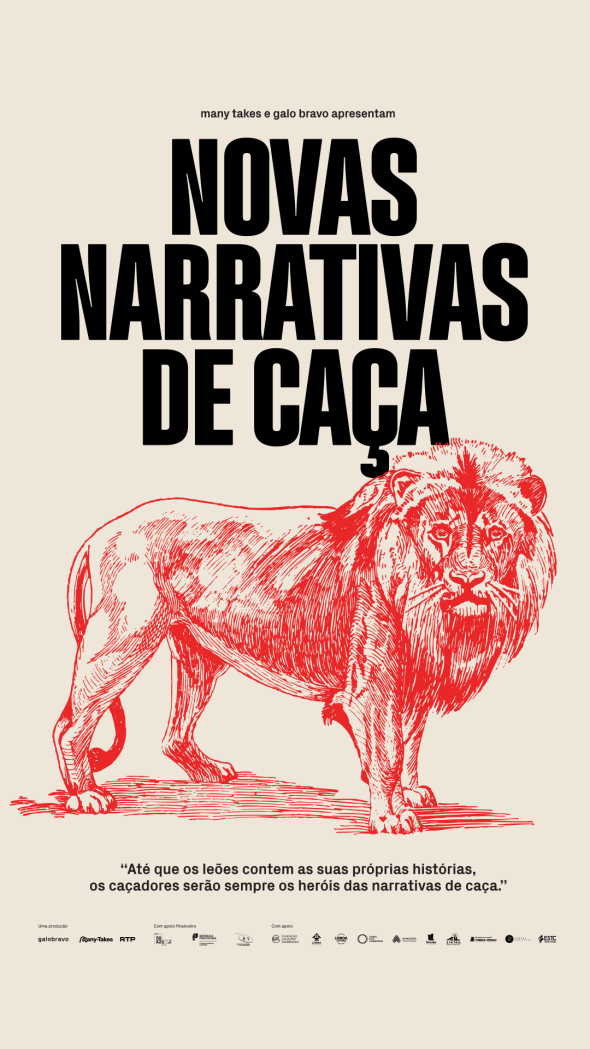
The original idea is by Luís Almeida’s, who also leads creative direction and showrunning alongside Víctor Lemos. From there, the series opens itself to a constellation of Afrodiasporic voices: Gisela Casimiro, Lara Mesquita, Fábio Silva, Dércio Tomás Ferreira, Diogo Gazella Carvalho and Cláudia Semedo. This is not a technical detail. It is the event itself. The series does not simply try to include Black protagonists within a pre-existing televisual imaginary; it tries to change who imagines, who writes, who decides the tone, who chooses the silences and who measures the discomforts.
In an interview with Lusa News Agency, published by Comunidade Cultura e Arte, Luís Almeida explains that the project was born from the desire to “get to know and make known new audiovisual talents”: Afrodescendant filmmakers writing about what it means to be Afrodescendant in Portugal. The piece records a decisive wound: as a young professional, Almeida did not know any Black directors working in Portugal whose writing made him feel seen. This led him to question whether there was a way for him to even become a director. More than an abstract absence, that invisibility is a vocational sabotage.
And this is why New Hunting Narratives is more important than its critical score. A mainstream reading may find its vulnerabilities — stronger episodes, weaker episodes, dialogue that is at times predictable, genres that do not always land. All of this may be true. There is no problem in noticing the unevenness; there is one in making this score the only category of assessment, as if a 6.5 out of 10 could describe a sociocultural and political moment that extends far beyond a television programme.
Kitty Furtado (Ana Cristina Pereira) writes, here in Buala, about Black Cinema in Portugal as a transnational counter-public sphere: a field of images, voices and counter-discourses produced by Black, Afrodescendant, migrant, Afropean and Atlantic subjects who refuse to continue being merely the object of the official public sphere. It is a practice of counter-visuality: the right to look back, to alter the relationship between who looks and who has historically been looked at.
That is the field in which New Hunting Narratives must be situated. Not as an origin story — considering that before it there are films, authorships, debates, showcases, criticism, archives, research and communities rescuing memory and filming against erasure — but as a rare megaphone. By transforming that counter-public energy into a television format that is accessible, serialised and popular, and by reaching first place on a public platform, the series levels up from an iconic cultural object, and becomes political information.
In a recent text about the rather personal and cinematic experience of watching Denise Fernandes’s Hanami, I wrote from memory archives that included my grandmother’s burnt papaya tree, my father’s tears before the lava of Fogo, and from the dry smell of the island entering my body as omnipresent inheritance. Here, I write from another mental and emotional archive: small memories, incidents and fait divers the brain tries to forget. I source it from neighbourhoods where communities gather, where there is so much life and culture, but also scarcity and oppression. From rooms, events and tables where hospitality turns into a subtle interrogation: “but where is your family from?”, “oh, but your father is Capeverdean? You really don’t look it at all!” From the café owner who, hearing yet another headline on the television — always on — vilifies “the Blacks,” only to turn to my father, Joaquim, a regular customer, his bica at the counter, his wide-eyed son with thick curls beside him, and says: “come on, Joaquim, not you, you’re different.” From parties where my belonging is measured by the accent I carry in a broken Creole, a Frankenstein of my diasporic existence. And from the land of our parents, where we are loved before we know how to answer, with our whole body, the call of that belonging.
I watched New Hunting Narratives, thus, from that place, simultaneously familiar and uncomfortable, which many of us know well: inside and outside at the same time. Afrodescendant enough to recognise the microaggression before it has finished forming in the mouth of many a well-meaning Portuguese; diasporic enough to know the loneliness of not always speaking the language well, of dancing slightly out of step, of arriving in the land of one’s parents or grandparents as both relative and foreign body. The series does not explain these contradictions from above. It observes and lets them happen in living rooms, kitchens, offices, parties, supermarkets, journeys, farewells, silences.
That is why its value cannot simply be measured by the metric of “television quality.” It’s not about absolving the series of its problems; it is about asking why so many white, Portuguese, mediocre, exhausted, and derivative works were allowed to exist for decades without their authors having to justify their own existence — while the first Portuguese series created and led almost exclusively by Black and Afrodescendant artists arrives already burdened with the impossible expectation of being impeccable, moving, artistically definitive, politically pedagogical and somehow representative of us all. Whiteness was granted the right to the banal. Afrodescendance is still expected to prove it deserves the exceptional. Well, the thing is, it doesn’t have to.
Writing from the inside out
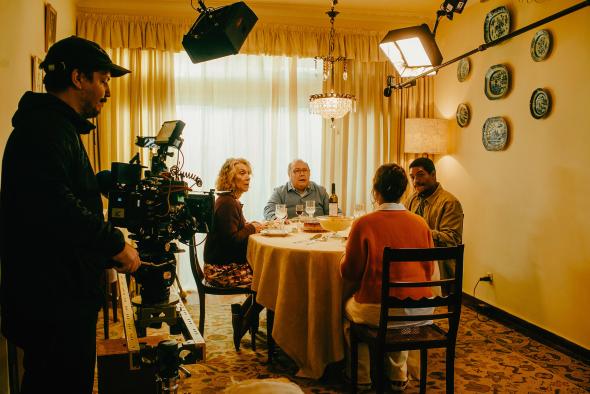
The creation of New Hunting Narratives should be understood, first of all, as an act of enormous curatorial authorship. Luís Almeida and Víctor Lemos organised a rare, if not unprecedented, device in Portuguese television: an anthology in which different Afrodescendant writers and directors contribute with their own universes, never being forced into an aesthetic unity that would have been both excessive and artificial. The through-line is not uniformity — it is the multiplicity of subtle experiences.
Naturally, the series does not encapsulate all the dimensions of Black and Afrodescendant Portuguese history. It cannot, and it does not try to. What it gives us instead are seven approaches, seven tonalities, seven doors into the same historical home: through domestic comedy, workplace thriller, racialised romance, drama of belonging, political dystopia, social realism, the journey of return. That home, or casa, is not the Portugal of the two-euro postcard, nor the Portugal of imperial self-pity, nor the one that imagines itself “mild-mannered” because it has never looked the violence of its own actions in the eye. This is the Portugal of mixed families, of children and grandchildren who speak Portuguese better than Kriolu but continue to be read as foreigners, of neighbourhoods that exploitative TV networks only remember to visit when riot police manufacture reasons to go in and overkill – sometimes literally –, and, most and foremost, this is the Portugal of the exhausted bodies of overworked immigrant fathers and mothers who, despite the effort and the stumbles, still aspire to more for their children.
The writing, it must be said, is less homogeneous than it would need to be. There are episodes in which the thesis is presented to the viewer before the character has been allowed to breathe, moments in which the dramaturgy seems determined to make sure nobody misses a political hook. But there are also scenes in which the series finds a truth rarely authorised in Portuguese fiction: that racism is not always explosive, not always an open insult or explicit violence. Often it is an innocuous living-room conversation, a café joke, a hurtful Instagram meme, an underhanded compliment, or even misplaced curiosity. It is the “look, don’t take this the wrong way, but”; it is the “I have many Black friends”; it’s the “but you’re different”; it’s the forced pedagogy we are occasionally summoned to perform when all we wanted was to eat dinner in peace, for fuck’s sake.
This anthology refuses a thematic enclosure. As Kitty Furtado reminds us, to think Black Cinema as a discursive movement must not trap its authors in the perpetual obligation to speak only about “Black themes,” whatever those are supposed to be. And so New Hunting Narratives allowed its Black and Afrodescendant creators to work with genre, intimacy, irony, romance, thriller, dystopia, family drama, desire. The right to full fiction includes the right to theme, and also the right to detour.
Tracking the Hunt, Episode by Episode
N.B: The episodic reviews that follow may contain spoilers. If you have not yet watched New Hunting Narratives, you may want to jump right to the Final Rounds section.
EP.01: Moamba: The Family Dinner and the Terror of Good People”
The opening episode, Moamba, bears Luís Almeida’s own signature. It introduces us to Leandro — in a phenomenal performance by Gonçalo Cabral — a young Portuguese man of Capeverdean descent, on the night he goes to meet the parents of his girlfriend: white, woke and activist q.b., of course. The device is simple: a family meal, a round table, four people, and a dizzying succession of comments and misunderstandings that transform social discomfort into a small chamber of liberal torture.
The comparison with Jordan Peele’s Get Out is irrefutable and immediate. But the strength of Moamba lies in not copying the narrative mechanism. Its horror is low to the ground, more Portuguese, more viscous, made of that second-hand embarrassment that makes you want to cover your face with your hands. Instead of a suburban cult metaphor, what we find here is the soft violence of good manners, that popular POV that allows anything to be said as long as its prefaced, caveated, or wrapped as a joke, genuine concern, ignorance, curiosity, or even a little saint brought by dad from “over there in Angola.”
Moamba understands that, in Portugal, racism rarely walks into the room wearing hobnailed boots. It explores that national specificity, filtered through the myth of the country’s legendary mild manners –– an illusion now visibly dissolving at the hands of radical right forces for which 20% of the country voted. How it most often shows its head is through structural exclusion, but also through pocket- racism and everyday xenophobia, the kind that asks where you are “really” from, and if you dare say the name of a Lisbon suburb, adds a laconic “okay… but what about your parents?” Or the kind that comments on your curls or your afro — “oh, they’re so cute, can I touch?” — and scorns at your name that doesn’t sound very Portuguese — or at least not, you know, old stock — and that wants to know whether the food is very spicy, and asks whether “over there in Africa” everything is like this or that, and that swears that whatever offensive elocution “was not meant in a bad way.” Of course it wasn’t. It never is.
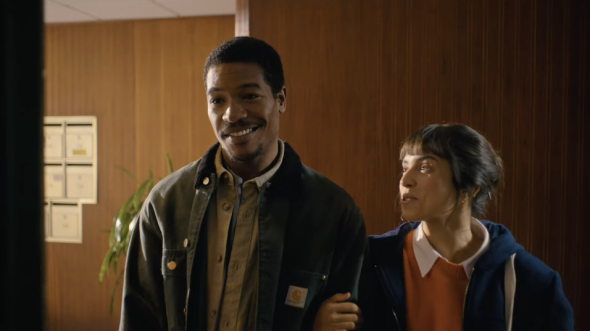
In Moamba, the family dinner, predicated on these cultural assumptions of contemporary Portugal, becomes a hide-and-seek, a kabuki sewamono — a domestic drama of the ordinary lives of ordinary people — in which Leandro is not merely being introduced to his girlfriend’s family, but implicitly assessed as a candidate son-in-law: the admissible Black body, the tolerable exception, the living proof of the supposed openness of that good Portuguese household, where they don’t hold anything “against Blacks or Brazilians.”
Gonçalo Cabral is decisive in not allowing his performance to live off other people’s embarrassment, but from recurring calculation. Leandro measures the space, measures the tone, measures the girlfriend, measures her parents, measures his own response. There is an underlying frustration and anger, albeit apprehensive and controlled, that cannot come out whole; a good education turned into armour; a desire to disappear and to dismantle the room at the same time. Anyone who ever sat in such a room knows that surviving this kind of family dinner requires more interior dramaturgy than a Chekhov play.
Luís Almeida’s direction manages this tension with taut efficiency, understanding the theatrical dimension of everyday microviolence. The round table becomes a stage, a court, a display case, a trap. The episode may be explicit in what it denounces, but that explicitness is anything but gratuitous, for some realities remain “subtle” only for those who never had to swallow them while smiling.
EP.02: Human Resources: The Disposable Black Body and of the Autofagia of Work
In Recursos Humanos, written by Gisela Casimiro and directed by Luís Almeida, the series moves into another territory and another genre: work, and camp horror. We follow Taís, played by Nuna, as she enters Chama Quente, an archetypal franchised burger joint where her sister Maya, played by Binete Undonque, worked before disappearing. Núria Serrote appears as Chantelle, an essential piece in this universe of suspicion, corporeality and survival.
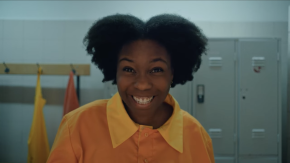
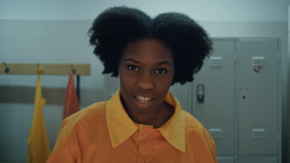
If the premise summons thriller and indie horror, the allegory runs deeper: the company as capitalist organism that literally consumes the body; under-employment as an economic trap; the discourse of opportunity as a mask for extraction. The episode approaches an Afro-horror and Afro-speculative lineage — the likes of Canadian filmmaker Lu Asfaha’s Fresh Meat, or Jordan Peele’s grammar in Us and Nope, by way of Amazon’s horror anthology Them — using genre to say what social realism often attempts to domesticate.
Recursos Humanos inhabits that zone. The Black body is not only exploited, but metabolised, and the word “resources” becomes less bureaucratic than autophagic. Work is presented as a supposed promise of social mobility and a device of capture: Taís does not find a job; she enters a building that consumes the Afrodescendant body, moving through a world that promises to integrate her, but perhaps only wants to devour her. Fortunately, there is an older, wiser woman nearby, one who no longer tolerates franchised narratives and assumes the mantel of the use of force as a way of restoring some justice — a resolution that finds echoes in the disturbing psychological thrillers Blink Twice (2024), by Zoë Kravitz, and Delicious (2025), by Nele Mueller-Stöfen.
Gisela Casimiro’s writing is interesting precisely because it summons that tension between allegory and concrete experience. A poet and performer with a sharp metric, she brings to this episode an acute awareness of institutional language, of the violence hidden in neutral vocabulary, of the ways people become functions, statistics, disappearances. When the suspense works, the thesis explains itself: the room, the corridor, the contract, the uniform, the music, the supervisor’s gaze — everything breathes conspiracy. In Moamba, the family home was the hunting ground. Here, through the episode’s allegorical logic, the company becomes a slaughterhouse.
EP.03: Once You Go Black: Desire, Fantasy and the Exhaustion of Objectification
The third episode, written and directed by Lara Mesquita, enters the territory of desire. Catarina Amaral plays Salomé, an actress who reconnects with an old Black schoolmate after yet another failed interracial relationship. The title, Once You Go Black, deliberately provocative, summons that familiar phrase loaded with boorish assumptions, cheap sexual cliché, utilitarian racial fetish, asking what happens to a relationship when desire turns us into social cachet, adventure, guilt or cultural argument, rather than respecting us as a human.
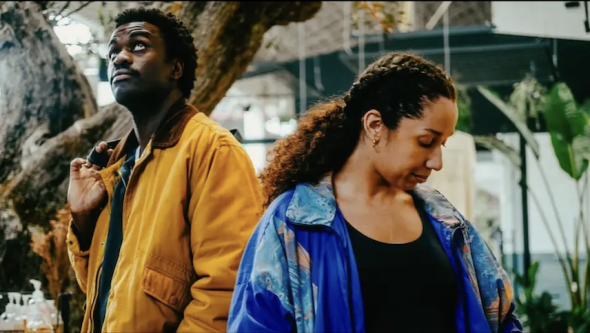
The episode bravely tackles one of the least discussed areas of contemporary Portuguese Afrodescendance: intimacy as a political field. Not the declaredly militant intimacy, mind you, but the kind in which the Black or Afrodescendant body is desired and dehumanised in the same gesture; where the interracial relationship is lived as modernity, transgression, rebellion or progressive self-image; where the other loves us, perhaps, but also loves what our difference allows them to feel about themselves — and convey to society.
There is here that particular exhaustion of realising one has entered someone else’s desire not as a whole person, but as a mental argument for the partner. Salomé allows us to discuss commodified Afrodescendance beyond the social wound and the intimate contradiction, beyond vanity, error, performance, self-deception, the desire to be seen and the fear of being reduced. The strength of Once You Go Black lies less in the shock value of its title than in what it dismantles: the fetish is not only external; it enters the way we learn to desire and be desired, and to negotiate intimate value in an affective market that is never neutral. Not least because it exists in this country of supposedly mild racism, borne out of a mythical lusotropicalism that conveniently forgets the archive of utilitarian sexual violence on which it was built.
EP.04: Limbo: Liminality, Fragmented Belonging, and Duality
The fourth episode, written and directed by Fábio Silva — whose previous work already explored this space of identity, memory and belonging — starts from the diffuse premise of the young Afrodescendant man who does not fit easily into the categories others try to ascribe to him. Nuno, played by Pedro Lopes and Artur, played by Ivo Arroja, showcase a territory of neighbourhood, male friendship, peripheral whiteness, recognition, and certain naivete. A dimension of recognition and validation is added by Edson (Teosson Chau). The series places us before a particularly contemporary question: what happens in the suburbs when skin, class, accent, neighbourhood and family memory do not coincide with easy maps of identity?
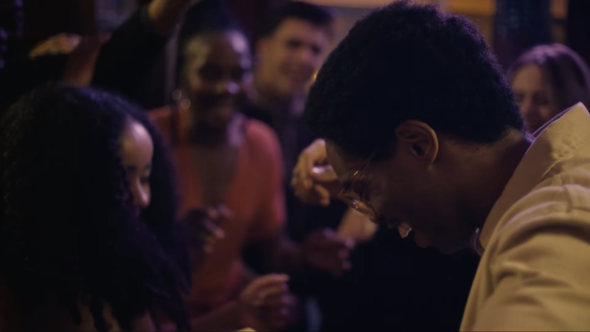
The word “limbo” suggests an absence of belonging. But the Afrodescendant experience is rarely that simple. It is not about belonging nowhere. It is about belonging in fragments to several spaces that do not always recognise one another, and that can never be one complete thing.
This episode invites the viewer to think about Capeverdean and Afrodescendant lives in Portugal without reducing the thought process to first-generation migration. It does not speak only of those who arrived. It speaks of us, children and grandchildren, people born or raised here, who master the codes of school, the white city, formal employment, normative language, but are returned to skin or social origin whenever the world needs to reorganise hierarchies. In a society that imagines integration as a staircase, Limbo reminds us of all the doors that staircase does not lead to.
The presence of Artur, the white kid from the hood, is particularly productive, avoiding caricature. And if peripheral whiteness is not bourgeois whiteness, it is not outside racial structures either. It may share poverty, street, friendship, precarity, language; it may also inherit, without noticing, a freedom of symbolic circulation that friends of another skin tone do not have, and maybe never will. The episode finds good material in this social space where white boys from the bairro, semi-fluent in Kriolu, in kizomba and cachupa, are themselves insider-outsiders to several communities.
Pedro Lopes and Ivo Arroja carry a tension more complex than the opposition between “Black” and “white.” The bairro can be community, but also test. The friend can be a brother, but also the cruel mirror of what one body can do without being read as a threat. Fábio Silva films this elusive space not as a sociological scenario or a postcard of the periphery, but as a place where belonging is negotiated according to rules nobody really wrote down, but everybody knows.
EP.05: Survivor: Dystopia and Social Anguish
The fifth episode, written and directed by Dércio Tomás Ferreira, is perhaps the anthology’s riskiest gesture. Sobrevivente imagines a dystopian Portugal, marked by civil war, political violence and Black survival in a world where the democratic mask has fallen. It is probably the episode of greatest conceptual ambition — and perhaps also the one most vulnerable to narrative fragility.
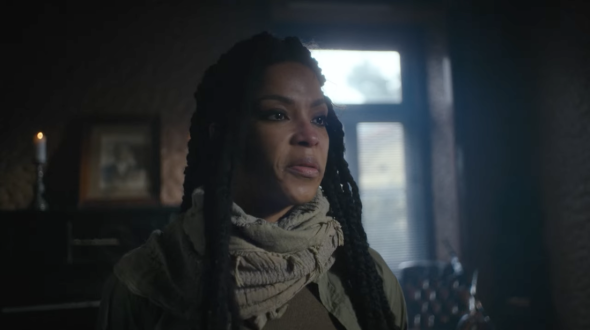
Racial dystopia can be powerful when it finds a precise form, or heavy when the allegory overwhelms content. Even where it stumbles, though, the gesture is pertinent: at a time when international far right movements are trying to control memory, school, culture, archives, language and bodies, dystopia stops being a distant exercise and becomes speculative realism with the volume all the way up. I think of R.T. Thorne’s recent 40 Acres, in which a family of Black farmers defend their land in a post-apocalyptic future. As in that feature, Sobrevivente is interested in sovereignty, body, territory and Black survival in a world where structural violence has stopped wearing institutional masks. And, need I remind us all, Portugal is currently a country where “This is not Bangladesh” is, for many, an acceptable thing to say.
Yet, the validity of an experiment does not automatically make it successful. If Sobrevivente is perhaps the least accomplished episode, that too can be thought through: perhaps dystopia required more resources; perhaps the world created needed more time to breathe; perhaps sexual and political violence, when compressed in this manner, risks becoming more a device than a narrative.
But even excess itself has meaning. At times, a country’s racial imagination is so repressed that only dystopia can say what realism keeps trying to negotiate and gently posit. Dmitri comes to mind — Y’lan Noel’s anti-fascist resistance leader in Gerard McMurray’s The First Purge — as do Elijah and Elias Moore, the brothers played by Michael B. Jordan in Ryan Coogler’s Sinners, who, armed with culture and community, begin to counterattack. Sobrevivente is a slap across the cheek of parochial extremism. It’s not a revenge fantasy, but a rather concrete nightmarish scenario for radicals types who always appear to expect oppressed Black bodies to remain docile and comply — not to survive, and to resist.
EP.06: Undeu: The Dramaturgy of the Dead End
Undeu, the sixth episode, written and directed by Diogo Gazella Carvalho, rests on a deep and versatile performance by Mavá José as Isaac, a young worker accused of stealing from the supermarket where he works and thrown into an existential spiral. The episode returns to social realism, but focuses less on poverty than on humiliation: accusation, lost job, wounded masculinity, emerging family responsibility, friendship as last refuge. Everything encapsulates a dramaturgy of precarity.
In Undeu, as in Recursos Humanos, labour precarity is not the background. It feeds a sequence of events imposed on an individual at the end of his rope. The exhaustion consuming this ordinary young man — Black, working class, complex, and easily accused — is born from his body being placed before an old social presumption: that certain people arrive in the world already guilty.
Mavá José has a difficult task here: to portray an Isaac who is morally compromised without reducing him to the exemplary victim he is not. The strength of the character depends on his right to failure — to react badly, think badly, love badly, try well, fall, get up, or not. Undeu allows Isaac to inhabit that uncomfortable zone of the whole person, pressured by forces that precede him and will survive him, yet still responsible for his gestures.
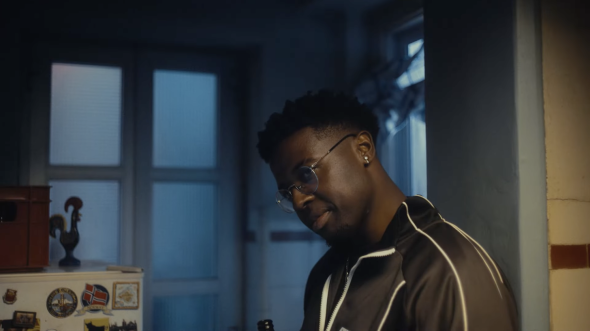
Diogo Gazella Carvalho’s direction throws itself headfirst into an excellent observation of the dichotomy of everyday spaces: the supermarket as central stage and a tribunal; the home as emotional refuge but also as the place where the pressure of social obligations is felt the most; the street as space of freedom and a space of surveillance. The strength of the episode lies in its ability to show that structural violence is explosive, yes, but also subtle: a word, an accusation, a dismissal, a silence.
EP.07: Codé: Returning to a Home That Is Both Love and Foreign Body
And then comes Codé.
This final episode, signed by Cláudia Semedo and starring Isabél Zuaa, is the emotional heart of the anthology. Not because it is necessarily the most perfect across every technical criterion, but because it seems to understand, more deeply, the wound that runs through so many Afrodescendant subjects: the journey to the land of one’s parents as both encounter and misencounter; the family that loves us before finding us; the language that recognises us before we can answer; the body received and embraced as one from inside, while inside it still asks for instructions.
In the wake of the international success of The Secret Agent, Isabél Zuaa adds pedigree to New Narratives, but in Codé, she is above all a presence of extraordinary emotional intelligence, delicate, sensitive, uncertain: Zuaa does not beautify the return, does not turn the journey into tourist epiphany, does not force her Cíntia to feel or act this way or that. She allows her to feel the ground under her feet, and lets her occasional awkwardness be awkward — until it no longer is.
Cíntia lands in Guinea-Bissau without her reluctant and stubborn father — a familiar story for many of us — carrying the affective grammar of someone who knows she belongs without knowing exactly how to belong. She is received with disarming love by people who are almost strangers and, perhaps for that very reason, far too close. She speaks little Kriolu, or speaks it badly. She dances unconventionally: the body betrays the distance and the white space in which she grew up. She laughs, watches, stumbles, finds herself uncomfortable but she allows Cíntia to sit in that discomfort. There is in her an intimate lack of social coordination that many of us will recognise from our own returns.
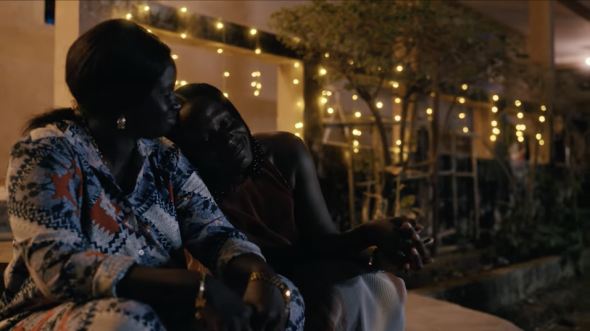
Those who have never arrived in the land of their parents with their body ahead of the soul may not fully understand what is at stake. The ancestral journey is often sold as simple return: we go back, we recognise, we belong. But reality is much rougher and, arguably, much more beautiful. We return and words fail us. We return and we are loved by strangers. We realise that our distance was also privilege. We feel ashamed of our accent, of what we do not know, of our clumsy dancing or the way we dress, sometimes of our skin or lighter eyes, even of our own caution. We discover that there was a part of us waiting for us there, but that this part does not necessarily speak the language we learned to use.
Codé is perhaps the episode that best demonstrates how belonging is not, at all, an achievement, but an interior wound, full of love, lifelong and sometimes impossible to heal.
And there is something to say about the devastating sadness of departure. I do not mean the tourist’s sadness, having enjoyed a trip so very much; I mean the hole that opens inside us when we realise we were recognised by a place to which we may never know how to respond fully. Many of us have a story like this: the first trip to the land of our parents, to the neighbourhood or village of their childhood, to the street where our surname still means something and where we meet an old woman of indeterminate age and tender hands, hands that, resting on our face, carry the soft touch of our grandmother, who had been her friend eighty years earlier; the uncontrollable tears on the return flight, as we leave behind cousins who are new friends; the first time someone tells us we are family before there is any shared biography; the first time belonging reaches the soul as surplus and not deficit. Zuaa is brilliant because she allows Cíntia to let herself be loved before knowing what to do with that love. In her body in Bissau, I travelled through my own in Fogo, still a child, equally lost and equally found.
Final Rounds
On the Responsibility of Public-Service Television
One of the aspects worthy of note is, overall, the phenomenal work of the actors. Too often, Black characters on television are summoned to signify before being allowed to exist: immigration, poverty, criminality, exoticism, sensuality, coloniality, music, bairro, racism. In New Narratives, at its best, the actors represent more: hesitation, desire, shame, irony, impatience, exhaustion, love, foolishness, fear, tenderness, arrogance, disarray –– in other words, a total human experience.
Gonçalo Cabral makes his politeness a survival mechanism; Nuna navigates the workplace as though throwing a grain of sand thrown into the finicky cogs of a wheel; Catarina Amaral works on the frontier between desire and projection; Pedro Lopes, Ivo Arroja, and Teosson Chau give body to friendships crossed by a myriad social codes; Mavá José turns precarity into a physical thing; and Isabél Zuaa offers one of the anthology’s most refined compositions. Perhaps this is where New Narratives most fully frees itself from the burden of representation, allowing the actors to escape a merely symbolic function, and allowing the series to breathe, to really breathe.
Its success on RTP Play should not be treated as an anomaly, but as useful information. There is an audience for this. There is an entire community — and not only that community — tired of the same stories, the same faces, the same TV Portugal in which diversity appears as an exception, a special guest or a current-affairs issue. RTP, as a public-service broadcaster, assumes a particular responsibility here: New Hunting Narratives was supported by the Cinema pela Democracia (Cinema for Democracy) programme, associated with the 50th Anniversary of the April 25th, 1974 Revolution. This anthology couldn’t be a clearer living commentary on democracy.
Portugal cannot celebrate April while keeping its Afrodescendance as a symbolic guest of the Republic. Lisbon has been African for centuries, not only because of recent migratory flows, but through a long material, linguistic, affective, bodily, economic and cultural history the country insists on treating as a footnote to its own modernity. The novelty lies in the spotlight now pointing there.
In that sense, New Hunting Narratives must be read within an international genealogy of works and platforms that are beginning to stop treating Black and Afrodescendant stories as niche, seasonal theme or programmatic exception. In Canada, the Black Stories section of CBC Gem has hosted projects such as OYA Media Group’s Reel Black: Our Film Stories; 21 Black Futures, by Obsidian Theatre with CBC; and Dreams in Vantablack, bringing together young Black poetry, slam, live action, animation and magical realism. In the United States, Horror Noire and the entire Jordan Peele lineage — Get Out, Us, Nope — demonstrate how genre can make visible the structures of fear, consumption and racial spectacle. In Brazil, Globoplay’s anthology Histórias (Im)possíveis, created and written by Renata Martins, Jaqueline Souza and Grace Passô, brings Black, Indigenous, female, LGBTQIA+ and popular authorship into contact with suspense, fantasy, mystery and social commentary. And initiatives such as Cinemateca Negra do Brasil (Brazil’s Black Cinemateque), by Nicho54, remind us that producing images is not enough: one must train, circulate, critique, preserve and archive. This is not about importing models, but about recognising that these new narratives do not exist in a vacuum: when a public-service broadcaster understands these stories as national grammar too, an ecology begins to appear.
And it is in this sense that the experience of New Narratives — cultural phenomenon and public success — must be taken seriously by RTP. A second season would be welcome. But the deeper gesture would be another one: a permanent section on RTP Play dedicated to Afrodescendant and Black narratives; writing labs; specific public calls; comedies, thrillers, family dramas, science fiction, documentaries, animation, romances, failed experiments, masterpieces, middling works, banal works. The right to banality is part of everyone’s right to humanity.
From the Episodic to an Ecology of Images
What New Narratives demands of the sector in Portugal is a shift in scale. Not complacent production, nor criticism so afraid of itself it cannot say that an episode fails, a scene drags, or a line of dialogue stumbles. Recognising the importance of the series means producing it with more resources and criticising it with rigour — but without pretending that an anthology like this arrives in the Portuguese public space under the same conditions as any other series.
Let us remember that the hunter always told the lion’s story according to the elegance of his weapon and his shot, not according to the blood shed by the feline.
So, perhaps it is time to change the angle of attack: rather than asking whether this is, effectively, a good series, what matters is asking what new fields it opens, which authors it reveals, which actors it allows us to see differently, which spectators it summons, which Portugal it makes visible, and what responsibilities follow when a work like this reaches number one on a public platform within days.
The success of New Hunting Narratives is not merely statistical. It is a forceful answer to a time of relentless attacks on public service television, on subtlety, even on facts. At a time when the political fringes of society expand and understand that images are infrastructure — that whoever controls memory controls the future, that whoever defines the so-called legitimate body defines the nation — a series like this is anything but harmless. Not because it is pamphleteering, but because, through a concrete aesthetic, it shows Black and Afrodescendant people as complete subjects of fiction.
In a country still trapped inside the fantasy of its own innocence, that is disruptive, subversive even — and thank goodness for that.
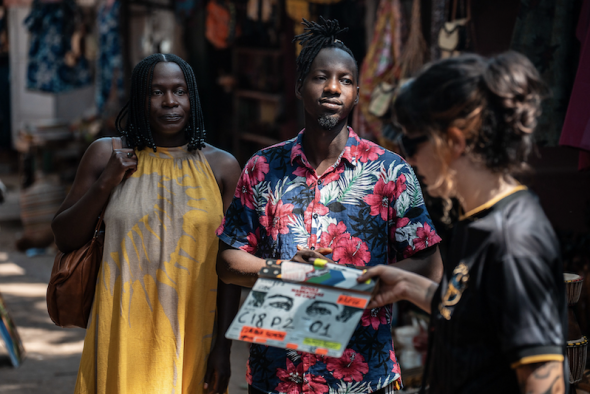
New Hunting Narratives does not need to be the perfect anthology. No first opening needs to reach such a high bar. But the series is born from an ancestry of burnt archives, interrupted languages, neighbourhoods filmed by others, poorly translated bodies, talents without rooms, belated criticism, distracted television networks. And when something is born like that, in the right place, before an audience that responds, it goes from a mere episode to a cultural foundation.
The lions took up the camera. They gave us seven voices, seven tones, seven attempts — some sharper than others, some still searching for their form. But they spoke.
Now, there is a whole tapestry to knit. This was just the beginning.


