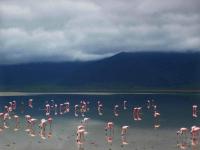
 Here in Ngorongoro, the flamingos spread across the lake’s low waters, walk erratic steps and peck the mud with greed. Reflections of the flamingos and of the sky, punctuated by clouds, paint the water in blue, rose and white. The wind disperses the clouds ceasing their self-admiration on the mirror; the afternoon is going to heat up.
In northern Tanzania, West of the Kilimanjaro and on the way to the famous Serengeti National Park, exists one of the bigger cauldrons in the world: the Crater of Ngorongoro.
Here in Ngorongoro, the flamingos spread across the lake’s low waters, walk erratic steps and peck the mud with greed. Reflections of the flamingos and of the sky, punctuated by clouds, paint the water in blue, rose and white. The wind disperses the clouds ceasing their self-admiration on the mirror; the afternoon is going to heat up.
In northern Tanzania, West of the Kilimanjaro and on the way to the famous Serengeti National Park, exists one of the bigger cauldrons in the world: the Crater of Ngorongoro.
22.02.2011 | by Nuno Milagre
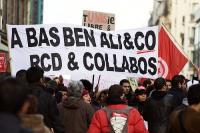 For the first time in decades, Tunisia is free of one-man rule. The extraordinary events of December 2010 and January 2011 have been nothing less than a political revolution: The consistent pressure of popular fury forced President Zine El Abidine Ben Ali first to make an unprecedented promise to relinquish power; then pushed him to step down; and finally halted an attempt at unconstitutional transfer of power, setting the stage for elections to be held at an undetermined date in the near to mid-term future.
23.01.2011 | by Nadia Marzouki
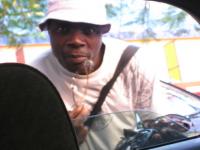 All Africa is an informal market, from Cape to Cairo, from Maputo to Marrakesh. And everything can be found; no VAT, no paperwork and sometimes even without having to leave the car. Briberies, embezzlements, speculation, benefits, manipulation, corruption. Things which are really handy, or might suddenly become so tomorrow.
15.01.2011 | by Nuno Milagre
 fter some back and forth travelling Lisbon-Madrid-Lisbon and some other back and forth travelling Maputo-Johannesburg-Maputo, I started finding linkage points between the voyage in the European Southwest and the voyage in the African Southeast. Both courses are about 375 miles long, from country to country, from capital to capital; syntonizing into another idiom when crossing the border, changing the bank notes for others – a step no longer necessary in the Iberian Peninsula. These are voyages in longitude, to the Orient: Madrid and Maputo; to the Occident: Lisbon and Johannesburg.
17.12.2010 | by Nuno Milagre
 The Museum of Marrakech, situated in the heart of the old Medina, hosted Resonnance exhibition featuring a number of works by artists of Moroccan origins. Painting, photography, video art, graphic design, all the artistic forms gathered in this collective exhibition to celebrate the rich cultural background that brought into the artistic scene those artists: Mounir Fatmi, Aziza Alaoui, Chourouk Hriech, Mohamed El Baz, Lalla Essaydi, Malik Nejmi and others.
25.11.2010 | by Hasnae Fathi
 One Swahili word would travel to integrate countless different languages: safari, meaning ‘journey’. Turks, Chileans, Indonesians, Swedish, Australians and Lithuans, together with many more inhabitants of all the five continents, all understand this word, because it is part of their vocabulary, although in the stricter sense of a journey for wild life observation.
22.11.2010 | by Nuno Milagre
 "Africa: See You, See Me!" portrays the history of African photography and its influence on non-African imaginings of Africa and the African diaspora in all their diversity. Together, the photographs are texts of African subjectivities, archives of history and societies in the making, and methods for understanding how images contribute to emancipation.
20.09.2010 | by Awam Amkpa
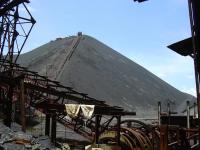 The independence of the Congo witnessed tensions between different groups which resulted among others to the Katangese secession eleven days after Belgium officially granted the Congo independence. Lubumbashi therefore became the capital of a state whose main goal was to perpetuate western industrialists economic interests and of the Union Minière du Haut Katanga. This history started ± 50 years ago since the assassination of Patrice Lumumba on the 17th of January 1961 up to the time Mzee Kabila took up the power through a statement rebellion movement.
14.09.2010 | by association PICHA
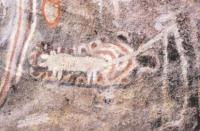 One of the most important archeological sites in southwest Angola, Tchitundo-hulo, lies in a semi-arid region on the edge of the Namib desert. The site comprises an imposing granite inselberg, with three smaller hills nearby. These smaller inselbergs are known as Tchitundo-hulo Mucai, Pedra da Lagoa (Lake Rock), and Pedra das Zebras (Zebra Rock). The inselbergs all feature carvings engraved upon the rockface.
09.08.2010 | by Dario Melo
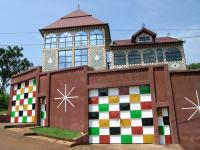 Africa is portrayed as an over-determined image. In other words, a place capable of shaping the abundance of circulating discourses, the terms and labels for the continent and the situations of traumatic nature. The widespread geography that characterises Africa both internal and externally, the continent remains a space of ambivalence that still polarizes fundamental issues as human rights, racial equality, apartheid, subordination, hybridization, mixing, the displacement of people and cultures.
23.05.2010 | by Marta Mestre
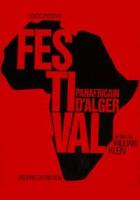 One part of the programm of the 7th Festival de Cine Africano de Tarifa, is called: "Utopia and Reality: 50 years of African Independencies?" Coinciding with the 50th anniversary of the Independence of 17 African countries, FCAT’10 offers a selection of African and non-African productions that explores, illustrates, questions and analyses this independence. There are films which talk about the life and ideas of figures like Aimé Césaire, Patrice Lumumba or Amilcar Cabral, or about the hope and dignity found after so many years of colonialism.
23.05.2010 | by Tarifa African Film Festival