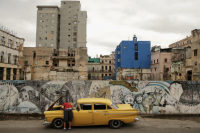
 This particular building evoked the Lebanese capital for various reasons, not only its colonial-style architecture and Ottoman-esque windows but also the fact that one of its sections was fully collapsed – a common architectural repercussion in the formerly relentlessly celebrated “Paris of the Middle East”. Following its so-called “golden age” in the mid-20th century, Beirut had gone on to host, inter alia, a 15-year civil war (1975-90), brutal Israeli military assaults backed by the United States, vast post-war demolitions in the interest of historical amnesia and ever-savage elite enrichment, and the Beirut port explosion of August 2020.
04.04.2022 | by Belen Fernandez
 Gentrification is not always defined in these terms. Some cite cultural explanations, from the kind and number of amenities (like coffee shops, bike lanes, etc.) developed in an urban neighborhood to changing social norms around “lifestyle choices” (like not having children), defining gentrification as a result of individual consumer preferences. Or they might define it as the result of collective consumption patterns, which happens in arguments about “gay gentrification.” Some define gentrification as a process of white people moving to Black neighborhoods and pushing long-term Black residents out of major urban centers
28.01.2022 | by Joe Tache
 Despite the importance of chattel slavery to the making of Portugal and its overseas empire, this terrifying history of black bondage is entirely muted in the public memory of Lisbon. In contrast to the (recently established and far overdue) National Museum of African American History and Culture in the United States or the Museu Afro Brasilin São Paulo, Brazil, there are no such museums or reckoning public memorials in Lisbon along the lines of the Mémorial de l’Abolition d’Esclavage as in Nantes, France. More recently, however, a slavery museum was established in the historic “Mercado de Escravos” (Slave Market) of the southern Portuguese port of Lagos, which is said to be the site of the first trade in enslaved Africans in Europe. Yet, Lisbon remains largely silent on its legacy of white terror and black captivity.
04.02.2021 | by Yesenia Barragan
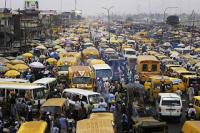 An analysis of territorial occupation of African cities resulting from rapid urbanization should take into account not only the neo-liberal globalization trends but also the recent (and violent) decolonization process. In this sense, a series of rights have been neglected and excluded from African national agendas, with serious implications for the configuration of African cities.
18.12.2020 | by Andréia Moassab
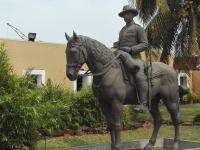 AbstractSince this is a matter that is not yet resolved, where the strength of ideologies and re-uses may change deeply or even reverse the ways it is evoked, the colonial past may become a problem (Vecchi, 2018a). This is the case of Portuguese colonialism which is frequently invoked to stress resentments: whether from the country that was colonised or the colonising country (Ferro, 2009). As soon as the Portuguese Revolution of 25 April 1974 took place, Mozambique promoted the elimination of colonialism symbols. This predictable attitude, aiming to show that the colonisation had ended, was later amended by the future Governments, with the colonial stat-ues (at least, the ones that remained) being relocated to a place where they may be observed and contextualised. This action aimed to preserve the memory, which may enable the development of intercultural dynamics, softening the mentioned resentment: promoting questioning, in order to understand certain logics and, at the same time, filling gaps in the forgotten memory and in the Mozambican identity (Khan, Falconi & Krakowska, 2016). This paper refers to the cases related to the new life of two colonial statues in Maputo – Mouzinho de Albuquerque and Salazar –, during the post-colonial period and the permanence, until today, of the first monumental trace of Estado Novo [Second Republic] (Monumento aos Mortos da Primeira Guerra Mundial [World War I monument]), showing the importance that the preservation of memory has in a country or a na-tion’s life, even when it is associated with the former coloniser. This sort of mental decolonisation (Mbembe, 2017; Thiong’o, 1986), aims the questioning of the way the colonial past weighs on the current intercultural relations, in Mozambique, when the country establishes a relation with the former coloniser, allowing its inhabitants to look at the past as a way to build future dynamics.
13.12.2020 | by Vítor de Sousa
 German colonial experience, as is well-known, was relatively short: the defeat of the Reich in 1918 brought about its abrupt end, since the several punitive measures set up by the Treaty of Versailles included the obligation for Germany to surrender all colonial territories in its possession. This goes a long way to explain why, contrary to the Holocaust, the history of German colonialism – although it was similarly marked by forms of extreme violence, culminating in the genocide of the Herero and Nama
peoples in 1904-1906 in so-called German South-West Africa – is today largely absent from German public memory, having, concomitantly, been long subalternized by German historic research.
German colonial experience, as is well-known, was relatively short: the defeat of the Reich in 1918 brought about its abrupt end, since the several punitive measures set up by the Treaty of Versailles included the obligation for Germany to surrender all colonial territories in its possession. This goes a long way to explain why, contrary to the Holocaust, the history of German colonialism – although it was similarly marked by forms of extreme violence, culminating in the genocide of the Herero and Nama
peoples in 1904-1906 in so-called German South-West Africa – is today largely absent from German public memory, having, concomitantly, been long subalternized by German historic research.
13.12.2020 | by António Sousa Ribeiro
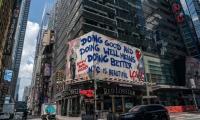 For 20 years, Fran Lebowitz has been dreaming of tourists disappearing from Times Square. “Now there are no tourists in Times Square,” she recently said, “but, of course, there’s no one in Times Square.” When the pandemic hit in March, Times Square went from a congested, and hellish, hub for tourists to an eerily empty dystopia. More recently, though, it has become a site of artistic expression, taken over by a free fall of protest art, colorful parades and performances. “It lacks the same history of worker organization spaces like Union Square, but with the spread of digital graphics and art during the Covid-19 pandemic and black-led uprisings, Times Square has made itself a unique site for protest in a city with more empty space, and an ongoing stream of creative mobilizations,” said Sarah J Seidman, a curator at the Museum of the City of New York.
04.11.2020 | by Nadja Sayej
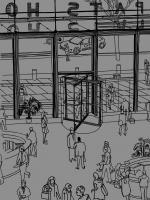 Compiled from episodes of their show, which has gained millions of listeners over the past 10 years, the book introduces us to mysteries that most of us have never considered. Why are manhole covers round? Why do the Japanese infuse them with elaborate decorations? What do painted yellow symbols on streets tell us? Why are traffic lights red on top and green on bottom? What might we notice about the designs and support systems of buildings and bridges? Why have so-called love locks or love padlocks become a problem around the world? Why are some streets straight and others curvilinear?
15.10.2020 | by Kenneth T. Jackson
 At the height of the movement, Harlem was the epicenter of American culture. The neighborhood bustled with African American-owned and run publishing houses and newspapers, music companies, playhouses, nightclubs, and cabarets. The literature, music, and fashion they created defined culture and “cool” for blacks and white alike, in America and around the world.
15.04.2020 | by vários
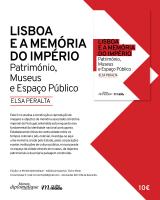 Its purpose is to analyse the several examples by which “images” related to the imperial history of Portugal are built and copied, thus being understood as a fundamental and articulating axis of the Portuguese national identity. The focus is therefore on a “image-memory” or a memory-representation, authorized by the State, by its corporation and by institutions of public culture and not so much on a memory-routine, passed on in the realm of daily social interactions, or a memory-remembrance, passed on verbally.
20.11.2018 | by Elsa Peralta
 With what significance do local and national public authorities in today’s Europe now want to include another narrative, not just the colonial narrative, in their official discourse about the past? Such a desire is clear in moments such as the Brussels municipality’s unanimous decision about Lumumba Square. That is, who has the responsibility to decide about how memories of colonialism should be brought forward in a Europe that is itself the child of colonialism? In other words, what does it mean that voices and visions of Europeans of African descent are taken into account in discourses about colonial legacy by a Europe that has struggled to recognize its own traumas and blind-spots?
03.07.2018 | by Felipe Cammaert
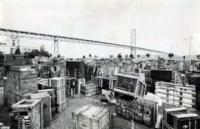 Europe is said to be currently facing the biggest refugee crisis since the Second World War. In the media, images of people escaping from their home countries devastated by war and misery and arriving to Europe are recurrent. As these pictures spread and instigate different reactions – some of them highly racist and xenophobic – another picture came to my mind: a picture of Lisbon in 1975 by Alfredo Cunha, shortly after the arrival of 6000 people from the Portuguese ex-colonies of Angola, Mozambique, Guinea-Bissau, São Tomé and Príncipe and Cape Verde.
in"Decolonizing Museums", L'Internacionale.
Europe is said to be currently facing the biggest refugee crisis since the Second World War. In the media, images of people escaping from their home countries devastated by war and misery and arriving to Europe are recurrent. As these pictures spread and instigate different reactions – some of them highly racist and xenophobic – another picture came to my mind: a picture of Lisbon in 1975 by Alfredo Cunha, shortly after the arrival of 6000 people from the Portuguese ex-colonies of Angola, Mozambique, Guinea-Bissau, São Tomé and Príncipe and Cape Verde.
in"Decolonizing Museums", L'Internacionale.
14.03.2016 | by Ana Bigotte Vieira
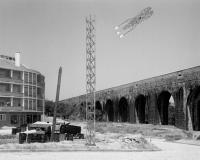 The text focuses on three operations – OPENING, REMOVAL and RESTITUTION - having Ana Hatherly’s work "As Ruas de Lisboa", Isabel Brison and Nuno Rodrigues de Sousa’s "O Monumento da Rotunda das Águas Livres", and Ana Bigotte Vieira’s "No Aleph – Notes about a research on Calouste Gulbenkian Foundation ACARTE Service (1984-1989)" as main sources. It is important to note that this text is being written in 2015, at a time when the brutal presence of a succession of absences in Portuguese recent history is felt more than ever. In fact, the current austerity policies point to the removal of a series of I would call ‘openings’ directly related to the Revolution on 25 April 1974 that overthrew António de Oliveira Salazar and Marcelo Caetano’s forty-eight year dictatorship and ended thirteen years of colonial wars. in"Decolonizing Museums", L'Internacionale
08.03.2016 | by Ana Bigotte Vieira
 A City Called Mirage is a complex exhibition, by the Angolan artist KILUANJI KIA HENDA (Luanda, 1979), which explores original approaches to a recurring theme in recent times: that of cities between the states of virtuality and desertification. Kiluanji uses (science and mythological) fiction and irony as ways of transcending the pessimism of hyper-criticism and the aesthetics of the ruin. Through humour we are made aware of just how ephemeral the largest human constructions are: all cities will be reduced to raw materials again, just like the metals removed from the ground will once again merge back into it.
03.10.2014 | by Lucas Parente
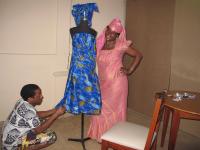 This project is part of a PHD research aiming both to apply, at an academic level, the identity, tradition and fashion-able challenges of African capulana textile into the XXI century fashion and, in parallel, to contribute in a practical way to the improvement of a more equal society through sustainable fashion design, seen as a vehicle for social changings and knowledge empower. Here African tailors are considered agents for the operational creativity of local fashion with this African textile (or sui generis), and therefore agents to develop mechanism between tradition and modernity.
27.03.2013 | by Sofia Vilarinho
 While some commentators and journalists have dismissed Occupy Wall Street as carnival, lawmakers and policemen did not miss the point. Carnival per se, the Shrovetide festival, hardly exists in the United States anymore, save for Mardi Gras in New Orleans and the West-Indian American or Labor Day Parade in Brooklyn, a pan-Caribbean celebration.The carnivalesque, however, as medium of emancipation and instrument of political protest, is alive and well. (...) Carnivalesque protests are a staple of the anti-corporate globalization movement.
18.10.2011 | by Claire Tancons
 The thud of hypocrisy does not end here. Seven months after Cameron criticised Egypt's efforts to block access to the internet, he is now considering increasing British police powers over social media networks like Twitter, Facebook and BlackBerry Messenger. Echoing the views of more authoritarian regimes, the prime minister says, 'Free flow of information can be used for good. But it can also be used for ill.'
18.08.2011 | by Lara Pawson
 Around the competition A House in Luanda: Patio and Pavilion, let’s talk about houses and let’s talk about Luanda. Intending, with all this talk, to add a few considerations to the debate driven by the Lisbon Architecture Triennale, in association with the Luanda Triennale, on the role architects could play in the solution to the urban and housing problem of this city with explosive growth, to the increasing socio-territorial inequalities. Let’s talk about houses through an analysis of some of the ideas presented in the competition to which we’ll add others around the problems highlighted on a brief analysis of life in “Luanda’s perimeter”, the place proposed by the competition.
18.07.2011 | by Cristina Salvador
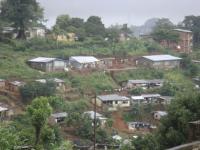 These new views of urbanity in Africa force us to re-equate new paradigms, new urbanism models, as Adjaye proposes, and new forms of intervention in urban areas that take into account the multiplicity and complexity of what occurs in each city and that can only be found and managed locally. This applies both to what occurs in the old city centers – some of their “hearts” still beat – as to their replicas that were born afterwards.
07.06.2011 | by Cristina Salvador
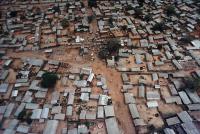 Thoughts around the interview and conference CIUDAD SUR presented by Pablo Brugnoli, last June 26th on “Próximo Futuro”, Gulbenkian Programme for Contemporary Culture. According to Pablo Brugnoli, CIUDAD SUR reviews ideas, practices and projects by collectives of architects and artists, whose recent works reinterpret cities from the southern cone of America (Argentina, Brazil, Chile, and Uruguay). The link between them is their focus on the value of communitarian reconstruction, regarding both the procedures and the socio-cultural dynamics.
23.05.2011 | by Cristina Salvador