What nuances shape interracial relationships?
Starting this reflection is not easy. I know I’m stepping into complex ground: sandy, clayey, and organic all at once. There are no right or wrong answers, there are situations we deal with on a daily basis that have historical roots and affect our social interactions. That said, let’s move on.
A while ago, here in BUALA, Valdeth Dala, a 19-year-old Angolan girl, wrote a text about interracial relationships. I thought her approach was brave because I know how sensitive this topic can be, especially being Angolan, and later on I will tell why. The text, as natural, raised discussions like this “Carta de duas mães às suas filhas mestiças”, and fortunately so, because that is why we are here. Afterward, Marta invited me to join the conversation, not to respond or refute Valdeth but to add my perspective and continue the reflection.
Henceforth, I think it is important to emphasize that the interracial relationships I am discussing here are those between black and white people. Moreover, I highlight that the ideas of “race” present in this text refer to social constructs about the Other, since, biologically speaking, there are no races.
I have always been interested in thinking about interracial relationships. Ever since I’ve lived in Lisbon, this has been a recurring topic in conversations with friends, and sometimes things get heated: there are those who support it, those who reject it, those who say no one should have an opinion on personal tastes, those who find it very complex, and those who have no definitive position. It’s always a topic that sparks discussion. And it sparks discussion because these relationships often intertwine love, culture, and history, they challenge or reinforce social stereotypes, and they highlight issues of individual and collective identity and belonging.
To move forward, I must first discuss the place from which I am speaking. I am Angolan, and Angola, like many African countries, had a European presence for hundreds of years. This presence was the origin of the long period of the transatlantic slave trade and, subsequently, the colonization of African territories until the 1970s. During both periods, racial mixing between black and white people took place, both in Africa and in the territories to which enslaved people were transported. In the Angolan context, under Portuguese colonial rule, this interracial mixing did not occur on a large scale compared to other countries, nor was it entirely peaceful or voluntary. This point is central to this conversation.
When the Portuguese and other Europeans arrived in various African countries in the 15th century, as history shows, they did not “discover” anything: they encountered people with cultures, languages, forms of political and social organization, and a deep well of experience and ancestral wisdom. Yet this arrival brought enslavement and, later, colonization. The evils of these processes are vast, and it is important to remember them: the displacement and death of thousands of people; brutal physical and psychological violence; continuous humiliation; the systematic rape of black women, which also led to racial mixing; the mandatory assimilation into what was considered “superior culture”; internal divisions; attempts to erase and ban the expression of African languages and cultures; economic and epistemological violence; racial hierarchies. This was the case in Angola and other colonized regions. I was born and raised in a country where the marks of the colonial regime endure and its vestiges remain alive.
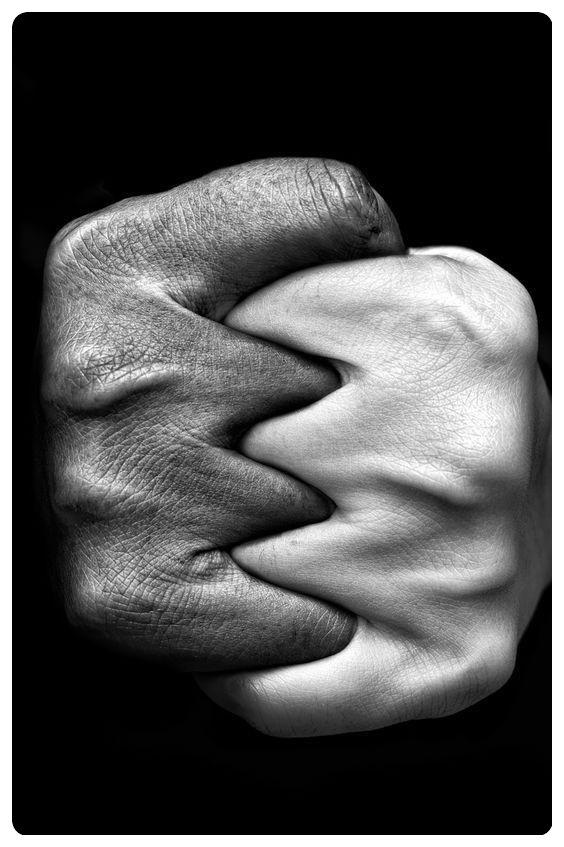
On the one hand, black Africans who immigrated, as well as those born and raised in the West, bear these marks, regardless of whether or not they wish to have a connection to that past. These marks can mean many things: falling outside the aesthetic “norm”; being the target of daily and institutional violence; facing difficulties in accessing quality public services; suffering from underrepresentation in spaces of power, culture, academia, and the arts; being seen as the Other who does not belong to the territory, the Other labeled as aggressive, violent, or naturally subservient; hearing the phrase “go back to your own country,” which is particularly aggressive for those born and raised in the West.
On the other hand, it is not only in the West that black people deal with these issues. In Africa, as a result of slavery and colonization, identity conflicts persist, along with the rejection of Black physical traits, the devaluation of local languages and cultures, colorism, and other forms of racism, as well as tensions caused by the territorial fragmentation imposed at the Berlin Conference.
You might ask what all this historical context has to do with interracial relationships. Quite a lot. Today, these relationships take place in settings where black people carry this past with them and white people carry the opposite: the privileges of those who were established as the standard, the norm, the symbol of beauty, the universal subject—those who had the power to name and define the Other.
Societies are still dealing with traumas from that past, many of which have yet to be fully examined. This has given rise to a racial hierarchy that functions as both a symbolic and material system, assigning value and social status to racialized groups based on historical constructs of superiority and inferiority. In practice, it places white and mixed-race people at the top and Black people at the bottom. In theory, we are all equal, but in practice, we are not yet.
This hierarchy also permeates interracial relationships, starting with the choice of partners. Before anyone starts complaining, let me make a point: people will tell me that romantic choices depend on personal preferences and that it’s nobody else’s business. Yes, no one should interfere in others’ choices. But no, it is not true that these choices are purely a matter of personal taste. It may seem contradictory, but it isn’t. It is important to make clear that the idea of “personal taste” is not impervious to the socio-historical context.
Tastes are also social constructs. What we learn to perceive as beautiful, desirable, valuable, sophisticated, or socially prestigious shapes our preferences. And so does what we learn to perceive as the opposite. Thus, when white is considered the standard and a symbol of these qualities, even unconsciously, our tastes tend to lean toward white people or those who physically resemble them.
Angolan society offers many examples of how tastes are not neutral. I grew up hearing, mostly from men, how women with lighter skin tones were praised as the most desirable and ideal for marriage or a serious relationship. These men and women are the product of a context that has inherited and perpetuated colonial values of racial hierarchy.
In Angola, as in other African countries, the idea of “advancing the race” was prevalent: marrying or dating white or mixed-race people to have lighter-skinned children was seen as a way to “soften” the blackness of a person or family. Paulina Chiziane addresses this brilliantly in “O Alegre Canto da Perdiz”. And although Angola is a predominantly black country, many still aspire to or idealize being with a white, mixed-race, or someone as light-skinned person as possible. Baptista Miranda’s recent video on colorism in the Angolan context illustrates this preference well.
Another example is the recurring pattern of Black men who, as they climb the social ladder, choose white or mixed-race women for romantic relationships. I am referring here to men because these are the most common cases. This occurs in Angola, Portugal, Brazil, and other contexts, and studies have already been conducted on these dynamics. The question then arises: don’t these men find black women around them? The answer is complex, especially when considering patriarchal and capitalist societies where economic inequalities weigh more heavily on women, hindering their social mobility.
I recall the play “A Missão da Missão”, by the Aurora Negra collective, that is inspired by the African liberation movements and reflects on the role of black women during the colonial and postcolonial periods and in the present day, both in Africa and in the diaspora. The play raises precisely this question: why is it that many successful black men, especially in Portugal, do not date black women? The play also links this phenomenon to the loneliness experienced by black women. It does not offer answers, but leaves us with the task of continuing the conversation.
In addition to the influence of racial hierarchies on affective choices, other issues arise in interracial relationships. The exoticization and fetishization of black and mixed-race women is still common. People of color are desired not only for who they are, but for stereotypical attributes associated with their racial group. Black women carry the stereotype of hypersexuality, while black men are associated with physical virility. These stereotypes have clear origins in the period of enslavement and colonization. The hypersexualization of black women served to justify systematic rape and their dehumanization. The association of black men with physical strength, on the other hand, sustained the slave trade and forced labor.
Today, hypersexualization remains. Black women continue to deal with sexual harassment and violation of their bodies (Ribeiro, 2019). I remember a traumatic incident I experienced in Lisbon. On a train, a white man tried to approach me several times. When I rejected him, he insulted me and said, “Who do you think you are to reject me? I can have any woman I want. On top of that, you’re black!” To this day, I still hear that “on top of that, you’re black.” I was in shock; I got up, changed seats, and continued my journey feeling deeply helpless. The incident reminds me that, in a certain postcolonial mindset, our bodies are still seen as available, especially if you’re a woman and black.
Unfortunately, interracial relationships continue to be marked by the image of violence inherited from slavery and colonization. Not because these relationships are necessarily violent, but because the past has left scars and prejudices that still brand these unions as transgressions or threats to the social order. My black girlfriends in interracial relationships have heard comments like “you should straighten your hair” or “you’re actually a pretty black woman,” along with paternalism and intellectual depreciation.
On the other hand, white people in interracial relationships also face resistance, not because of who they are as individuals, but because of the symbolic weight they carry as representatives of a slave-owning and colonial past. This distrust is not merely personal but structural: it comes from the need to protect dignity and prevent the reproduction of power hierarchies.
Does all this mean that every interracial relationship is permeated by racial hierarchy, exoticization, or fetishization? No. Although treating the Other as a fetish is still a reality, I do not believe that all interracial relationships are based on these principles. There are healthy relationships where people learn to see the Other through new ways of being and existing in the world, from a human perspective. I know of interracial relationships where there is a genuine commitment to anti-racist practices, to justice and social equity at every level. A commitment to love.
References: Ribeiro, Djamila. (2019). Pequeno Manual Antirracista. São Paulo: Companhia das Letras.
Video Baptista Miranda:


