In the unit's mouth
If African unity were to be made around a dish, what would its ingredients be, what flavors would it have, what new stories would be shared, and what possibilities would arise?
In 2020, UNESCO designated couscous as an Intangible Cultural Heritage of Humanity. The multinational dossier was submitted by four African countries—Tunisia, Algeria, Mauritania, and Morocco—which have long disputed the paternity (or perhaps “maternity”?) of the dish. Although typically made from wheat semolina, the couscous featured in the dossier has, however, many other versions and methods of preparation. The origins of this dish are not limited solely to that region of North Africa.
In Cape Verde, the kuskús, traditionally made from wheat semolina, is part of the national identity. We can find the entire history of the archipelago in a kuskús binde, a traditional clay pot used to prepare couscous. The binde, the pilão, and the balaio are, therefore, archives that tell stories and come to life when activated by other living archives — and here I’m referring to the women who cook it: our mothers, grandmothers, and aunts, whose culinary knowledge deserves to be recognized. Thanks to a sister, a daughter of those lands of Pindorama, commonly known as Brazil, I realized that cuscuz (the different spellings are interesting) is also a dish that travels, carrying a strong sense of identity and, curiously, many similarities to the one prepared in Cape Verde. We have here clear evidence of undeniable circulation routes across the Pan-African Atlantic.
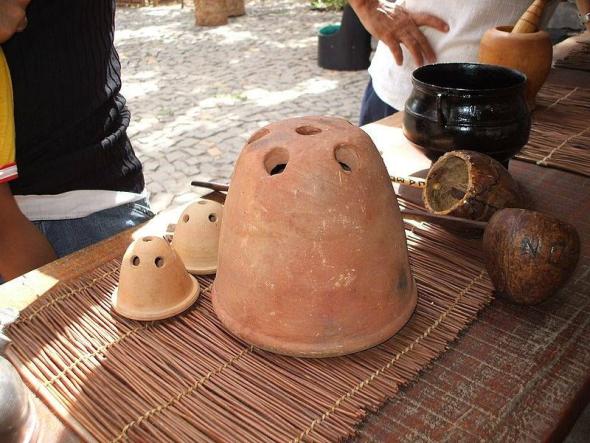
In this spiraling narrative, the fascination of couscous lies as much in the stories it still has to tell as in the possibilities of confluence that allow us to glimpse and speculate. I believe that the dossier presented failed to acknowledge that this dish has many origins, all of them sharing the same African continental heritage. To paraphrase Ngũgĩ wa Thiong’o, every corner of our language holds a part of our shared memory.
To construct a history of African unity through language, through the muscles of this organ that feels and experiences, is to acknowledge the body’s potential in its entirety: from the soles of the feet to the intestines, passing through the lungs to the mouth, where organic and grammatical matter are chewed.
To think about food, nourishment, and gastronomy in the process of unifying the continent is also to allow for our humanization, the fertilization of our creative and inventive capacity, and a more genuine fraternal bond, since food is a school of sincerity.
It is often quoted Kwame Nkrumah`s phrase: “Seek ye first the political kingdom, and all other things shall be added unto you.” Indeed. But what is politics? Although we often hear it said that “everything is politics,” many things — such as food, nutrition, and gastronomy — seem to remain outside, or on the margins, of discussions about “politics.” In this regard, it is interesting to note what Amílcar Cabral says: “The people do not fight for ideas, for things that exist only in the minds of men. The people fight and accept the sacrifices demanded by the struggle, but to obtain material benefits, to be able to live in peace and better, to see their lives improve, and to secure their children’s future.”
This is not merely a “politics of the belly,” but rather a matter of bringing the belly to the center of politics and, consequently, abandoning the condescending view we hold of the people. Changing our perspective on food, ingredients, and gastronomy — these “unidentified political objects” — and seeking our history through them would greatly assist us in this process of liberation and unity.
Kuskús di midju téra, di pilon, fumu ta baza, kuskús ku kufongu: a simple dish, made by simple people, embodying the full materialization of thought, the most beautiful testament to the creative genius of our people in times of scarcity. Above all, it represents abundance as a manifesto against colonial famines.


