The politics and ethics of a “Vida Justa”- The Future is Now!
The adaptability demonstrated by capitalism over the course of two centuries would lead us to accept Thatcher’s famous phrase, “There’s no alternative”, as a self-fulfilling prophecy. Since then, other changes have taken place in response to upheavals, uprisings and crises of various kinds and intensities. At none of these moments, the cohesion and foundations of a global system—which, let there be no doubt, defines itself as the “end of history” — were ever truly called into question.
Does this mean, as Mark Fisher so dispassionately put it, that it is easier to imagine the end of the world than the end of capitalism? For those living today, yes, without a doubt. Thatcher’s prophecy and Fisher’s bitter reflection have become a truth that is hard to question.
The outlook becomes even darker when we consider some of the factors that heavily influence the landscape shaped by algorithmic capitalism. This refers to the development of what, since the early years of this century, has established itself globally as the platform economy, where the central role of the algorithmic model has revolutionised relationships at every level, far beyond the workplace.
The tendency towards individualisation, the loss of meaning in collective ways of interpreting processes and formulating responses, the dominance of the ideology of success at any cost and of meritocracy – where failure is attributed to individual blame – and the constant undervaluation of physical relationships in favour of virtual ones: all of this points to an anthropological shift that reaches deep levels, including the realm of the unconscious and of dreams.
The absence of a collective subject to which one can attribute a sense of belonging in one’s own life – a subject that must be created, not found somewhere else, nor reduced to a mere “crowd” that is always already antagonistic – produces, as Márcio Pochmann writes in “Outras Palavras”, frustration and resentment. These, in turn, reinforce the sense of individuality and loneliness, fuelling the vicious circle that is grinding us down and weakening our will to live.
The last twenty years have been marked by a striking acceleration in the consolidation of this new model, which is at once economic, social, cultural, political and anthropological. The speed of this process has left us no time to reflect on what was happening. The traces it leaves behind are indelible and already clearly visible today. Undoubtedly, they will become even more so in the coming years, particularly amongst the younger generations, in every aspect of their lives.
This does not prevent us from envisioning a different future, because “thinking” means imagining and discovering something new and unpredictable, as opposed to merely recognising what is already known. In this sense, knowing the new translates into experiencing the new, that which is not yet. “Imagination, fiction and myth are not escapes from reality, but ways of intensifying, articulating and transforming it,” writes Vittorio Gallese in Il Sé digitale (2025).
“To frequent the future” – as Dr. Cardoso suggested to Pereira, the elderly journalist from Tabucchi’s famous novel Afirma Pereira – thus becomes a necessary condition for creative resistance. “The capacity to create possible worlds, to inhabit otherness, to construct shared structures of meaning that exceed what already exists” (Gallese, 2025) is what we must reclaim, precisely because it represents the target of the extractivism exerted upon our very specificity as human beings.
The future can begin to be created now. It can be experienced in the everyday aspects of our lives, in the spaces we subtract from relentless and omnivorous domination.
Under these conditions we manage to live, even if temporarily and partially, beyond the horizon mapped out for us. Every struggle, every victory, every brake applied to the dominant logic, produces new relationships, where the capacity to imagine is transformed into the power to build, right now, what for us is a full-fledged otherness. And, precisely for this reason, we are no longer willing to accept that nothing can be different.
Faced with an algorithmic capitalism that domesticates every aspect – physical and temporal – of our existence, subjecting it to the chain of valorisation and financialisation that feeds and reproduces it, the response can only be situated at the level of life as a whole. It is, in fact, the only possible response to the logic of biopolitics, which is where we must find the ground on which to produce conflict. To the extent that collective life is appropriated by power as a sphere of intervention, the demand for a “fair life” embodies its subversion and projects its reverse.
This breaks down the boundaries between “production” and “reproduction”, between labour disputes and social conflicts. It broadens the range of initiatives based on “self-care” as a condition for “caring for others”. It places political ethics — rather than morality — at the centre of the worldview in which we wish to live.
Ethics is the cartography of the forces that produce ways of life oriented towards social, political, economic and cultural well-being, relating both to the community and to each of its members.
In this sense, ethics, politics and justice work together.
In the article that was intended to be the first part of the reflections continued here, we described the modes of action and the role played by war in a context fuelled and managed by chaos.
It is worth recalling Foucault’s famous statement from his course “We Must Defend Society” at the Collège de France: politics is war waged by other means. Never before has this statement sounded so relevant. The centrality of war in the global political landscape, with all the mechanisms that accompany it, relegates “traditional” politics to a secondary role.
It is enough to read the 22 points contained in Palantir’s recent manifesto, published by Alex Karp in “The Technological Republic”, to realise how society itself is becoming a field of application for the logic of permanent and total war.
The “war” against all those who emerge as a threat to the designs defined by algorithmic capitalism knows no bounds and harbours no remorse. What is at stake is the fight against the very idea of civil society as a space for legitimately antagonistic political action. A space where it is legitimate to act to subvert the order of principles that regulate the toxic relations to which we are all subjected.
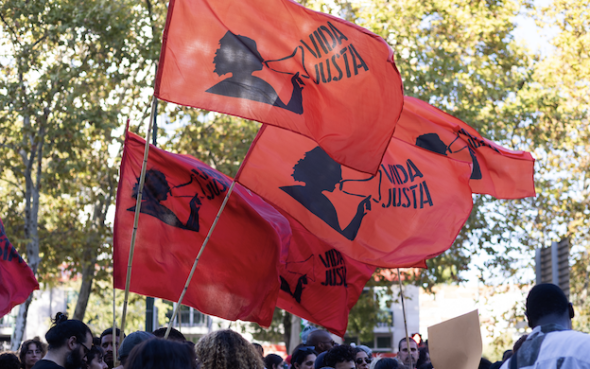 (photo) From the website Vida Justa
VIDA JUSTA, by Marta Lança
The emergence of the Vida Justa Movement shows that, even within a society deeply fragmented by algorithmic capitalism, as Stefano Rosa describes here, there are still concrete possibilities for collective renewal. In these three years of existence and fight, Vida Justa brings the power of action and thought from working-class neighbourhoods, committed to ceasing to be merely territories of poverty and marginalisation management and becoming spaces for political organisation and the building of solidarity. Through popular assemblies, the Jornal dos Bairros, from the Rádio Vida Justa and mobilisations against evictions, police violence, the rising cost of living and the criminalisation of poverty, the movement seeks to rebuild community ties destroyed by neoliberal individualisation and capitalist exploitation. In this sense, the “neighbourhood revolution” takes on a particular centrality: not as an abstract insurrectionary myth, but as a concrete practice of creating popular power from everyday life, local areas and people’s real needs.
The Vida Justa Movement serves as an example of what we call a “fair life” policy. The Fair Life Movement serves as an example of what we call a ‘fair life’ policy. The struggle is no longer confined to the traditional workplace, but extends to the whole of existence: housing, transport, police violence, immigration, care, food, dignity and the right to the city. By organizing people who are often isolated and rendered invisible, the movement breaks with the logic that each individual must survive alone and take full responsibility for their own precariousness. The “neighbourhood revolution” therefore represents a preview of the future: an attempt to build, here and now, ways of life based on solidarity, self-organisation and the collective capacity to decide on one’s own conditions of existence. This is not merely a matter of defensive resistance, but the practical creation of an alternative vision of society, founded on the conviction that life cannot continue to be subordinated to the demands of perpetual valorisation and the diffuse social war that structures contemporary capitalism.
The Vida Justa Movement has served as a testing ground for social conflicts and for both party-political and street action. It emerged against the background of the inflationary and housing crisis that worsened in Portugal following the pandemic, particularly in the urban outskirts of the Lisbon Metropolitan Area. The idea began to take shape in 2022, following meetings between activists, residents of working-class neighbourhoods, local associations and campaigners from various social movements. A key moment was a workshop on communication and activism held in Cova da Moura, where the proposal emerged to organise a mobilisation ‘from the neighbourhoods’ against the rising cost of living. Since the beginning, the movement has sought to break down the separation between traditional political spaces and peripheral areas typically excluded from public representation. The demonstration on 25 February 2023 in Lisbon marked this political breakthrough: thousands of people from working-class neighbourhoods brought issues such as housing, wages, the cost of essential goods, structural racism and public transport to the forefront of the debate. And it has been present at all demonstrations of solidarity with immigrants, labour issues, and dates of celebration and struggle such as 25 April and 1 May. They organised a large solidarity march in support of Odair Moniz and other victims of structural racism.
The Vida Justa is defined as a platform that “brings voices to the neighbourhoods” and seeks to build popular power based on the concrete realities of everyday life. Its distinctive feature lies precisely in the fact that it brings together issues traditionally treated as separate: housing, police violence, immigration, precarious work, urban mobility, food, mental health and social dignity are presented as inseparable dimensions of a single struggle for life. The movement has organised itself geographically into local groups: Margem Sul, Amadora, Sintra, Loures, Odivelas, Cascais, Lisbon. More than a traditional protest movement, it seeks to bring about what it calls a “neighbourhood revolution”: the idea that historically marginalized people can become agents of political organisation, solidarity and collective decision-making. In this sense, Vida Justa represents a concrete attempt to rebuild social ties and forms of collective action in an era marked by the individualistic fragmentation produced by contemporary capitalism.


