Algorithmic Capitalism: war, chaos, and knots
Everything suggests that a historic shift is taking place in the Western world, the consequences of which extend far beyond the geographical area we usually associate with it.
This is the crisis of the neoliberal model, which emerged fifty years ago from the dissolution of the social state that until then had characterized the European and American post-war societies. For years, we have witnessed a deep crisis of representation and function of institutions – at various levels – as well as the patterns of economic, social, and cultural production and reproduction associated with this model.
We have now entered a new phase of the capitalism life cycle.
We chose, from among the many names used to describe it, algorithmic capitalism, because it seems to us that its best accounts for the tensions that cross it. One of its most evident characteristics is the concentration of capital and substantial power - and thus the ability to influence an extremely high share of the world’s population - in the hands of a small number of people. The general context in which this happens is a continuous request for chaos and, consequently, the abolition of any rule that suggests non-exceedable limits.
It is very difficult to find something similar in the previous stages of capitalism.
In this new model, the threshold between the private interest of large corporations and the role of public institutions becomes almost imperceptible; the overlaps and intersections between the two scopes are at the basis of their reproduction.
At a “molecular” level, this new phase results in a different relationship between the individual and the structures (social, economic, legal-administrative, cultural) within which the individual defines himself and by which, at the same time, he is defined and constrained.
The rapid development and implementation of AI is one of the key aspects of this change.
New infrastructures are born, formal and informal, accompanied by speeches, norms, laws, statements that make them concrete and “true”. Finally, a new device arises, and this concept will be particularly useful for the development of what is intended to be discussed here.
The purpose of these pages is not, however, just to try a description – even if it is very partial – of the new scenario.
We intend to outline some points that seem crucial to us to envision an escape route, a possible collision route, an act of piracy, a synchronous collective breath.
Let’s start with the second level, which we define as “molecular.”
AI increasingly takes on an undisputed role in establishing the new entity to which – as French post-structuralist philosophers – we call man-machinery. This is an entity characterized by the “full integration between the individual in meat and bone and their digital extensions, consisting of the non-homogeneous set of data, shared in the online dimension”, as Davide Sisto writes in his essay I confini dell’umano.
Man-machinery finds in AI a horizon conducive to going beyond the cyborg connections that have placed it, for three decades, in a space without physical borders, a horizon where the conditions for a relationship with new characteristics between itself and the environment that includes it are created.
Externalization, or delegation, of organs, functions, and memories for digital extensions has impact on the way we perceive ourselves as subjects – assets and liabilities – of knowledge. Changes our direct involvement in defining what is true, fair, ethically viable. In summary, if the network has offered us, since the Nineties, connections, data, the possibility of intrusion into scopes that were precluded to us until the previous decade, AI not only amplifies – vertically and horizontally – this possibility in an immeasurable way, but “changes the locus of representational power, that is, the point of view that organizes all perspectives,” Lucas Vilalta writes, in the presentation of a conference by Kate Crawford.
From other tools that have entered our lives in the past decades we knew a lot: the basis of its operation, the production processes that brought them to our hands, the struggles fought by the working class that enters those products as “living work”. Sixty-seventh-year Italian “operalist” scholars taught us a lot about the need to have this kind of knowledge.
The nature of AI and the brutal speed with which it is permeating our way of living included the possibility of confronting ourselves with a process of understanding – although basic, superficial and, if possible, criticism – what we have in front of us.
This, however, does not seem to represent a problem: AI appears not only as a tool that is used to improve individual benefits – such as the PC, where this text is being written – but also is born as an environment of trust, where it is possible and enjoyable to live. The fun and reconciling tone of any AI tool makes us feel comfortable talking to a bot. We receive congratulations each time the answer contains an appreciation for what we are writing.
The ability of LLM (Large Language Model) systems to produce distinct types of works creatively and deductively without being based on direct and continuous training processes by humans has an overwhelming impact on our idea of traditional machine use. The surprise leaves us immunized against the desire to know – more and critically – what is happening.
Who is interested in the amount of energy and water our question required or how much were the Filipino or Indian workers paid to enter billions of data and images to train the machine that answers us? Or where and how minerals that data centers need to function have been extracted. Or, even if there is any relationship between the processing of our data offered as a tassel and those used in the strategies of specialized corporations to train machines in the deadly choices of military targets.
There is another specific aspect that needs to be mentioned, as it symbolically represents a change that directly involves the most emotional and intimate part of life. The erotic and sentimental gathering sites of the 1990s and the first decade of the new millennium represent the archaeology of what chatbots offer us today.
In 2013, Spike Jonze made a beautiful film, Her. The story narrated there seemed - at the time - quite far from becoming real. A man was dating a bot, a virtual woman named Samantha. Twelve years later, in December 2025, a Japanese woman married a bot, a virtual man whose profile she created on ChatGPT herself. In this second case, it is not a film.
This does not necessarily represent the future of marriages; it is a boundary figure, or, if we want, an example symptom. No matter how many people get married this way in the coming years; what matters is to show that a limit has already been reached, it has become possible, and even for that reason, it is beyond.
Going back to more general arguments, we noticed how between the second half of the Eighties and the first of the Nineties, two of the most important thinkers of the XX century, Deleuze and Guattari, were noticeably clear on the direction that was already marked.
In the new entity that is born after the “death of man” – Deleuze writes – the inner forces of the individual relate to other forces, those of the Fora. They are those of silicon, genetic components, and grammatical components. These forces produce some literature, molecular biology, third-generation machines, cyber and computing.
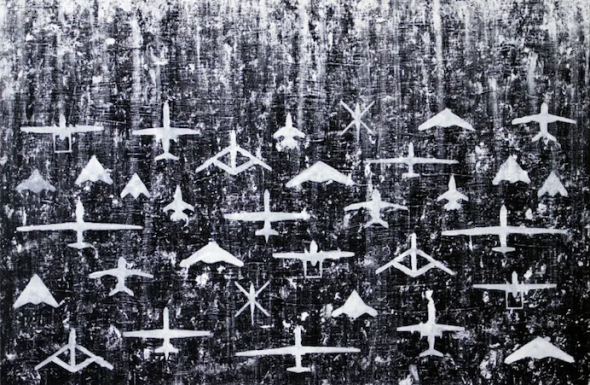 Drone Warfare Decoration, 2015. Por John Johnston/Flickr
Here seems to be Deleuze’s great view of something he had not experienced directly. What AI does is to launch the three “beings” – the being of language, of life, and of work – in the dimension of the finite limit, which is the reference of the new subject, which Deleuze calls “superman”, in his dedicated essay to Foucault.
Felix Guattari wrote the script for what should be a science fiction film, cyberpunk, in the second half of the Eighties, but which never existed: Un amour d’UIQ (Infra-Quark Universe), very well reviewed recently by Felice Cimatti.
On the one hand, we have a hyper-smart form that transcends the carnal lives of humans – the UIQ – and, on the other hand, their bodies, which interact with the first. The result is a mechanical combination between the two entities, where the subjectivity that constitutes therein “has no fixed body boundaries, no constant personality, no even predefined sexual orientation.”
The French psychoanalyst philosopher presents here a “body love letter”. Recovering the body with its limits, euphoria and dysphoria means subtracting it, at least partially, from the delusion of the mechanical agency grafted in the new “cosmotechnique” - unorthodoxly employing the definition used by Yuk Hui in Technodiversity - which is shaping our lives.
It is an argument that will come back to the last pages of this text, because it has a lot to do with the forms of resistance to the apocalyptic framework that algorithmic capitalism is defining with increasing clarity and dramaticism.
Let’s return at the concept of device that was stated above and with that, the broadest level that, with Deleuze, we call “molar”. To clearly explain the importance of this concept in the economy of these interim reflections, we present the definition given by Foucault in an essay included in Dits et Écrits. The device is “a decidedly heterogeneous set, which includes speeches, institutions, architectural structures, regulatory decisions, laws, administrative measures, scientific, philosophical, moral statements, philanthropic proposals […]. The device itself is the network that can be established between these elements.”
It seems to us that, with the beginning of the second decade of the century, these elements have started to present characteristics that move away from the dictates of neoliberalism that marked political and economic life at the time of the yaw fifty years ago. Today, after fifteen years, we can state that a new device defines the relationships unfolded at all levels.
We associate the set of elements that constitute the active device today with two nouns that, in our opinion, are consistent with the situation we are experiencing: chaos and war.
Algorithmic capitalism proposes an operating scheme that is increasingly defined by circular lines that join the two terms, producing scenarios that do not seem exaggerated to define as apocalyptic.
The development of AI strengthens that plot, which becomes increasingly evident through stated strategies and actions taken, where nothing must be disguised. Everything finds an explanation in scientific – or pseudoscientific – statements that bring together absolute confidence in technology, religious beliefs, differences between human beings based on the intelligence quotient. The main exponents of the vector class do not give up any opportunity to recall these principles, as Quinn Slobodan says.
Christian Marazzi, one of the most insightful and prolific analysts of the transformations of capitalism, has defined the involvement of the state in the development strategies of algorithmic capitalism as a revival and modernization of “State capitalism”. A fully shareable reading that leaves a question open. What is the future of the State?
The State institutions we are used to deal with appear to be put into discussion by the most radical thinkers of the new extreme-right globally, once again with the U.S. in the first line. Quinn Slobodan, in Destructive Capitalism, identifies this trend with fragmentation of state entities and the creation of zones where the pattern of development and management of resources, of the production of wealth - even the lives of inhabitants - is averted by the rules that, in different ways, represent the foundations of the form-State that emerged from Enlightenment.
It is in these areas that vectorialists plan an existence that – as if the ferocity of its protector were not sufficient – is free from the threat, always present, of the “anti-Christ”, as Thiel defined.
The founder of Palantir sees this threat in those fighting against inequalities and in favor of social measures for victims of the omnivority of the economic system he promotes and who want to push forward. Thiel’s antichrist also has the features of those who propose ecologist obstacles to the designs outlined by the vocation that animates him and the other vectorists.
The device that appears today as a network of the elements listed above is a direct expression of the “war and chaos regime” that manages relationships on a global scale. This seems to us the change we face today and that explains everything we are experiencing.
When we talk about chaos, we mean the selection of strategies based on a continuous and overwhelming production and dissemination of statements and images, whose results are assessed within minutes of their release. In this strategy, everything can be affirmed and at the same time denied. It does not matter if what was said has a correlation with facts or not, because after a very few minutes, another statement arrives that diverts the attention of the first one. The consequences of this strategy spread vertically and horizontally in any scope, from our workplaces to relationships between States.
AI favors this mode of communicative production. Statistical correlations replace logical, gradual understanding; define cognitive pathways that present decisions as objective, and even for that reason unquestionable. Through AI, one finds explanations, read keys, which provide a justification for everything that is brought forward as objectively true, or false.
Consider, for example, the narrative of ethnic substitution, the greatest fear for a large part of the European population, aged, resentful, and racist. Whether it’s realistic or not, just present it, supporting it with a search on any chatbot, and the results are there.
By war, we do not only understand the war conflicts in any way declared. These are dramatic, criminal, genocidal (many overlooked or ignored), but not the only ones. There are implicit wars against the environment, against the peoples who claim forms of life subtracted from the logic of algorithmic capitalism. There are implicit wars against nations that choose a different direction, claiming different forms of sovereignty. There are wars against segments of the population that defend self-managed and collective social spaces and means of generating income, or that defend the right to decent work. There is a war against the welfare system, against culture, against the poor, the marginalized, and the “disgraced.”
In other words, where there is no declared war, there is a policy that is no more than “war conducted by other means.” Elon Musk, answering a question about the countless homelessness in the US, did not hold back, defining them as drug addicts, violent, and suffering from serious mental illnesses, saying they are nothing but trash and must be treated as such.
Even ahead of many questions raised by specialized studies on the scarce applicability in war conflicts of parameters used in peacetime to train AI, as is the case of Sérgio Amadeu da Silveira, its use is massive. AI offers descriptions of enemies, strategies for hitting them, quantification of “side damage,” and acceleration of “kill-chain”, that is, the time it takes to make a decision.
The consequences in Gaza are within everyone’s reach.
The Lavender and Gospel programs offer clear and daunting examples of the use of AI in Palestinian massacre by the Israeli army. Lavender chooses the targets based on the information acquired in the training. Speed is its main characteristic; mass killing is the most visible consequence. “During the early stages of the war, the army gave general approval for officers to adopt Lavender’s target lists to be eliminated without requiring thorough verification.” “The Israeli army systematically attacked targeted individuals while they were in their homes—usually at night when the whole family was present […]. According to the sources, this happened because, from the perspective of what they considered to be intelligence, it was easier to locate individuals in their private residences.” These excerpts are mentioned in Yval Abraham’s report on the use and effects of Lavender and other AI tools by the Israeli army in Gaza.
In this sense, Gaza marked a turning point between a before and an after. With Gaza, it was clear that any action, even the most brutal and disruptive ones, needs no explanation or excuses. With Gaza, the historically accepted distinction between military targets and the civilian population has ended, and with this ended any reference to international law.
War has no boundary, no beginning, and no end, because – as it is becoming evident with ever greater force – war has ceased to be a condition of exception. Before that, it takes a central position in international and national relations, as well as in defining the economic programs of the main Western countries, and not only.
The use of force – material or intangible – retaliation, blackmail, threat in any situation deemed useful, no longer needs to be disguised. Its intrinsic acceptance brings together countries seemingly separated by political orientation, as well as different sectors of civil societies.
But fortunately, there are always those who resist.
“Where there is power, there is resistance.” Resistance is “never in a position of externality to power.” The resistances must be considered in the plural: These are “possible, necessary, unlikely, spontaneous, savage, lonely, concerted, crawling, violent, unreconcilable, ready for compromise, interested or doomed to sacrifice.”
Let’s assume that the scenario of power relationships in which we are involved is contained in the points we have presented so far. Each of us could make a list – some longer, some shorter – of situations that present one or more of the resistance characteristics described by Foucault in “The Will to Know”.
The bigger question remains the same as it has been through the debates on the left for decades: how high the impact of each of the listed resistances is, not only regarding the specific scope of its reference, but in the construction and symbolic representation of other possible ones.
In each act of resistance there is a subjective process, with characteristics that change from one resistance to another, and at different scales. Which joints or resonances can be taken up, favored and developed between different subjectivities is a question addressed by various approaches. It fuels a discussion that has existed since it became clear that there is no longer a single subject around which to build the process that will lead us to a resplendent future.
Resistances and conflicts cross societies without having a unique direction. They first take variable forms, times, and directions, to match the emergencies that arise in other areas where a threat, an injustice, a value to defend, or to conquer appears.
Given the fragmentation on a global scale of capital appreciation processes, the first thing that seems evident to us is that the chaining of resistances – conducted by different subjects – produces greater effects as it articulates on that scale.
This leads us to important matters.
First, the visibility of actions and the ability to intervene in the sensitive points of the system organization we call algorithmic capitalism. The stevedores of the port of Genoa and the indigenous peoples of the Amazon act with different means, modalities, and objectives, also different from those used by a hacker working on any platform, or by Amazon’s stockists.
These four subject examples produce acts of resistance, whose visibility and strategic relevance are dictated by multiple factors. Its placement along value-producing chains makes the resistances and emergency conflicts of elements of political disruption. Those acts problematize within the global order that includes them, from their cracks and contradictions.
The conditions for transforming the power expressed by the polyphony of voices and resistant actions into subversive power are based on essential and complex issues. There are two in particular that are briefly discussed in this final part of the text.
The first one is about a definition of the actions themselves, which helps us encompass the multiplicity of who we are – directly or indirectly – witnesses.
Let’s continue with the four previous examples, to which we could add others that are in our eyes every day, such as citizen committees against dumping tenants, or to defend common social spaces.
If we face those struggles as points – implicitly or explicitly – interconnected, it will not be enough to define them as spontaneous, collective, self-organized. As Rodrigo Nunes suggests in Nem Horizontal Nem Vertical (2023), the best term to describe them is the distributed shares, because there is something that, still, unites them. Distributed is not synonymous with loose.
A simple concept of statistics helps us represent the distribution of actions. The shares are distributed as a function of a line, in relation to which the points (the shares) result dispersed, with greater or lesser distance. Its graphical representation is a scatter plot, with the “points of resistance” spreading around a line, which, in this case, we could define as the trend – at a specific time and space – of actions against the biopower of algorithmic capitalism.
The points vary in both the position on the diagram and the number. As a result, the slope of the line changes, a mission is defined that is not constant and predictable – contrary to what the followers of a Marxist orthodoxia on the only revolutionary subject still believe today.
Wanting to use Laclau’s terminology, we could call this line “significant empty”: does not belong directly and exclusively to any of the points, but each maintains a more or less close relationship with it. Greater the number of resistance points and their proximity to the line, greater the intensity and power itself of the line itself.
The second element – related to the first – has to do with the issue of the organization. The points of that dispersion can produce local, circumscribed, valuable, and well-related effects. The long-standing problem is how to trigger consolidation and multiplication processes that make those effects a turning point, not a return. Experiences in most countries around the world show how far that perspective is from being easily attainable.
As the global scale is the only one that makes sense today, the organizational pattern must also match that scale. This means that there is no ideal model which can be exported or imported, as it has been with the form-party for decades. Each locally contextualized action must find its positioning in a worknet, more than in a network job, according to the happy distinction given by Bruno Latour. What is central is not the structure of the network itself, but rather the ability of jobs to produce network connections, which go beyond the immediate identification of what is contiguous.
In this regard, Nunes’ suggestion in the article mentioned is quite clear. It makes no sense to think in terms of individual organizations, but rather to design the organization “as a distributed ecology of relationships that cross and bring together different forms of action.” Or, in even clearer terms, “a non-totalizable system, composed of numerous networks, an ever-evolving network ecology” (205).
Distributed actions and ecology of the organization produce a productive tension, based on the appreciation of specificities and diversity, within a rhizomatic operating logic. A tension that enlarges the number of nodes, rising and falling along supply chains. A tension, at last, that sets new goals, whenever conditions are given, redesigning and favoring the connections between new and old resistant subjects.
The experience of the fight against war by stevedores and the handling of any kind of merchandise related to it teaches us a lot.
Fougtt by Genoa’s stevedores in 2019, took on an international and international dimension in 2026. Over these seven years, the “line” – as defined above – has gained a truly clear direction and favored the spread of initiatives to the entire social fabric of the city.
In 2025, these mobilizations came, in solidarity with Palestine, to have an unusual dimension. There were many school and university occupations, social centers organized discussions about the meaning of the “war regime”, some smaller political parties on the left, and the USB-based union further expanded the reading of the current phase, involving other subjects, especially in logistics. Even the city council of Genoa took a clear stand against weapons traffic in the port. Many artists have offered to support the struggle with their works. A volunteer organization collected about 400 tons of products to be shipped to Palestine, in conjunction with the mission of “Global Sumud Flotilla”.
The international echo was enormous: in the general strike proclaimed by the stevedores in November 2025, were in Genoa Greta Thunberg, Yanis Varoufakis, Chris Hedges and the New York rabbi opponents to the Palestinian occupation.
The next step was in February 2026, with the proclamation of an international strike. It joined workers from more than 20 European and Mediterranean cities. The manifestation in Genoa was attended - and was partially led by - Chris Smalls, the Amazon worker from Staten Island who organized the first union within one of the company’s U.S. state units.
Each school, university, social center, until reaching the organizations of workers from other cities, autonomously chose the way to join that fight, or, to better say, make that fight their own. There were collective discussions - in rooms full of people - where each representative from one of the “points” explained the way to conduct their own resistance.
In short, distributed actions that show an attitude to rely on equally distributed leadership. How to sediment, expand and strengthen these fighting experience worknets is a question far from being sufficiently analyzed. Notwithstanding this, it seems to us that action and organizational logic represent today the only viable direction.
This brings us back interlocutoryly to the subject with which this text began.
If we accept that our present is marked by the emergence of a new world order to which we call algorithmic capitalism - with the production of war and chaos and based on the logic of the connection between man and machine - what challenges do we have in front of us, in terms of actions and your organization?
Or, said in other ways, how to build connections with those segments of the chain indispensable for conflict to be brought there, where capital gains greater strength, that is, where it produces abstract information, through the appropriation of social cooperation on a global scale?
These questions, which are not just doubtful about which the debate is, fortunately, alive, and open, were already presented in another article. There, the possibilities of promoting the use and function of the internet in a democratic key were also discussed, as well as many scholars describe them.
This in no way diminishes the urgency of our creating the connections we need, between struggles that are physically visible and digitally livable. Without these connections, our acts of piracy will not take us to the most important treasure, the one that is still worth living for.
This is part of the article on Esquerda.net


