Eusébio in Portuguese Racial Discourse: Recent Claims of (Non-)Racism in Football
In the wake of the UEFA Champions League match between S.L. Benfica and Real Madrid on 17 February 2026 – when Benfica’s Gianluca Prestianni allegedly racially abused Real’s Vinícius Jr. – debates about racism have once again garnered global media attention. This has been exacerbated, in part, due to the comments made by José Mourinho defending his club (Benfica) against accusations of racism on the grounds that the team’s most renowned player was Eusébio da Silva Ferreira (Johnston, 2026). By and large, the incident demonstrated a persistent problematic racial discourse: the invocation of celebrated black figures as proof of racial harmony.
Although Mourinho later stated Prestianni will be removed from the club if it was proven he had been racist, demonstrating zero tolerance for racism (Lang and Millar, 2026), it is still worth considering the ease in which Mourinho’s earlier comments were made, which referred to Eusébio. Several figures, including the current manager of the Kenyan national team Benni McCarthy, have condemned Mourinho’s choice of words (Johnston, 2026). However, these responses have overlooked a deeper understanding of Eusebio’s invocation to claim that a club associated with such a figure cannot be racist. Namely, the highly suspect logic at hand, that seeks to invalidate concerns about racism by relying on the memory of an exceptional footballer – ‘the first world class striker to emerge from the African Continent’ (FIFA, 2015: 5:49–5:55).
In Portugal, this is a familiar discourse that is entrenched within Portuguese society and linked to the nation’s colonial and dictatorial past, and claims of racial tolerance – what is regularly referred to as Lusotropicalism. This concept has been discussed many times by this very publication (Buala), most commendably by Cláudia Castelo (2015) in how it became part of the official ideology of the Portuguese government – the Estado Novo (1933–1974) – to sustain Portugal’s colonial empire from the mid-1950s onwards. As a discursive framework, originating from studies on colonial Brazil, it emphasised mixture, cultural adaptability, and the supposed absence of rigid racial barriers, offering a perspective of Portuguese colonialism as not malevolent. In short, a quasi-theory that helped Portuguese leadership to project the notion of a pluricontinental nation, united by a shared culture and free (purportedly) from the racial divisions that characterised colonial societies governed by other European powers.
Born in colonial Mozambique in 1942, Eusébio bridges the colonies and the metropole, exemplifying the notion of Portugal as a pluricontinental nation. During late colonialism, his rise as a star player for Benfica and the Portuguese national team offered proof that the Portuguese were blind to race and that in Portugal anyone with talent could succeed, even achieve international fame. In this way, the invocation of Eusébio’s career is not merely recalling a successful footballer: it mobilises a long-standing discourse of faux-Portuguese exceptionalism – the ‘good’ colonial subject he symbolised for Estado Novo propaganda, serving as the ‘embodiment of the representations of Lusotropicalism’ (Cardão, 2018: 381 & 386). This is what resurfaces in Mourinho’s comments by using Eusébio to claim Benfica’s non-racism, especially given that around half of Eusébio’s life was lived under the Estado Novo – a regime that, in reality, exercised racist policies and maintained a system of forced labour in its African colonies long after slavery had been abolished. These practices were serious enough for the newly independent African nation of Ghana to lodge a legal complaint against Portugal before the International Labour Organisation in 1962, helping to expose the fallacy of Portuguese benevolence towards its black population (Wolfson et al., 2009). As such, Eusébio, falsely made into a symbol of a non-racist past, functions to soften colonial realities and to silence the everyday racism experienced by African and Afro-Portuguese figures, who could not speak up at the time, in contrast to the anti-racist activism of Vinícius Jr. today.
In invoking Eusébio, Mourinho reaffirms a falsified vision of Portugal as a historically racially harmonious nation, demonstrating the persistence of Lusotropicalist logic in Portuguese racial discourse. Although his comments do not appear to imply a conscious defence of past ideology (I do not believe Mourinho is a racist, unlike Prestianni), they nonetheless reflect how the symbolic repertoire of Portugal’s colonial empire – in which Eusébio belonged – is still mobilised to defend institutions against accusations of racism. Acknowledging this does not diminish Eusébio’s achievements in football; he is, rightfully so, a highly commemorated figure even if at times remembered in tokenistic or forgettable ways (see figure 1). However, by recognising the symbolic uses of Eusébio, it helps to clarify how his memory continues to operate within a discursive framework bound up with Portugal’s colonial and dictatorial past. This is especially important considering the recent expansion of the far right in Portugal with Chega, which co-opts and propagates Lusotropicalist logic, asserting ‘Portugal is not racist’ to deflect accusations of their racist views (Público and Lusa, 2020), reflecting the danger of lingering racial discourse and the tokenisation of celebrated black figures.
In total, Mourinho’s comments illustrate how little racial discourse has changed in Portugal, highlighting the ongoing need to better understand that figures from the past cannot be fully separated from the institutional and structural contexts in which they emerged and were subjected to for many years. To claim that Benfica, or by extension Portugal, cannot be racist because of the example of Eusébio is to replicate the Lusotropicalist logic from the Estado Novo, which hinders efforts to confront proven racism and that of which is alleged, typified by the Prestianni and Vinícius Jr. incident.
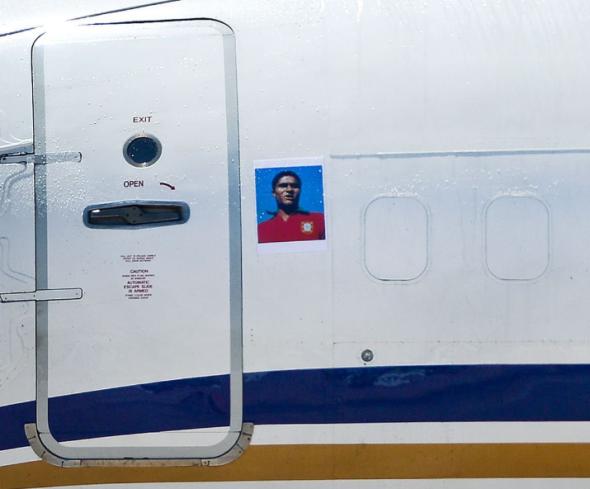 figure 1. An image of the footballer Eusébio da Silva Ferreira on the aircraft that carried the Portuguese national football team home following their victory at the 2016 UEFA European Championship. The image had been kept onboard the plane and was attached to its exterior before the team disembarked. Remaining on the plane’s exterior, the image did not follow the team during their victory parade through the city of Lisbon, reflecting neglect and rendering the commemorative gesture as somewhat hollow. Photo by Patricia de Melo Moreira/Agence France-Presse (2016).
Bibliography
Cardão, Marcos, ‘A Star is Born: Eusébio, Football, and Ideology in the Late Portuguese Empire’, The International Journal of the History of Sport, vol. 35, no. 4 (2018), 374–88.
Castelo, Cláudia, ‘“Luso-Tropicalism” and Portuguese Late Colonialism’, Buala, 28 May 2015, https://www.buala.org/en/to-read/luso-tropicalism-and-portuguese-late-colonialism [accessed 7 March 2026].
FIFA, Eusebio – FIFA Classic Player, online video recording, YouTube, 1 October 2015, https://www.youtube.com/watch?v=5yySFaJe1yg [accessed 7 March 2026].
Johnston, Neil, ‘Mourinho Made “Unacceptable, Huge Mistake” – Kompany’, BBC Sport, 20 February 2026, https://www.bbc.co.uk/sport/football/articles/crl4jx0jw11o [accessed 7 March 2026].
Lang, Jack and Colin Millar, ‘Jose Mourinho says Gianluca Prestianni’s Benfica Career “Over” if Alleged Racist Abuse Proven’, The Athletic (The New York Times), 2 March 2026, https://www.nytimes.com/athletic/7080549/2026/03/02/mourinho-benfica-prestianni-vinicius [accessed 7 March 2026].
Público and Lusa – Agência de Notícias de Portugal, ‘Chega Junta Algumas Centenas de Pessoas em Lisboa para Mostrar que “Portugal não é Racista”’, Público, 2 August 2020, https://www.publico.pt/2020/08/02/politica/noticia/chega-junta-centenas-pessoas-lisboa-mostrar-portugal-nao-racista-1926812 [accessed 7 March 2026].
Wolfson, Oksana, Lisa Tortell and Catarina Pimenta, ‘Colonialism, Forced Labour and the International Labour Organization: Portugal and the First ILO Commission of Inquiry’, International Labour Organisation, 4 May 2009, https://www.ilo.org/publications/colonialism-forced-labour-and-international-labour-organization-portugal [accessed 7 March 2026].


