A Geography of Permission
Turning the Map Upside Down
Portugal is the beginning or the end of the Old Continent. It always depends on where you are coming from, what perspective belongs to you, what borders you cross and which ones your passport permits. The privilege of the red cover, of frontiers and human maps, because the categorization of spaces is directly proportional to the transparent security extolled by European nations, which not so long ago invaded, usurped, killed and violated virgin lands, changing the anatomy and ecosystem of the modern world, and easily forgetting the numbers of lives swallowed by the sea. We were all migrants once, always with the self-determination to declare ourselves righteous, in exile and in resilience; now we are afraid of movement.
And there it is, the Atlantic Ocean, immense, where archipelagos of islands, languages and stories are sisters in the constellation of a history silenced on this side of the world. The center is no longer this small, jagged, tired, saturated continent; it is shifting. We should turn the maps upside down to understand the other, sit quietly and listen to the stories that explode from the bottom of the sea, stories that have not been erased but passed down from generation to generation, by mothers, grandparents, aunts, uncles, fathers, griots of a past that needs to be rewritten, as do the history books. Across this ocean, facing Lisbon, after three flights, descending and ascending the Caribbean Sea, I finally arrived in Kingston.

Everything Is an Open-Air Market
The airport is small but welcoming; music already blaring from every speaker, and no one complains that it is too loud. It takes me a while to adjust to the accent, with its slurred diphthongs and the r, rolled and soft like the island’s hills. People are very patient with me. Outside, the air is warm and humid, the sun clings to you with the sweetness of the tropics. The taxi driver smokes pure weed rolled quickly in unfiltered papers, talking with this crooked joint that hangs constantly from one side of his mouth. They drive on the left, strictly with the radio blasting. The houses are low, and here too, every sign is hand-painted. Colors upon colors set the city’s horizon ablaze, chaotic and ungrammatical, the sky tangled with a web of electrical wires. Everything is an open-air market. Coconut, starfruit, ackees, and Jamaican apples line the roadsides. Smoke from jerk chicken drifts out of grills made from tin barrels, mingling with the exhaust of motorbikes weaving and wheeling through intersections.
On the hills of Kingston, the seeds of homegrown ganja crackle and pop, while dub sends trance-like bodies dancing for hours in front of the sound system speakers. Wherever I go, Beres Hammond is singing on the radio.
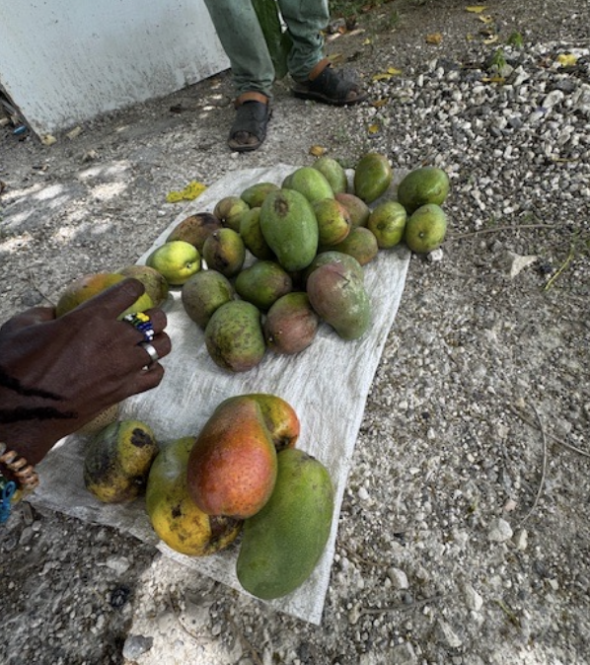
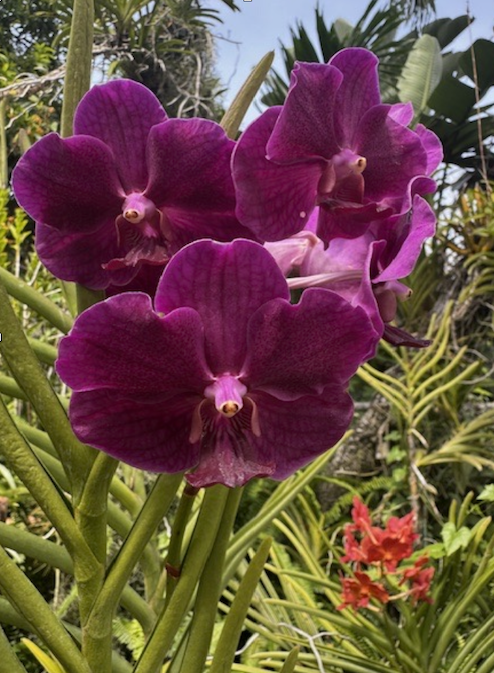
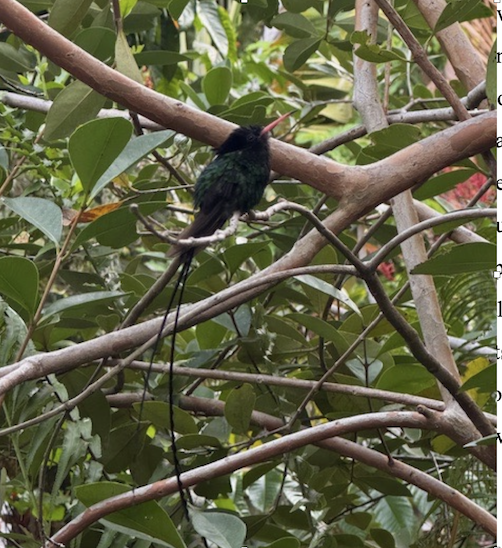
In the garden of the house where I am staying in Norbrook, orchids twist around the trunks of trees, while red jasmine, the Rangoon creeper, bursts into fragrance only with the arrival of night. Breadfruit falls ripe from the trees and is fried for breakfast, alongside boiled green bananas, ackee and saltfish, while the juice of sweet, succulent East Indian mangoes clings to clothes. The palm trees sway, and amid their rustling, one can hear the tiny, frantic engine of the national hummingbird, the Doctor Bird, with its green feathers shaded into black and its long, elegant tail reminiscent of the robes once worn by physicians. It traces joyful arabesques across the sky after drinking sugar water from feeders hanging among the Spanish moss, which looks like fishermen’s nets left to dry between the trees. At dusk, the crickets begin to sing, their chorus alternating, like an invisible metronome, with the calls of other nocturnal birds.
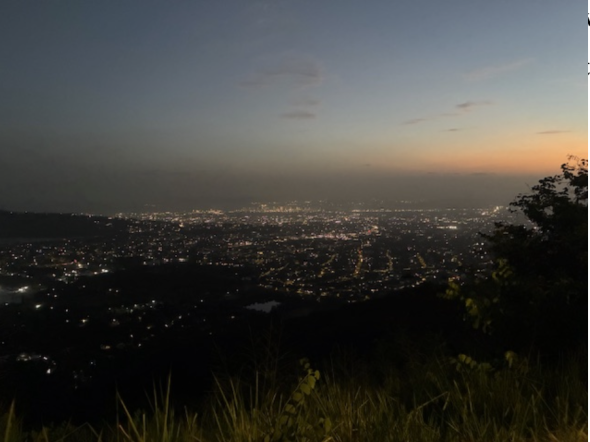
From the hills, the city stretches all the way down to the water. The port has an efficient transport system from the factories; loads slide down metal chutes directly into cargo ships. This engineering playground defines the capital’s landscape, with artificial bridges dedicated to carrying alumina. Yellow lights flash, signaling that night will soon blanket the houses.
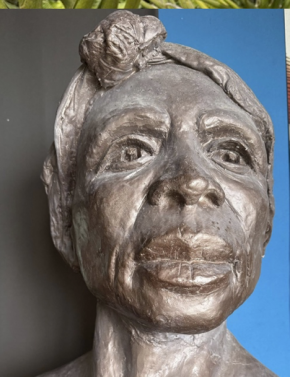
Behind the hills, the Blue Mountains embrace the valleys of Kingston and the surrounding parishes. To get there, you must navigate bends overtaken by the lush, steep vegetation that seems to swallow the concrete. The sounds of the city become a distant mirage. Radio signals are weak, and the sweetness of reggae mingles with the rustling of the wind. The aroma of roasting coffee fills the air: Jamaica Blue Mountain Coffee is considered one of the finest in the world. It is a mystical place, ideal for high-altitude walks or for escaping the pace of the city. Hidden waterfalls, crystal-clear rivers, and warm, pure waters springing from the mountain sources can be found here. This is the land of the Ashanti warrior Nanny of the Maroons, and her stories echo among the caves and peaks brushed with countless shades of green. Born in Ghana and having survived the Middle Passage, she fled into the island’s rugged interior, where in the early eighteenth century she founded Nanny Town, an autonomous community of free Africans that resisted repeated assaults by the British colonial army for decades. Legend holds that she could catch bullets with her bare hands and that her profound knowledge of medicinal plants and the land itself made her invincible. Over thirty years, she freed more than eight hundred people from slavery. Jamaica declared her a National Hero in 1976, one of only seven, and the only woman among them.
The Sound of the City
The shops that play only lovers rock or political reggae during the day, at sunset wheel out enormous sound systems blasting bashment and dancehall, the bass shaking the walls of houses and the bellies of passersby, inviting everyone to dance: hips wining, legs following, bodies pulling close those who dance with them. The music is explicitly sexual, no half measures. Every song has its own defined steps. No age limit, everyone dances. No one judges. People hold each other tight while they drink magnum, the Jamaican aphrodisiac wine, or rum and Red Bull. At the dancehalls, where every night of the week has its own party with a specific name, from Uptown Mondays to Dancehall Fridays, dancers show up in carefully curated looks for just a few hours of celebration. The parties strictly start filling up after 2 am. 1,000 Jamaican dollars to get into the official event, another 1,000 after 4 am when the party spills onto the street, as true sound system culture demands.
In Kingston, there is a street lined almost entirely with record stores. It is called Orange Street. Industrial fans running at full blast keep away the mosquitoes, which never seem to sleep. The shops are small, sometimes opening onto inner courtyards where, on weekends, sunset gatherings bring together the local community and curious collectors. It is a paradise for vinyl lovers and rare 45s. The records are arranged in a kind of alphabetical disorder, packed into narrow rows, and you have to pull them out one by one to find what you are looking for. It is easy to get trapped there for hours, amid the sweat of the sticky heat, the bass vibrating from the speakers, and the photographs of artists who have passed through, listening to the owners’ stories about each 45 as it is tested on the turntable.
In front of Michie’s, my favorite shop on the street, a rustic first-floor space houses an Ital restaurant run by three towering Rastafarian men who, without ceremony, simply ask what you would like from the open kitchen, where vegetables are washed, chopped, cooked, and fried throughout the day. Ital food has been my salvation on this island ever since I developed a severe shellfish allergy. It is always one of my main concerns when travelling in the tropics, at the Equator or south of it. Inside, there are portraits of Haile Selassie I, photographs of Ethiopia, images denouncing Italian colonialism in the XX century, prayers of liberation and redemption, and several pictures of Ibrahim Traoré. I sit waiting for my chickpea burger, with fried breadfruit standing in for the bun. I eat while waiting for the rain to stop, watching drops fall through the damaged roof onto the earthen floor below, where exposed bricks emerge from the packed dirt. The rain erupts suddenly and without warning. It usually comes to relieve the oppressive humidity, but since Hurricane Melissa last November, so violent and destructive, the healing power of water is no longer seen as part of a normal cycle.
The hurricane left immense devastation and loss of life, especially in the south of the island, and the return of the rainy season now triggers a survival instinct in those who live here. Then the power goes out. Nothing works. For hours we sit without electricity while rivers of water pour from the sky, which in the meantime has turned the same color as the night.
 Enclosure
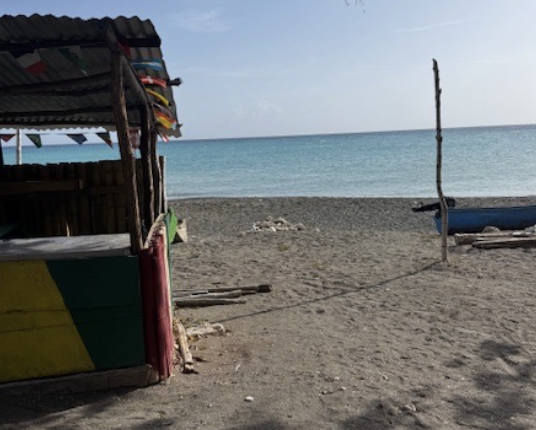
Kingston is clogged with traffic lights during rush hour. From the houses on the hillsides, the sea looks like a distant mirage, and in practice, it is. In the collective imagination, when people think of an idyllic place such as a Caribbean beach, the image that comes to mind is one of crystal-clear waters, an intense sky-blue made even more striking by such beauty and transparency, and coconut water. Yet this sea does not belong to those who live beside it.
The island’s beaches, in general, have gradually been fenced off, sold, or leased to resorts and private facilities that have erected walls where there were once steep paths leading down to the blue waters, and gates where there were once open beaches. It is a geography of permission, where local people must ask for access to what was historically a commons: a shared space, a collective heritage. The privatization of Jamaica’s coastline is not a neutral economic phenomenon; it is the continuation of an extractive logic with deep roots in the plantation system, where land was expropriated, enclosed, and made productive for the benefit of those who did not live on it.
Frantz Fanon wrote that decolonization is always a violent phenomenon because the original moment of colonization was itself violent: the division of space into zones, the separation between those who occupy and those who are occupied. The beaches of Jamaica and those around Kingston tell the story of this violence through the discretion of tourism, through the polished language of foreign investment and sustainable development agreements.
The Jamaica Tourist Board markets the island as an accessible paradise, but only for those who arrive with American or European currencies, not for those who live in neighborhoods such as Trenchtown or Arnett Gardens, located just a few kilometers from this untouchable sea.
There is a precise term for this: enclosure. Historically applied to the common lands of sixteenth-century England and later exported as a colonial practice to Africa, Asia, and the Caribbean, enclosure is the mechanism through which public space becomes private property, through which customary rights, the rights of those who have always been there, are replaced by the written rights of those who can buy.
Small beaches endure. On weekends, families find openings among the remaining accessible public spaces: makeshift piers, low rocky shores, and volcanic sand strewn with tiny shells. It is a quiet, everyday form of resistance, one that does not bear the name of protest but takes the shape of persistence. Simply remaining is already a political act when the territory is structured to push you away. And within this act of remaining lies all the complexity of an island that gained independence in 1962 yet continues to negotiate the boundaries of its sovereignty with international capital that buys the sunset over the water and resells it with an admission fee. Particularly emblematic in this regard is the case of Bob Marley Beach in Bull Bay, east of Kingston. Today, the beach is at the center of a legal battle between the local community and the Woof Group Limited, a private developer that acquired the surrounding land in 2019 with plans to build a $200 million luxury resort. The only road leading to the beach passes through private property, a seemingly minor urban-planning detail that says everything about the grammar of power, about how a space can be enclosed without the need to erect a visible wall. In Kingston, this takes the form of beach concessions, all-inclusive resorts occupying the eastern coastline, and hotels that build private piers extending into the sea, taking it away from the visual and physical reach of those who live within the city itself

Beach Inna Di Bondage: The Fight for Jamaica’s Coastline, the recent short film by Emiel Martens and Elsie Vermeer, draws a direct line between the colonial dispossession of land and the contemporary privatization of Jamaica’s shores. The title itself carries part of that struggle; it is itself a form of cartography, drawing a map that developers cannot redraw, in a language that resists translation into the standard English of legal contracts and investment prospectuses. The film follows three fronts of resistance, Bob Marley Beach, the Blue Lagoon in Portland, and Mammee Bay, and, through them, the work of JaBBEM, the Jamaica Beach Birthright Environmental Movement, which, since 2021, has been taking the state and private developers to court in an effort to make access to beaches a constitutional right. At the heart of the legal battle is the Prescription Act of 1882, a law inherited from the British colonial system. The Act establishes a key principle: if a beach has been freely used by the public for at least twenty consecutive years, for fishing, swimming, or recreation, the community acquires a permanent and absolute right of access that no private owner can revoke, unless it can be shown that such access was explicitly granted in writing. This is the law JaBBEM is relying on to defend Bob Marley Beach and other stretches of the Jamaican coastline, while demonstrating that local communities have used these places for generations, the movement seeks to transform custom into a legally recognized right.
The paradox is striking. The protection derives from a nineteenth-century British colonial law, the very system that originally dispossessed many Jamaicans of their land. Today, that same legal framework has become a tool for resisting a new wave of enclosure. Meanwhile, the Beach Control Act of 1956 pulls in the opposite direction, empowering the government to grant licenses to private companies and corporations to control sections of the coastline, thereby facilitating the very forms of privatization that communities are now fighting against.
The Most Crowded Place on Earth
There is a concept that the Martinican philosopher Édouard Glissant called Tout-Monde, the whole world, the totality of relations that connect peoples, languages, and histories across oceanic space. For Glissant, the Atlantic was not simply a body of water but an archive: a submarine memory containing the bodies of those thrown overboard during the Middle Passage, a living text yet suppressed. Kingston sits at the edge of this archive. Its beaches are the final surface of a deep geological and political stratigraphy, where the history of extraction continues under new names. I began this journey at the edge of Europe, where the continent folds into the Atlantic, and the maps run out. I ended it on the other side of the same water, where the maps were always drawn by someone else, for someone else, with someone else’s interests marking the center. To turn the map upside down, as I suggested at the outset, is not merely a metaphor: it is an epistemological act, a way of asking whose knowledge counts, whose memory is archived and whose is submerged. The sea between Lisbon and Kingston is not empty. It is the most crowded place on earth, full of unreported deaths and stories. The time has come to gather them, to bring them back into view, and to listen, carefully, tirelessly, to the voices that history tried to drown.
Sources:
Fehskens, E. M. (2017). Nanny of the Maroons. In H. L. Gates Jr. & E. B. Higginbotham (Eds.), Oxford African American Studies Center. Oxford University Press. https://doi.org/10.1093/acref/9780195301731.013.74644
Government of Jamaica, Ministry of Justice. (1882). The Prescription Act. https://laws.moj.gov.jm/library/statute/the-prescription-ac
Jamaica Observer. (2022, October 14). Watch: Residents fight to protect access to Bob Marley Beach. https://www.jamaicaobserver.com/2022/10/14/watch-residents-fight-to-protect-access-to-bob-marley-beach/
Martens, E., & Vermeer, E. (Directors). (2026). Beach Inna Bondage: The fight for Jamaica’s coastline [Short film]. IMDb. https://www.imdb.com/title/tt42173794/
Taylor, N. (2026, June 14). Jamaican beach access campaigners go to court to fight privatisation of coast. The Guardian. https://www.theguardian.com/news/2026/jun/14/jamaica-beach-access-court-fight-privatisation-coast


