Sea, Margins, and Center
Fragments
La Isla Hispaniola is where everything began, a thought turned inside out, which I study to gather the scattered fragments and retell the story from the side of the just. Haiti of revolutions glows like a far-off mirage within nationalist, Spanish Santo Domingo, a divided present that still echoes a shared origin. On this same island, renamed to assert possession over the shimmering Caribbean Sea, the mother of all lands, or Quisqueya in the Taíno language, Nueva Isabela was what Santo Domingo was called centuries ago, located within the central cacicazgo of the island, Maguana. When Columbus’s brother arrived, the lush green of sugar, tall canes rising through untamed growth, was uprooted, while the hill was used to scan the maritime horizon. The port was overtaken by caravels, replacing the canoes carved from great tree trunks, and dividing walls were erected, walls that still stand in the colonial zone. As in the other Antilles, private property, or the very notion of it, was violently imposed: a concept shaped by Catholic restraint and guilt, as the Spaniards took everything with a sense of superiority masked as benevolence, one that judges without recognising the other beyond a biblical moral line.
Cosmology
The Taíno believed in simple deities, born from the force of the earth and the sea, guardians above all the tides and the land. The supreme god, Yócahu Bagua Maorocotí, held the gift of fertility and embodied the power of the sea. He was the son of Atabey, the moon, guardian of the waters and of childbirth. The Turey were the deities of the sky, governing the stars and the paths to be read in nights of navigation. These divinities were celebrated in the areitos, ceremonies carried by the rhythm of the mayohabao, drums carved from wood, their beats echoed by shell rattles, as ancient stories were passed down orally within the clan, and colored feathers fastened to bodies drifted through the embers of the fires and the falling stars.
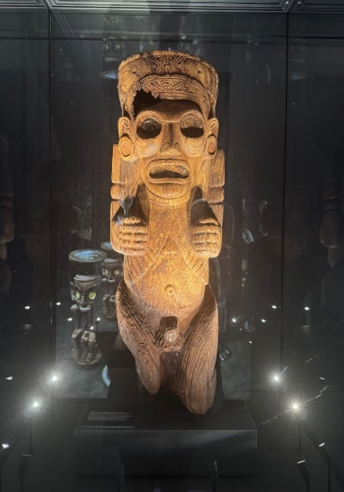 Centro Cultural Taíno Casa del Cordón
Center
Walking through the historic centre, there is this abstract idea of Eurocentric urban space, where a city begins and ends from a sanctified core, a centre that starts from a church or cathedral, in this case, the first de las Américas, and then expands outward in straight, intersecting lines. Some cities instead unfold in the disorder of necessity, yet we Europeans always ask where the central nucleus lies to guide our steps. It would be worth questioning this as an implicit bias, if only the beauty of the place did not overwhelm us. Then we can let this notion of a center dissolve freely, among hills, slopes and climbs, blaring horns and motorcycles carrying families, bags, entire lives. The sun is harsh, yet it softens in the shade of ancient stone, or beneath the Spanish terraces of low houses. There are no hummingbirds on this side of the island; mourning doves and parrots inhabit the remains of the colonial hospital and the cathedral, brown and green flashes in flight, filling the palms so tall they swallow the sun.
https://www.buala.org/sites/default/files/imagecache/full/2026/03/captur..." alt="Catedral Primada de América
" width="456" height="598" />
Sunday
Sundays move slowly in the colonial zone. Bachata floods the streets, elderly people dance, wining their hips: it is love, it is music carving out space among circles of plastic chairs, knocking over domino tiles in the irritated murmur of the players, which then bursts into laughter when women invite them to forget, with sips of mamajuana, the aphrodisiac made of rum, wine, and roots. It is so sweet that nothing else matters, and in their dark, liquid eyes glimmers the opaque history of the entire island, Taíno, Spanish, African, and Creole. It is Sunday, so life is celebrated: sancocho is eaten, a rich, delicious meat stew, and tostones, freshly fried plantain fritters. Hands reaching for each other in bachata are slick with oil and salt, lips sweetened by the rum just drunk.
Anacaona
The statue of Columbus in Plaza Colón always has a flock of black birds perched on its head, an omen of a history laid bare. At his feet, the beautiful Anacaona, the leader, the cacica of the Taíno kingdom of Jaragua. At his feet. A poet, a leader, executed by the Spaniards at the beginning of the sixteenth century. Her very name means Golden Flower, crushed by the violence of colonization. I argue with the guide, hoping for the kinds of local stories you don’t find in books, the ones I travel for. I ask what he makes of the statue, and whether it might matter to mark what existed on the island before Columbus, perhaps even leaving only Anacaona, a figure of both anti-colonial and feminine resistance in the Antilles. I bring up Trinidad and Tobago, where his statue was removed just last summer. He doesn’t believe me. News does not travel between the islands, and history, a history told from the center, from a monarchy thousands of kilometers from Santo Domingo, continues to be the only accepted truth. In this fracture between history and reality, fiction and invention, the stalls of Protestant churches, recruiting followers and crying out against sin, settle around the statue, while dembow, all sex and sweat, blasts from portable speakers clipped to hurried jeans.
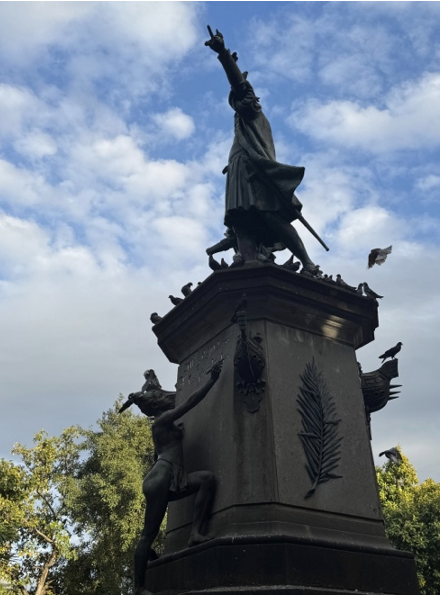 Statue of Cristóbal Colón
River
The Ozama River divides the city, splitting it between the visible reality of the center, made of tourists and street vendors selling fritters, yaniqueques, roasted corn, or fresh fruit, and the invisible reality of the communities that live among shacks resting along the very boundaries traced by the river itself, such as La Ciénaga and Los Guandules. These communities cluster like a fragile extension of the city, built where the land gives way to water. Houses of wood, sheet metal, and unfinished concrete face the dark river, often too close, too high when it rains. Here, “scarcity” reigns: little space, little money, little margin for error. And yet it is also what holds everything together, because it is shared, multiplied, transformed like an atavistic energy. The houses open onto the street, which becomes at once kitchen, shop, workshop, and meeting place. Children play through narrow passages, while the river flows as a constant presence. The Ozama thus becomes an invisible boundary: on one side, the center of the historic, colonial city, ordered to be seen; on the other, a city that builds itself, without a center, disordered and without straight lines, where life spills beyond the limits imposed by the water.
Language
At one of the universities on this side of the island, I taught Caribbean literature from the other English-speaking Antilles, about migration to Europe in the last century, about the beauty of diversity and the creole world that belongs only to the Caribbean. About the need to recover history and to tell it justly, and that to recover it, one must encounter language and oral traditions. The languages of the colonizer have become reinvented vehicles, carrying music, melancholy, and revolution. Across all the language-nations of the West Indian islands, they have been reshaped to exist in the tropics. In the case of English, for instance, Kamau Brathwaite emphasized how the African experience in the Caribbean transformed the English language, making it expressive and powerful, like a cry, the wind, or the waves, creating a hybrid and living form, comparable to the blues. Dominican Spanish is the poetics of the relation between colonial history, urban life, and Africanness. Final “s” sounds fall away, or are breathed out like a cigar, while the “r” often turns into an “l”, as happens in nearby Boriquén, Puerto Rico.
Haiti
Students do not study the other islands; the center is always a distant Europe. And yet, and yet, there is so much literature and poetry that speak of their own culture. Little is said about revolutionary Haiti. It remains there, nearby and yet so distant, as if its revolution were still too overwhelming to be truly named. The first successful revolt of enslaved people, the irreversible rupture in the colonial order, is reduced to the margins, to silence, or worse, to stigma. The name of Toussaint Louverture does not move through classrooms as it should, resonating as the founding echo of another possibility.
In Santo Domingo, distance is constructed in this way too, in language, in bodies, in the gaze cast upon Haitians, made into the Other, necessary and rejected at once. Even in skin tone, in its gradations, a silent hierarchy is at play: a subtle yet persistent colorism that moves across bodies, ordering them without ever needing to be named. A codependence that Frantz Fanon would have recognized: the colonized subject internalizing contempt, the need to distinguish oneself from those placed even lower within the hierarchy invented by the colonizer. And yet, the island is one, split by lines that are not natural but historical, repeated, taught. Homi K. Bhabha would speak of hybridity, of that in-between space where identities contaminate, negotiate, and escape imposed purity. But here, this hybridity is often denied, as if acknowledging it meant losing something rather than finding oneself.
Édouard Glissant instead invites us to think of relation not as fusion but as an opaque, irreducible entanglement, where identities do not need to be transparent to exist. Haiti and Santo Domingo are parts of an archipelago of stories that answer one another, cross through one another, even in refusal. The right to opacity thus becomes the right not to be reduced, nor explained through the gaze of the Other, neither European nor colonial.
So, what does it mean to be Dominican on an island that is also Haitian, African, Taíno, and Creole? What does it mean to choose what to remember and what to forget? A history that continues to be told from the Centre, while everything else remains at the margins, as if it had never truly begun.
Sea
And then the sea, which surrounds and binds this island, knows no margins. The water of the sea washes everything, preserves, corrodes, yet does not forget. It is guarded by Yócahu Bagua Maorocotí, the supreme Taíno god. It is a water that holds together what history separates, that returns what has been submerged without ever rendering it fully visible. In its depths, the same blue of the waves crystallizes into larimar, the sacred stone of the Dominican Republic, as if the sea, unable to contain all it remembers, hardened fragments of itself into something that could be held, carried, kept. Of this absence, or rather immersion, of evidence, Derek Walcott also speaks when he writes “The Sea is History”. In the Caribbean, battles, bodies, and unarchived atrocities lie on the ocean floor, withdrawn from official narrative but not from memory. In this continuous movement, between emergence and disappearance, the sea becomes cyclical memory: it brings fragments back to shore, smooths them, disperses them again. Nothing is ever truly lost; everything returns transformed. So too the stories of the island, Taíno, African, Haitian, Dominican, are not erased, but rewritten in a rhythm that is not linear, but circular. Like the waves, advancing and retreating without ever ceasing, history persists. And in their coming and going, they hold what has been, what is, and what has yet to emerge.
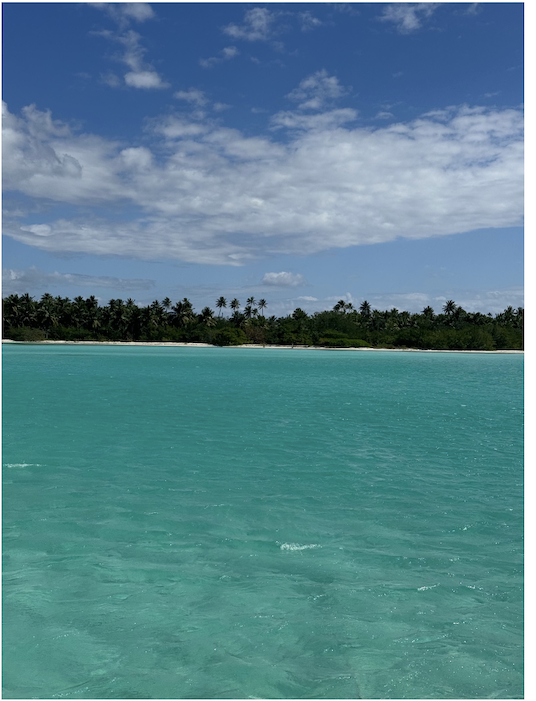 Isla Saona, Dominican Republic


