The situation of women in Angola
I decided to reflect about citizenship from the perspective of women, in a particular moment of our history as a country and the way we tell this story. With the understanding that the practice of citizenship in Angola is still a recent and in construction phenomenon, marked by numerous inequalities in access to information, to health and to other rights, and that these inequalities are reinforced by gender issues.
Women, despite being the majority, are still underrepresented in public and decision-making spaces, and they are systematically submitted to different forms of violence. This is a constant that compromises their participation.
Therefore, the history of independence of Angola, the broadcasted narrative about how the movements of national liberation fought and won colonialism, do not reflect the place of women in this process. It is told from the masculine perspective that omits the participation and contribution of women. It omits the fact that women joined the fight for national liberation because they had an understanding and perspective that colonization was a form of violence that affected them in a double way: as women, but also as citizens of Angola, or as Angolan women.
By denying the participation of women, by separating women’s gender identity from that context of resistance, what the movements of liberation did was to exclude the structural causes of gender inequality that are perpetuated to this day.
In addition to that denial and erasure of women participation in the independence movement, there is also the invisibility of women in peacebuilding processes. When it comes to peace in Angola, is a speech marked almost exclusively by men’s presence: men negotiate, men achieve peace. And then women are relegated to a very limited or almost non-existent role. All of this contributes to the state of violence that women are subjected to daily.
Fifty years after independence, violence against women continues to be constant and an element that compromises their existence. We talk about violence in various forms: domestic violence that, although international commitments and legislation that recognizes it as a violation of human rights, there are still no effective public measures in place to address this issue; they are either almost nonexistent or not being implemented effectively.
There is also economic violence, that happens through women’s exclusion of economic processes. We have an informal sector in which women account for nearly 90% of the workforce, and which denies women equal opportunities of participation, of execution and full existence in this country that wants to be democratic, but with a democracy still under construction.
Violence such as sexual assault continue to be a factor that inhibits women’s full participation in public life and access to employment.
But there is also the matter of denial of their existence as citizens of Angola, which manifests itself in the difficulty of accessing civil registry records. Recently, within our women’s movement, We conducted a project in the municipality of Cubal where, out of a group of about 300 women, only two or three had identification cards. This compromised access to education for these women`s children.
The country that dreamed of independence still has not accomplished that for women. Although the political representation inside the structures of government, the role of women continues to be sideline, and this prevents them from truly feeling part of the State.
In the fight for Angola`s accomplishment for all, there is the need to revisit history, that includes the independence and construction of this country, and that must contain the history, participation and contributions of women. Because a history that does not include their role is incomplete. Fifty years after independence, it does not make sense to continue to tell an incomplete history.
A question was raised as to whether or not there had been any improvements in terms of participation. Women`s participation can not be seen only from a numeric perspective.
In fact, if we look at Angolan law, there is no discrimination established in the law. The Constitution of the Republic of Angola established equality between all citizens and condemns discrimination based on gender. From this formal point of view, everything is fine. We have a good representation - not yet at the levels that are expected in accordance with the SADC Protocol, the Maputo Protocol, or other international instruments to which Angola is a party - but there has been improvement.
We hold about 30% of the seats in Parliament, we have nine female ministers, we have women in the judiciary presiding over higher courts. But the equality and effective representation that is intended are the ones that should be verified in public policies.
As an example, Angola recognizes in official documents the fight against violence, but, in March, we had women that were detained for wanting to protest to condemn violence against women. It has been verified that, even though the 37% of women representing in Parliament, for the past three or four years, the budget allocation for programs to combat violence has been systematically reduced.
Programs of acceleration of civil registry, that do not specifically attend issues about violence against women, are also important to promote gender equality.
For example, right now, cholera is a problem that reaches all population, but it has gender dynamics, because, traditionally, women are the ones responsible for care works.
When there is cholera, it increases the pressure and overload under women. They are the ones that will take care of the sick, they are the ones who leave work to ensure the house dynamic keeps working.
There is money to celebrate independence and highlight the men who fought, but there is no money to treat cholera, a problem that affects communities, and particularly women.
The concern with police brutality on streets against “zungueira” women, street vendors, is also a gender issue that remains prevalent in society.
Many advances that were made in terms of representation, with indication of female ministers, do not recognize the deeply rooted dynamics of inequality that shape our society, but they are made only to meet the requirements of protocols and international treaties. In addition, Angola does not want to be seen as a country with no women in government, but the public policies fail.
Another example: the law against domestic violence does not specifically protect women from violence. It includes elderly, children and a series of groups, but it does not focus particularly on women.
Therefore, representation increased, there are more women in power, but unfortunately, from a material perspective, the inequality remains.
Women continue to be the poorest and they are the majority in the informal sector. When we look at education programs, for example, the Institute of Technical Training, the majority of the programs aimed at training young people continue to place women in a subordinate position, in the domestic space: sewing and dressmaking classes, interior design classes, cooking classes, and more.
The Maputo Protocol recognizes that progress has been made in the African continent from a formal perspective, but from the material point of view the inequalities continue to happen.
Violence is a constant. Everyday women die because of violence, everyday women are sexually abused and there are no public institutions capable of responding to this violence.
A last example related to sexual violence: we do not have structures to assist victims of agression. On the contrary, there are cases of women who, after being victims of such violence, go to the police station, where they are sexually assaulted again.
So, this is a problem that needs to be faced.
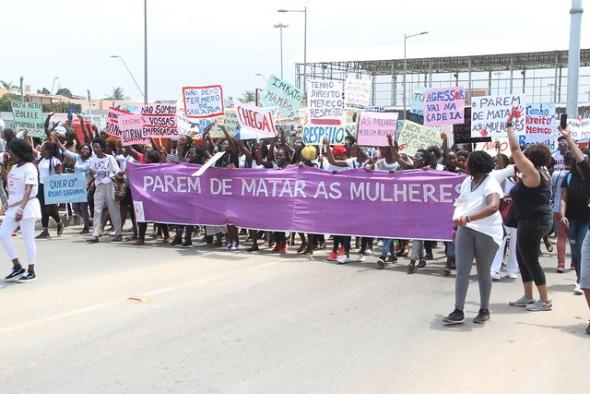 Women’s March in Luanda
The Ondjango Feminista tries to establish this connection between the problems we face today as women, and the inequality of gender that shapes our society - the way men and women are perceived and how public spaces are created, still intended for men.
Public space is generally understood as a men’s space, while for women it continues to be the domestic space.
Many women who are on these places, to assert themselves, also have to deal with gender dynamics that happen in the space, where they are not seen as equals, and are subjected to sexual assault and other forms of violence.
That is why I believe that thinking that simply putting more women in positions of power will solve the problem of violence is an illusion.
Thinking of solutions, I believe that the extension of spaces with citizen participation is essential.
Ondjango tries to create safe spaces where women can discuss their questions, but also to be educated about citizenship, so they can establish a relation between their social condition and comprehend that the lack of water is a political matter, that the lack of public hospital is a political matter, and thus take action to find solutions.
And it is also essential to educate men about gender issues. We still have a lot of work to do in that regard.
Intervention in the context of the seminar “Como se Constrói um País: Diálogos Interdisciplinares”, 22 a 25 May de 2025, organization BUALA.


