The King Who Crossed Backwards
For eight centuries before the first Portuguese ship anchored off Lagos in 1444 and unloaded its human cargo onto European soil, a different trade was already running.
When Portugal opened the Atlantic routes, it did not invent African extraction. It stepped into a machinery that had already been running for centuries and simply gave it a new geography, a second horizon.
The caravans had already long been crossing the Sahara with their cargo of salt, gold, ivory, and human beings; the Trans-Saharan slave trade had been carrying Africans northward across the desert since the seventh century, into the Arab world, into Persia, into India, into the courts of medieval Islam.
Portugal did not begin the taking. It widened the road. The desert and the ocean became parallel corridors of the same long project. The Trans-Saharan slave trade would run for twelve centuries in total. It trafficked an estimated ten million people, and yet it is barely spoken of. In the West, it barely exists as a cultural fact at all.
When the schoolbooks finally came to name what Portugal had done, they called it the Age of Discovery, but at least it was written down. However softened the language, however polished the story, at least it entered the record. The Atlantic left a paper trail. The desert left faintest imprints in the sand, steadily eroded by desert eddies, haunted though those sands must be by the anguished and bloodied severed from lineages, personhood, life, and very often limbs and genitals.
There is a story the Hausa tell of a prince named Bayajidda who fled Baghdad in disgrace, travelled westward across the great desert, until he arrived in the lands that are now northern Nigeria. There, the tale says, he fought monsters, married a queen, fathered sons, and founded seven kingdoms that would endure for centuries. =
It is a beautiful myth of exile transformed into empire, severance become sacred sovereignty, and displacement redeemed through conquest, a story of a one man’s journey becoming the origin story of an entire civilisation. A man stripped of honour who remakes himself as the ancestor of nations, a single rider crossing sand to found a civilisation.
The Bayajidda legend survived because it is simply a better story - that greatness can emerge from loss, that exile can become foundation, that even the dispossessed can build worlds in lieu of the brutal, obscured history.
It survives in spite of being the opposite of what the real crossings meant for the countless African men who were taken northward through that same desert. Their journeys did not end in founding cities. They ended in courtyards, barracks, mines, kitchens, harems, and silent graves. The crossings were not heroic rides but forced marches: chains biting into ankles as despair settled into hearts, leather water skins passed along in measured drops, as panic rose in parched throats along with bile, the stink of sweat, dust, sickness, and fear pervasive in the caravan air.
Names disappeared first. Then languages. The parallel trades had these in common. The fork came in the often lost rights even to father children who would carry their memory forward. The power and the device of Bayajidda’s story lies in the fact that it restores in legend - lineage, power, continuity, all that the historical crossings systematically, actually removed.
And yet the Bayajidda legend, and others like it, endured because it tells the story humans need myths to tell: that greatness can grow out of loss, that exile can become foundation, that even the dispossessed can build worlds. It offers redemption where history offered erasure.
These stories may also have served a wider stabilising function. The Trans-Atlantic trade created an industrial paper trail; the Trans-Saharan did not.
The business of selling person, and their families were not always and everywhere clandestine, especially once the industry matured.
The ports of Atlantic Slavery trade were theatres of violence, where you could watch ships loading for days, weeks or even months, as ships could not leave half empty, a visibility that gave the violence a kind of permanence. The Atlantic trade was built into port bureaucracies, bills of sale, shipping insurance, customs records, plantation ledgers, abolitionist pamphlets, parliamentary debates, court cases, and later national archives; the desert trade often moved through merchant networks, private households, dispersed routes, and regimes where documentation was less central, less preserved, or less accessible to later historians.
We know that what becomes “history” often tracks what leaves a record, what gets institutionalised, what gets litigated, what gets taught, and contrasts sharply with the decentralised extraction networks of the Saharan trade. The Atlantic system produced large, concentrated descendant populations who became political actors and memory producers (churches, newspapers, abolitionist alliances, civil rights movements, museums, monuments) who could reproduce, form communities, build churches, newspapers, movements - and eventually campaigns loud enough to force the world to remember what had been done. Lineage persisted, numbers accumulated, and memory acquired institutions.
European abolition campaigns created a mighty historical imprint by turning the Atlantic into a moral stage: images of ships, chains, the Middle Passage, parliamentary hearings, missionary narratives. That theatre did not attach to the desert in the same way, and Europe had incentives to centre the story where it could cast itself as eventual “redeemer”. Academic work on abolition and legal histories flags how Eurocentric frames distort what gets remembered and how.
Whereas, the desert systems often produced something structurally different: dispersed capture, caravan transfer, redistribution into households, military units, courts, and cities far from the point of taking. Populations were thinner, more scattered, more dependent on assimilation for survival and belonging, and therefore less able to form large, continuous public communities capable of sustaining collective campaigns of remembrance. The result was not necessarily less suffering, but less visible demographic continuity and fewer mechanisms for organised historical insistence.The desert often produced descendants who needed belonging.
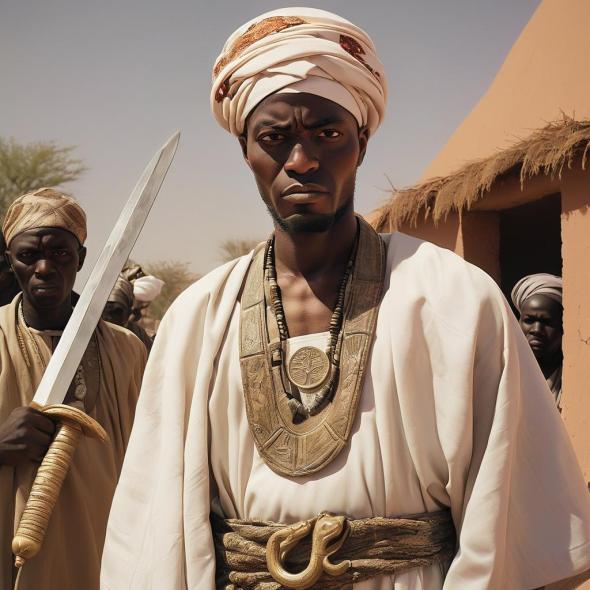 Bayajidda, fundador do império Hausa
Across many North African/Middle Eastern contexts, slavery’s afterlives are more likely to be handled as taboo, private genealogy, quiet assimilation, or denial, making public memory structurally harder to build. Scholars writing on slavery and race in North Africa and the Arab world explicitly describe slavery as a continuing taboo and an under-developed monographic field.
In that landscape, founding myths may become ballast, because they allow a civilisation to narrate the desert crossing as origin rather than disappearance, kingship rather than captivity, lineage rather than loss. Bayajidda’s journey runs in the opposite direction to the probable fate of countless unnamed travellers: the king crosses the desert and founds nations; the others cross and vanish into households, armies, and unrecorded graves. The myth stays loud enough to repeat. The other journeys scatter into grains nearly invisible in the glare of the transatlantic story.
Bayajidda is the myth we were allowed to keep precisely because it obscures the myth we were forced to forget. He is the beautiful lie.
But its deeper power lies in the direction of the journey itself. Bayajidda crosses the desert and becomes more: a stranger who becomes husband, father, founder, ancestor of kingdoms. His crossing produces lineage, sovereignty, continuity. The desert in the story is a corridor toward civilisation.
For countless unnamed Africans taken northward across that same desert, the journey ran the other way. Capture inland. Forced march. Caravan. Redistribution into households, barracks, courts, and cities where names thinned, languages thinned, lineage often thinned. The historical desert crossing did not usually produce founders. It produced disappearances.
In that sense, the Bayajidda story does not conceal the desert routes so much as reverse them. It gives the culture a survivable version of the crossing: exile instead of capture, arrival instead of dispersal, ancestry instead of vanishing. Where the historical system generated silence, the founding myth generates continuity loud enough to live inside. The king crosses and founds nations. The others cross and dissolve into the sand. The myth remains speakable. The vanishings rarely are.
The Transatlantic trade, for all its horrors, generated a guilt economy with usable mythology on both sides: abolitionist hero myths, civil rights movements, the language of reparations. The enslaved and the enslavers both inherited stories. Because communities emerged and persisted, and the trade was predicated on slave propagation. The Trans-Saharan trade offers no such consolation. It indicts the Arab world, implicates African elites as both victims and facilitators, and demands reckonings that no contemporary Muslim-majority state has been willing to make. It left behind no diasporic community strong enough to demand its own remembrance. Where Atlantic slavery created the Gullah Geechee, Afro-Brazilian communities, Haitian Vodou, the ring shout and the negro spiritual, the desert routes produced an unnerving comparative silence. A drumbeat in Morocco that sounds almost like Mandé syncopation. A praise song in Oman that echoes Yoruba cadences. Fragments too dispersed to constitute living tradition. The Congolese historian Elikia M’bokolo called it ten centuries of slavery for the benefit of the Muslim world, noting that it has never produced the reckoning the Atlantic trade at least partially forced.
The Atlantic produced descendants who could demand memory. The Atlantic produced abolition campaigns; the desert produced origin myths.
And so the mythologies required are for those who were left behind. And Bayajidda is the myth that fills the space where its history should be.
According to the legend, Bayajidda arrived in Daura carrying nothing but his sword and his royal bearing. Queen Daurama’s people had been terrorised by a serpent guarding the only well, preventing them from drawing water except on Fridays. Bayajidda slew the serpent, married the queen, and founded the seven kingdoms - Kano, Katsina, Zazzau, Gobir, Rano, Daura, and Biram - that became the federated architecture of one of Africa’s most sophisticated commercial civilisations.
His crown is earned, not inherited. He resolves water access through service. His union with the queen is less conquest than covenant, a fusion of external innovation with indigenous authority. The myth encodes an understanding of migration as civilisational strategy: movement toward Africa, into its centres of wealth and learning, driven by opportunity and exchange. Until the rupture of the slave trade, the flow was often toward Africa, not away from it. This is not an argument against the Bayajidda tradition. It is an argument about what founding myths are asked to carry when the archive is thin, contested, or politically useful.
The power of the tale lies also in its ambiguity. Bayajidda may be Black or Arab, returning exile or foreign prince. He could be a trafficked man who escaped servitude in Iraq and found his way home, or an outsider whose arrival redefined home entirely. In this way the myth compresses the whole arc of the Trans-Saharan slave trade, not just its violence but its inversion. A servant becomes sovereign. An exile becomes a founder. It is a counter-history, a tale that dignifies the very routes that once dehumanised.
And that is precisely why it survived.
The stories Africa lost were those of displacement unredeemed. The Trans-Saharan slave routes carried thousands of Bayajiddas in reverse, and with them thousands of mythologies, genealogies, and cosmologies encoded as story, song, and ritual, designed to survive through narrative transmission. Princes, administrators, military leaders, and royal craftsmen who possessed the complete cultural technologies of kingdom-building were stripped of everything except the knowledge they carried in their bodies.
What disappeared into the desert was not just stolen humans but the intellectual infrastructure of entire civilisations, mythologies in motion. The Yoruba priest who arrived in a Baghdad slave market carried the Ifá operating system encoded in his memory: the binary mathematics of 256 odù, formulas for irrigation, geometry, and justice, a divination system that was essentially time travel, practitioners consulting mathematical patterns written into existence itself. His captors dismissed it as superstition, then borrowed what they needed and called it their own. Obatala’s mythological principles were encrypted so they could survive cultural rupture. Folklore was precisely the point. The knowledge was not hidden in spite of the beauty of the stories. It was hidden inside it.
Unlike the Atlantic trade, which preserved fragments of African cultural memory through community formation, the Trans-Saharan system was designed for complete amnesia. Men were castrated. Lineages severed. Women folded into harems and households. The children were raised to forget, so that not only lives and futures were taken but the very possibility of civilisational recall.
The Zanj, hydraulic engineers forced to drain the salt marshes of Basra using knowledge developed in the wetlands of East Africa, understood exactly what had been taken from them. As Alexandre Popovic documented in the only full scholarly monograph on the subject, their leader Ali b. Muhammad was a poet and a teacher who promised freedom to men who did not even speak his language and needed translators, and thousands followed him anyway. Their fourteen-year rebellion was not just a labour revolt. It was a swampocracy of the dispossessed reclaiming not just freedom but the right to their own expertise. It was eventually crushed, their technical knowledge absorbed and rebranded as Islamic innovation, their uprising erased so thoroughly that most Iraqis today deny their descendants exist at all.
This is the anti-Bayajidda: the king who crossed the desert in chains, building the empires of others with knowledge he had built for himself, dying in foreign service carrying the complete blueprint of the civilisation he would never see again. These men existed in their thousands. The reason why the archive is thinner may be the final instruction of the relative silence in this episode which is that the dscendants of the Atlantic trade persisted and promulgated and they needed stories whilst the people left behind in the trans Saharan trade were the ones in need of containers for their grief, and for the absence. No word came back. If there were myths, they did not come home. Any surviving myths would have arisen at home, and would have been functional for that context. Hence myths that show the harms exclusively in reverse. We kept his story because it allowed us to believe that African greatness could emerge from African loss, when the historical reality was that African greatness was the very thing being systematically harvested and transplanted into other people’s achievements.
History did not survive primarily in books. It survived in breath, drum, divination, and dance. It lived in the folds of folktales, in the names of Orisas carried into exile. But the desert trade was engineered to break even that. Without mythology, the reason for ritual disappears. Without ritual, language follows. What the slavers understood, even if they never articulated it cleanly, was that if you torched the belief you did not need to burn the books. You could simply invent mythlessness and watch a civilisation dissolve from the inside.
In 2024, the President of Portugal said his country must pay the costs of slavery and its colonial crimes. It was a rare thing for a European leader to say. The government dismissed reparations within days. The port of Lagos, where in 1444 the royal chronicler Gomes Eanes de Zurara stood in the square and watched 235 people divided into lots and asked in his official record what heart could be so hard as not to feel pity, (then wrote it up in service of the king who commissioned him), has had a small museum since 2016 that most Portuguese people do not know exists, the precise moment Europe entered the machine, has had a small museum since 2016 that most Portuguese people do not know exists. The national curriculum still organises itself around the Age of Discovery. The president spoke. The schoolbooks did not change. This is what acknowledgement without memory looks like: a beautiful gesture that fills the space where reckoning should be. Bayajidda, updated. The myths lives, only the costume differs.
The desert consumed entire ways of knowing: how to read the stars, call rain, transmute metal, organise just societies. Today, Afro-Iraqis in Basra, Siddis in India, Black communities across North Africa exist in genealogical limbo, severed from the civilisational contexts that could dignify their suffering and explain their presence. They do not appear in the Pan-African imagination because the trade that produced them has been allowed to disappear. Their loss reverberates still, not as history safely concluded but as an open wound in the African descended world that has never been named, let alone dressed.
The serpent Bayajidda slew was guarding the water. We should ask what serpents still guide African wells of history and knowing, and whether we will always need inverted heroes to make the keep the truth bearable, or make an acknowledgement of the harms inevitable.


