The importance and purpose of memory and legacy, within the poems of Conceição Lima.
Conceição Lima exhibits the importance of memory and the legacy left behind after colonialism in her homeland, São Tomé e Príncipe, within her poems, educating readers about the country’s role in the transatlantic slave trade whilst exploring the resulting ideological movements. This is explored through features of Santomean Forro culture, Pan-Africanism (African unity [Emerson, 2009, p.275]), and Négritude (‘conscience of a global blackness’ [Diagne, 2023]), which contribute toward Lima’s exploration of Santomean identity. The purpose of memory is to retrieve experiences in order to never forget them, and Stern argues that memory is ‘the meaning we attach to experience’ (2004, p.105), in which Lima conveys her mixed feelings of bitterness and hope, and the meaning attached to the collective experience of living in a decolonised country. Legacy is presented as something inherited, a carrying of the intangible history and experience between people, leading to the presence of a collective identity. This essay sequentially shows how Lima uses the themes of place, history, identity, and transformation within the poems of ‘Afroinsularidade’ (2004, pp.39-40), ‘Metamorfose’ (2011, p.105), and ‘Viajantes’ (2006) in relation to a global setting from an insular perspective, as the location of São Tomé e Príncipe is also an area of experience. Rich echoes this in her statement that ‘a place on a map is also a place in history’ (Rich, cited in Rothberg, 2014, p.652). Conceição Lima shows that memory and legacy are key to the history and future of São Tomé e Príncipe, as it is how society interprets these as to whether there will be growth and transformation.
Firstly, the island of São Tomé e Príncipe is presented as a place of significant meaning, containing memory and legacy within the themes of home and family. In the free-verse poem ‘Viajantes’ (2006), written in three short stanzas to capture readers’ attention, Lima satirically depicts the arrival of colonialism on the island, in which ‘nossa avó’ greets the ‘viajante’ with a cup of water, settling their ‘sede do horizonte’ (2006). The use of the possessive adjective ‘nossa’ and the familial term ‘avó’ (to signify the Santomean people’s ancestors) suggests that Lima views the island as a community, a familial place where the negative memory of colonialism is recounted, but where the welcoming legacy of the Santomeans is positively remembered. The poem explores familial themes further with the introduction of the ‘avó’s dialogue towards the viajante: ‘-A quem pertences tu? / Quem são os da tua casa?’ (Lima, 2006). The noun ‘casa’ can be interpreted to mean ‘house’ or ‘home’, which is implied to be the island of São Tomé e Príncipe, as the idea of homeland is metaphorically presented as the house in many of Lima’s works (Castaño, 2016). Additionally, Lima conveys the idea of people belonging (‘pertences’) to their ‘casa’, specifically Santomeans belonging to the island as an ancestral community, as a house or home is a space generally shared by family. This in turn reiterates the title of the poem, ‘Viajantes’ (Lima, 2006), highlighting that the colonisers were initially visitors of the island – they did not belong, and arrived unwarranted, bringing enslaved people with them. Conceição Lima’s first book of poetry, O Útero da Casa (2004), contains similar references to the island being a part of the Santomean people, which Urbano Tavares Rodrigues reinforces: ‘Lima escreve-se, em idéia e corpo, na carne viva da ilha’ (cited in Hamilton, 2007, p.196). This implies that the island provides a collective identity for which Lima is the spokesperson through her poetry, and mirrors the work of Bell, who states that places are ‘personed […] even when there is no one there’ (cited in Drozdzewski, De Nardi and Waterton, 2016, p.1). Lima centralises the Santomean people within the idea of the island, highlighting the legacy of her people by reclaiming an identity stolen by colonialism.
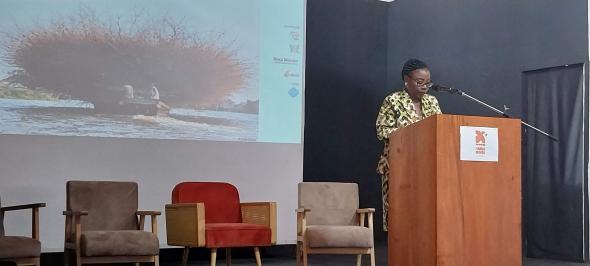 Conceição Deus Lima, Festival Fim do Mundo, Cacau, São Tomé, 2025 foto de Marta Lança
Additionally, the island is conveyed as a place full of memory in the historical recount of ‘Afroinsularidade’ (Lima, 2004, pp.39-40), as Lima explores the legacy of island life shaped by colonialism through Santomean culture. For example, Conceição Lima educates readers and reflects on the African influence on the Forro culture, ‘the Santomean dominant ethno-cultural group’ (Rodrigues, 2018, p.92). This is shown with the use of specific culinary vocabulary like ‘zêtê dóchi’ and ‘calulu’, the inclusion of the traditional pot used (‘ubaga téla’) as well as Santomean dance (‘ússua’) (Afroinsularidade, Lima, 2004, pp.39-40) which exhibits the legacy left behind by those enslaved. This can be characterised as a positive approach to memory, localising ‘memory in culture and, […] understand[ing] remembering as a cultural practice, […] social[ly], collective[ly] or historical[ly] remembering’ (Brockmeier, 2002, p.8, cited in Drozdzewski, De Nardi and Waterton, 2016, p.5). Lima’s focus on culture shows readers the legacy borne from the country’s cultural hybridity and mixed heritage.
However, Lima also implies that Santomean history contains negative memories, shown in the title ‘Afroinsularidade’ (Lima, 2004, pp.39-40), which describes the experiences of people of African descent living on islands, and how their identity is affected by their geographical and historical circumstances. This is projected in the poem as she recounts the island’s role in the transatlantic slave trade, history of slavery and colonialism, and the collective identity formed within Forro culture. In the third and final stanzas of ‘Afroinsularidade’, Lima states that ‘toda a ilha era um porto e uma estrada sem regresso’ (2004, pp.39-40), and calls it a ‘fragmento de África’ (2004, pp.39-40), implying a country isolated from the African continent. The poem’s historical contextualisation and the legacy left behind by Portuguese colonisers is shown in Lima’s descriptive use of the imperfect past tense and the acknowledgement of São Tomé e Príncipe’s past of being a port used in the trafficking of the enslaved (Vogt, 1973). This links to the memory of the country being a place of continued oppression of African peoples with the colonial prolongation of the ‘quasi-slave trade’ (Clarence-Smith, 1990, p.153), despite the abolition of slavery in 1875 (Clarence-Smith, 1990). A collective uncertainty is presented by the phrase ‘uma estrada sem regresso’ and ‘toda a ilha’, (‘Afroinsularidade’, Lima, 2004, pp.39-40) which reflects the disorientation and loss of identity after the country’s independence, a mix of what came before (memory) and how this changes what comes after (legacy). Alternatively, ‘insularidade’ can be seen positively, through the coalescing of ancestors from Portuguese speaking Africa, creating a culture of hybridity. As suggested by hooks, ‘marginality [is] much more than a site of deprivation […] it is also the site of radical possibility, a space of resistance’ (1989, p.20). Therefore, ‘Afroinsularidade’ (Lima, 2004, pp.39-40) suggests the development of a new landscape, one that remembers the past but prevents it happening again.
Moreover, Conceição Lima shows how the history of colonialism is linked to memory and legacy, and encourages societal change in the form of global recognition. The noun ‘naufrágio’ is used as a metaphor for the brutality of slavery and the island’s colonial history, as shipwrecks contain an element of destruction – they can only be created if what they once were (a boat) is destroyed, which can be applied to the colonisation of African civilisations. For example, in ‘Metamorfose’ (2011, p.105), Lima describes adapting to decolonisation, and states: ‘hoje as palavras nada dizem de naufrágios’, which echoes Stern’s idea of memory as a closed box being ‘a certain ‘will to forget’, a social agreement that some remembrances were so explosive […] that little could be gained from a public opening and airing of the contents inside’ (2004, p.89). This suggests that society, including Santomean society, voluntarily forgets or disregards colonial history, as it is too difficult to address, which Lima criticises by raising the issue at the start of the poem. This juxtaposes the positive idea of change and transformation in the rest of ‘Metamorfose’ (Lima, 2011, p.105), but reflects the last line of ‘Afroinsularidade’: ‘um verbo amanhece alto/ como uma dolorosa bandeira’ (Lima, 2004, pp.39-40), highlighting the painful history that São Tomé e Príncipe holds. The use of ‘verbo’ instead of ‘palavra’ suggests progressive action, in that Lima accepts that Santomean society is attempting to address its history, with the ‘bandeira’ being São Tomé e Príncipe’s patriotic struggle to obtain the rest of the world’s notice of its colonial past.
Furthermore, Lima condemns the Portuguese colonisers by conveying a bitter tone in ‘Afroinsularidade’ (Lima, 2004, pp.39-40) when describing the legacy they left behind in São Tomé e Príncipe. For example, a ‘legado’ of ‘tétricas plantações’ and ‘nomes sonoros aristocráticos’ (Lima, 2004, pp.39-40) are statements filled with vitriolic irony, which is further expressed through the alliteration of ‘amarguras atrozes’ (Lima, 2004, pp.39-40), resulting in a cutting assonance when describing what the colonisers brought with them. This is followed by the capitalisation of the nouns ‘Norte’ and ‘Sul’, a purposeful allusion to the terms Global North and Global South, in which Global South ‘denote[s] regions outside Europe and North America, mostly […] low-income and often politically or culturally marginalised’ (Dados and Connell, 2012, p.12). The Global South is stereotypically the colonised, whereas the Global North consists of the former colonial powers. Lima demonstrates her dislike for these colonial powers by stating ‘ficaram/ incisivas – arrogantes estátuas nas esquinas’ (2004, pp.39-40), which criticises the entitlement of using another country for resources and disrupting civilisations, exaggerated with the use of caesura which points to the establishment of ‘arrogantes estátuas’ (2004, pp.39-40). This can be compared to the idea of placing memory in public, where objects in public places (like statues) can hold memories, and as stated by Drozdzewski, De Nardi, and Waterton: ‘these memoryscapes remind us that crimes utterly gruesome in nature occurred in mundane places’ (2016, p.10), which ‘can trigger real pain’ (Byrne, 2009, p.235, cited in Drozdzewski, De Nardi, and Waterton, 2016, p.10). One can draw parallels with the ‘estátuas’ erected by the colonisers, as they serve as painful memories of the country’s history of colonialism.
Additionally, Conceição Lima presents an outlook of transformation after the decolonisation of São Tomé e Príncipe. This is shown in ‘Metamorfose’ (Lima, 2011, p.105), where both the title and the last line (‘de uma exacta metamorfose somos testemunhas’) (Lima, 2011, p.105) suggest a reflection of the history and the legacy of the country, in which hope for the future is personified as a ‘fantasma’ (Lima, 2011, p.105). This relates to Bell’s work on memories as ghosts of place, where ‘ghosts are, […] ubiquitous in the places in which we live, and they give a life to those places’ (1997, p.814), and ‘are not only ghosts of the past; they can as well be of the present, and even the future.’ (1997, p.816). This signifies that memories can exist in all areas of life, and as Lima reminds readers, memories (especially painful ones) are not easily forgotten. Written in the present tense to indicate forward-thinking, this poem contrasts with ‘Afroinsularidade’ (Lima, 2004, pp.39-40), which is written in the preterit past tense, as it concerns completed actions in the past, signifying a buried history. This abruptly changes in the last stanza to the present tense, signifying a switch in focus from memories of the past to legacy of the future. Furthermore, ‘Viajantes’ (Lima, 2006) was written in the imperfect tense to demonstrate that the arrival of travellers to São Tomé e Príncipe was not a single event, nor was it unique to the island - it has happened throughout history, to many peoples and to many countries. In ‘Metamorfose’ (Lima, 2011, p.105), ideas of transformation and growth are conveyed through the imagery of a flower with ‘pétalas’, which symbolises the freedom of São Tomé e Príncipe. The flower indicates a carnation, referring to the Carnation Revolution of 1974, in which the country gained independence shortly afterward in 1975 (Seibert, 2016, p.987). Lima shows that throughout this history of colonisation comes the legacy and creation of movements such as Négritude, which is described as ‘a psychological response to the social and cultural conditions of the ‘colonial situation’ [and…] a fervent quest for a new and original orientation’ (Irele, 1965, p.499). This implies the development of a collective identity that has moved on from its past, indicating the solidarity of Pan-Africanism within the diaspora of people of African descent.
In conclusion, Conceição Lima explores the challenges of being part of a nation with a history of conflict and slavery, showing readers her resentment towards the collective memory of colonial power, whilst also exhibiting hope for a legacy and future that celebrates the culture that has stemmed from this. Lima shows that only through societal remembering and global recognition can colonial memory be untangled from the legacy of São Tomé e Príncipe.
Bibliography:
Bell, M.M. 1997. The Ghosts of Place. Theory ad Society. [Online]. 26(6), pp.813-836. [Accessed 27 May 2026]. Available from: https://www.jstor.org/stable/657936?sid=primo&seq=4
Castaño, J.2016. The Island in Conceição Lima’s Poetry. Journal of Lusophone Studies. [Online]. 1(1), pp.25-36. [Accessed 27 May 2026]. Available from: https://doi.org/10.21471/jls.v1i1.34
Clarence-Smith, W.G. 1990. The Hidden Costs of Labour on the Cocoa Plantations of São Tomé and Príncipe, 1875-1914. Portuguese Studies. [Online]. 6, pp.152-172. [Accessed 6 June 2026]. Available from: https://www.jstor.org/stable/41104911
Dados, N. and Connell, R. 2012. The Global South. Contexts. [Online]. 11(1), pp.12-13. [Accessed 27 May 2026]. Available from: https://doi.org/10.1177/1536504212436479
Diagne, S.B. 2023. The Stanford Encyclopedia of Philosophy. [Online]. [Accessed 6 June 2026]. Available from: https://plato.stanford.edu/entries/Negritude/#GenCon
Drozdzewski, D., De Nardi, S. and Waterton, E. 2016. Memory, Place and Identity: Commemoration and remembrance of war and conflict. [Online]. Oxon: Routledge. [Accessed 27 May 2026]. Available from: https://ereader.perlego.com/1/book/1635129/0
Emerson, R. 1962. Pan-Africanism. International organisation. [Online]. 16(2), pp.275-290. [Accessed 27 May 2026]. Available from: https://www.cambridge.org/core/journals/international-organization/article/panafricanism/3872EBD07464A460CC4FD665408D9243
Hamilton, R.G. 2007. Conceição Lima, Poet of São Tomé e Príncipe. Research in African literatures. [Online]. 38(1), pp.194-198. [Accessed 27 May 2026]. Available from: https://go.gale.com/ps/i.do?id=GALE%7CA162921742&v=2.1&it=r&sid=summon&u=leedsuni&p=LitRC&aty=shibboleth
hooks, b. 1989. Choosing the margin as a space of radical openness. Framework. [Online]. 0(36), pp.15-23. [Accessed 27 may 2026]. Available from: https://www.proquest.com/docview/1311777309/fulltextPDF/BF6C58E4D2004AFCPQ/1?accountid=14664&sourcetype=Scholarly%20Journals
Irele, A. 1965. Negritude - Literature and Ideology. The Journal of Modern African Studies. [Online]. 3(4), pp.499-526. [Accessed 27 May 2026]. Available from: https://www.cambridge.org/core/journals/journal-of-modern-african-studies/article/negritudeliterature-and-ideology/EB48287C8A9AF58D3B75091D324748CD
Lima, C. 2004. O Útero da Casa. Portugual: Editorial Caminho.
Lima, C. 2011. O País de Akendenguê. Portugal: Editorial Caminho.
Rodrigues, I.N. 2018. How to Draw a Haunted Nation: Colonial Ghosts and Spectres in Conceição Lima’s Poems. In: Jensen, L., Suárez-Krabbe, J., Groes, C. and Pecic, Z.L. eds. Postcolonial Europe: Comparative Reflections after the Empires. [Online]. London: Rowman & Littlefield International, pp.91-100. [Accessed 27 May 2026]. Available from: https://ereader.perlego.com/1/book/573722/11?page_number=91
Rothberg, M. 2014. Locating Transnational Memory. European Review. [Online]. 22(4), pp.652-656. [Accessed 27 May 2026]. Available from: https://www.cambridge.org/core/journals/european-review/article/locating-transnational-memory/D2FE6E1CCA6CDED37F831B50F2D69461
Scottish Poetry Library. 2026. Viajantes by Conceicao Lima. [Online]. [Accessed 27 May 2026]. Available from: https://www.scottishpoetrylibrary.org.uk/poem/viajantes/
Seibert, G. 2016. São Tomé and Príncipe 1975-2015: politics and economy in a former plantation colony. Estudos ibero-americanos. [Online]. 42(3), pp.987-1012. [Accessed 27 May 2026]. Available from: https://www.redalyc.org/pdf/1346/134648568009.pdf
Stern, S.J. 2004. Remembering Pinochet’s Chile : On the Eve of London 1998. [Online]. London: Duke University Press. [Accessed 27 May 2026]. Available from: https://ebookcentral.proquest.com/lib/leeds/detail.action?docID=1168051#
Vogt, J.L. 1973. The Early Sao Tome-Principe Slave Trade with Mina, 1500-1540. The International Journal of African Historical Studies. [Online]. 6(3), pp.453-467. [Accessed 27 May 2026]. Available from: https://doi.org/10.2307/216611


