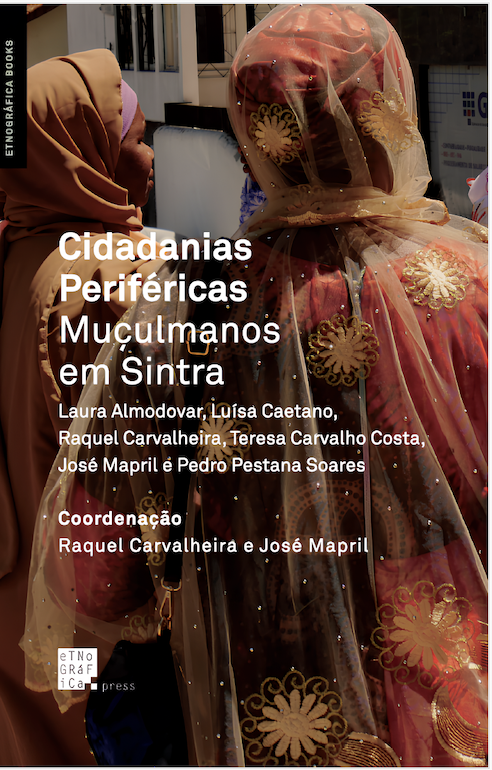
Peripheral Citizenships, Muslims in Sintra
Coordinated by Raquel Carvalheira and José MaprilAutoria: Laura Almodovar, Luísa Caetano, Raquel Carvalheira, Teresa Carvalho Costa, José Mapril and Pedro Pestana Soares
Link for the book (Portuguese)
INTRODUCTION
This book arises from an investigation requested by the City Council of Sintra to the Centre for Research in Anthropology, with the purpose to understand and analyze the social integration of Muslim people in the municipality of Sintra. It is, maybe, one of the first ethnographic works done by a team of anthropologists about social integration of Muslim population in Portugal, filling a widespread gap in knowledge about Islam and their multiple expressions on national territory.
The presence of Muslims in Sintra is a relatively recent phenomenon. However, this is an area of the country where Muslims have established institutions, synergies and partnerships that show their full integration on Portuguese society, and simultaneously, their involvement in diverse forms of citizenship that often emerge from peripheral areas. The Muslim population in the city, mostly of Guinean origin, have been transforming their peripheries - spatial, social, symbolic - in places of solidarity who face various vulnerabilities (job insecurity and housing instability) and forms of discrimination (including both Islamophobia and racism).
If Muslim populations of Guinean origin constitute the main subjects of this investigation, this study has shown that the city of Sintra has housed, more and more, Muslim people from countries like Bangladesh and Pakistan, which are reshaping religious practices and transforming the landscape of Islam in the municipality. Though all of them have common aspects: they are often migrants or descendants of migrants, they occupy the lowest-paying and most precarious jobs in Portuguese society, have low levels of education or qualifications that are not recognized nationally, they are racialized populations living in peripheral areas (with poor social equipment and public investments), and they are frequently the target of prejudice regarding their religious beliefs and affiliations, which stirs up fears and reinforces their sense of otherness.
It was in this general context that we looked at the integration of Muslims in Sintra. This study understands inclusion as a process of adaptation both of migrants and non-migrants within the societies in which they live. Simultaneously, integration also includes municipal and government efforts and actions (in collaboration with third-sector organizations) to guarantee the inclusion of migrant populations, especially when they are originally from contexts of bigger social and economic vulnerability, places that are also on the periphery of the global economy. The lack of social policies on the part of governments has adverse effects on integration, and can reinforce the vulnerability of migrant people. This vulnerability is often emphasized by the intersection of multiple discriminations they experience in their daily lives. In this case, the religious identity, racialization, and socioeconomic inequality have implications that affect the lives of Muslims, thereby contributing to their marginal — and precarious — position in Portuguese society. Still, and we will see, it is through these peripheries that they develop initiatives with the intention to reclaim a right to the city and to be acknowledged as citizens with full rights.
Throughout this book we use the concept of integration to develop various areas of analyses, such as: (i) migration paths; (ii) the manner in which institutions (associations, local administrations, school systems) take into account and act with a view to the integration of these populations and the arguments they put forward; (iii) the intersectional ways of discrimination and their impact on the lives of our interlocutors; and (iv) the way Muslim populations understand what is necessary for their integration, and what are their aspirations, expectations, difficulties, strategies and desires.
Many of the challenges of integration that we find and which our interlocutors have to deal with are not unique to the Muslim population, but rather cut across the peripheral areas of Portuguese and European urban centers, where people face job insecurity and housing instability, as well as various forms of marginalization and social exclusion. Also in Sintra, these questions were identified between the migrant population and their descendants (Gaspar Iorio 2023).
This study examined the socioeconomic factors linked to access to employment and housing, as it considers these to be central to integration. However, gender issues are equally considered, since there is an overlap between precarious employment and housing conditions, and domestic and family care responsibilities, which causes bigger inequalities for women and lead to their invisibility on civil and collective projects. On the other hand, the hypervisibility of Muslim women that use hijab in workspace, public transport or, more generally, in the public sphere, contributes to the stigmatisation. Islamophobia as a form of anti-Muslim racism (Sayyid e Vakil 2010; Rana 2011; Meer 2013), was also one of the factors analysed.
This study focused on an ethnographic approach and selected two areas from which to examine peripheral citizenship: Tapada das Mercês and Cacém. These areas grew up along the train line, as part of a process of suburbanization of the Metropolitan Area of Lisbon, and we can call them suburbs. Tapada das Mercês and Cacém, with their specifications, are suburbs in relation to the town of Sintra (the municipal headquarter) and the city of Lisbon (capital of the country and workplace of many of Sintra inhabitants). They were chosen because that’s where Islamism associations emerged, which is not only an indicator of Muslim presence, but also their collective mobilization.
The selection of those places allowed to take a comparative analysis for this two areas, identifying, for one side, problems, solutions and socioeconomic characteristics transversal to the Muslim population, and for the other side, the particularities of each of these realities, in which depend, in some extent, on their locations within the peri-urban network of the municipality of Sintra. The existence of two pioneers institutions on the municipality, the Associação da Comunidade Islâmica da Tapada das Mercês e Mem Martins (ACITMMM), since 2007, and the Associação Islâmica de Sintra (AIS), on Cacém since 2005, is associated to the creation of mosques that, as mentioned earlier, are mainly attended by populations native to Guinea-Bissau and other West African countries.
The religious experience of Muslims men and women transcends the entire book, but it does not serve as the central explanatory focus. It is not intended to emphasize the exceptionality of Islam in comparison to other religions, nor even to suggest that it gives rise to radically different ways of life that might hinder its integration. However, this religious experience shows how being Muslim involves challenges that arise from misinformation and fear among the non-Muslim population.
The media coverage of Islamism in Portugal, Europe and the world has as consequence the construction of Muslims as radical otherness - associated to many moral panics (Cohen 2002) - that is often based on the supposed incompatibility between Islamic values and the secular values of European societies. For this reason, we conducted a discursive analysis of news from local and national media that focused on Muslim populations from Tapada das Mercês and Cacém.
In this study, it was verified that Islamic associations are spaces for the construction of a plural citizenry. Religion is lived out in practice, but is also important for the construction of lives in collective. The Islamic associations and mosques interact with various institutional actors, organize activities, create problems and find solutions, often using principles of Islamic religious ethics that are unknown by the majority of non-Muslims. If it is true that the Muslim population have specific ways of living and religious habits, it is also true that they expect things very similar to those of other non-Muslim populations, such as giving better life conditions for their children and young people, a better quality of life, independence, and security.
For this reason, the issues with discrimination are important; just as are the answers given to them by community leaders and religious figures. These answers create solidarities that go beyond their Islamic affiliation, while at the same time viewing Islam as a driving force for citizenship. The title of this book, Cidadanias Periféricas (Peripheral Citizenry), therefore aims to explore the vulnerabilities and hardships faced by Muslim men and women in Sintra, while also showing how they use these experiences to find ways to improve their lives and integrate into the community where they live. These peripheries are places of instability of life, but also new hubs which redefine solidarity and solutions to deal with the uncertain.
As we see, this investigation equally considers the perceptions of schools and teachers about Muslim students. Schools are the ideal setting for assessing how well the state and local governments manage cultural and religious diversity. They are situated in specific contexts, sometimes in socially deprived areas, and no matter how hard teachers try to make them inclusive places, they face countless barriers and difficulties (starting with a lack of human and financial resources). The two discussed schools on a bigger scale for this study, the Escola Básica Visconde de Juromenha (on Tapada das Mercês) and Escola Secundária Ferreira Dias (Cacém), have slightly different interactions with the surrounding reality, which influences their understanding of the reality of their Muslim students and religious practices.
The ethnographic character of this book also reveals that anthropology is a suitable and necessary discipline to discuss citizenry on the suburbs of contemporary cities. By prioritizing an approach centered on people’s experiences, it presents itself as a humanising discipline that seeks to capture the nuances of everyday life, beyond the statistical cut-outs and social determinisms. Of course, there are structures, tendencies and politics that go beyond people’s will and that must be analysed (consider the processes of racialisation and precarisation), but a closer look at their strategies, dreams and aspirations allows us to understand the choices available to them within socially defined boundaries, highlighting their strengths and weaknesses. For this reason, this study takes specific localities in order to gain an understanding of the situation of Muslims in Sintra and does not claim to represent the Muslim population as a whole.