Latin America is not a pawn without its will
Amidst all the stances, opinions and even political passions, there is a line that must be held firm when the world seems to be collapsing into contradictions: being against a dictatorship does not, under any circumstances, justify applauding barbarism disguised as liberation.
The fact that Nicolás Maduro heads an authoritarian regime, responsible for serious human rights violations, does not make it acceptable, nor legal, to bomb a sovereign country, carry out a foreign military invasion or have a head of state abducted by a foreign power.
What has happened in Venezuela goes beyond the realm of internal political dispute and enters, quite explicitly, the territory of raw imperialism, undisguised, shameless and without any real commitment to democracy.
Donald Trump’s speech, in which he announced that the United States would “govern” Venezuela and take control of its oil, laid bare what Latin America has known ever since it was invaded by the Europeans: it has always been about resources, trade and profit. It has never been about freedom, it has never been about human rights, it has never been about democracy.
In his speech following the abduction of Maduro and his wife, Trump merely stripped away the diplomatic veneer from an age-old logic, which continues to operate with the same colonial ease as it has for over half a millennium.
From the perspective of international law, the action is indefensible. The United Nations Charter, in Article 2, sections 1 and 4, establishes the sovereign equality of States and prohibits the use of force or the threat of force against the territorial integrity or political independence of any country. There is no authorisation from the UN Security Council, there is no situation of self-defence under Article 51, and there is not even a remotely credible attempt to frame the operation within any framework of international law. It is, therefore, an act of illegal aggression.
Under US law, too, the incident is serious. The US Constitution reserves the power to declare war to Congress. The president cannot, unilaterally, launch a large-scale military action against another country. It was precisely this point that Bernie Sanders, senior senator for the state of Vermont, highlighted in his speech following the attacks and the capture of Maduro, stating that Trump had, once again, shown contempt for the Constitution and the rule of law. Sanders stated the obvious when he said that the United States has no right to govern Venezuela and that the operation constitutes a flagrant violation of international law, setting a dangerous precedent.
After all, if one power can attack another country to capture its leader and seize its resources, any nation in the world might feel entitled to do the same.
Under Venezuelan law, the situation is equally clear. The Venezuelan Constitution unequivocally affirms national sovereignty, the self-determination of peoples and the inviolability of the territory. No foreign government has the legitimacy to intervene militarily or to decide who governs the country, regardless of the nature of the current regime. The struggle against a dictatorship is a right of the people, not a licence for foreign occupation.
Another element, one might say, revealing the true nature of the operation is the deliberate exclusion of María Corina Machado from any political scenario envisaged by Donald Trump. Despite being Maduro’s best-known opponent, a 2025 Nobel Peace Prize laureate (despite questions surrounding this) and a public supporter of the US president, Machado was explicitly ruled out. Trump stated that she “lacks the respect necessary to govern Venezuela”, said he had not been in contact with the opposition leader and, although he described her as “likeable”, assessed that she would be unable to govern because, according to him, she does not have sufficient support from the population.
It is impossible to analyse this episode without mentioning the Monroe Doctrine. Proclaimed in the 19th century under the slogan “America for Americans”, it has always meant, in practice, “America for the interests of the United States”. The explicit revival of this doctrine, mentioned by Sanders itself when criticizing Trump, does not affect only Venezuela. It reopens the door to interventions in any country in the Americas, whenever economic, strategic, or political interests so require. Today it is Caracas, tomorrow it could be any Latin American capital. By all indications, Colombia is next on the list, but Brazil is not far behind.
Venezuela is an Amazonian country. For the region, which is intensely debating oil exploration at the mouth of the Amazon River, watching a foreign power declare, without embarrassment, that it intends to seize the oil reserves of an Amazonian country through military force should sound like a continental alarm. This is not just about Venezuela, but about the precedent being set regarding who decides the fate of the Amazon and its resources.
It must be clearly stated that national sovereignty is neither a right-wing nor a left-wing issue. It is a basic principle of international law and of coexistence among nations. Defending sovereignty does not mean defending Maduro. Just as celebrating the fall of a dictator—which is a legitimate sentiment among Venezuelans—does not justify a foreign invasion. The joy of ridding oneself of an oppressive regime is human and understandable;
This issue should be particularly sensitive in Brazil. A country whose recent history includes a U.S.-backed military dictatorship, whose past and present demonstrate how foreign interventions do not bring democracy. Yet, a segment of the Brazilian population, caught up in toxic polarization, took to the streets following Jair Bolsonaro’s electoral defeat to call for military intervention, including foreign intervention. There were those who openly called for U.S. intervention, who raised a giant American flag right in the middle of September 7th on Paulista Avenue, as if sovereignty were a disposable detail. Eduardo Bolsonaro’s criminal efforts to secure foreign support in order to prevent his own father’s arrest are part of this same colonial mindset, which normalizes foreign tutelage when it suits them.
None of this is new. Gabriel García Márquez, upon receiving the Nobel Prize in Literature in 1982, already denounced, in “The Solitude of Latin America,” the world’s inability to understand our history outside the frameworks of domination. He reminded us that the violence, instability, and suffering of the continent are not the result of an intrinsic inability to govern ourselves, but of centuries of plunder, interventions, and external impositions. Latin America, Gabo said, does not want to be a pawn without a will, nor does it accept that others decide its destiny in the name of supposed civilizing virtues.
What is at stake now is the right of peoples to determine their own paths, including the right to make mistakes, correct them, and transform their political systems without a foreign boot on their necks. By saying he will govern Venezuela and control its oil, Trump has not only exposed the imperial nature of the operation but also confirmed that, for certain sectors of global power, democracy has never been anything more than a convenient talking point.
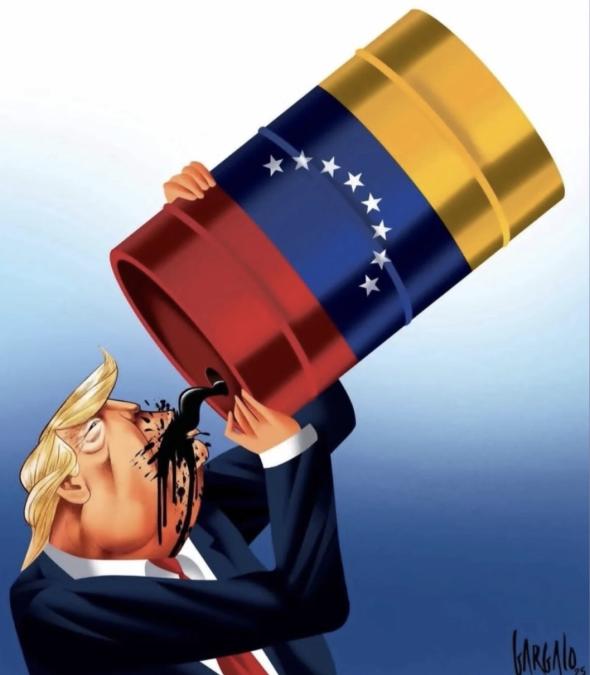 Bordalo
Condemning Maduro and condemning the invasion are not contradictory positions. On the contrary: they are two sides of the same radical defense of human dignity and the sovereignty of peoples. The real danger begins when hatred for a regime blinds us to the point of accepting any atrocity committed in its name. Latin American history has already shown, all too often, where that leads.


