From Student Airlifts to Slave Exports: Kenya’s Economic Decay
On the afternoon of Tuesday, 6 September 2022, at exactly 1:40 p.m., a crowd gathered outside Terminal 1A at the Jomo Kenyatta International Airport (JKIA). Under ordinary circumstances, one would assume that they were here to welcome back an athlete who’d just won a medal at the Olympics, garlands and a calabash of mursik in hand.
However, that wasn’t the case. This time, the crowd was gathered to welcome back someone who’d left her home in the Rift Valley for a very different reason.
It all started with a tweet posted by a user called Ted. In the tweet, he shared four photos of an emaciated woman, mentioning that the person in the photos is a relative of his who had gone to Saudi Arabia to work as a “house manager” one and a half years earlier. The work conditions there turned out to be terrible, her employer abusive, and so she was seeking a way to come back to Kenya. The agency that had sent her to Saudi Arabia wasn’t helpful (they said that their “hands were tied”), so intervention in the matter was needed.
For the next few days, Kenyans aggressively called out the Ministry of Foreign Affairs, the Kenyan Embassy in Riyadh, the Government Spokesperson, and everyone else within reach. The message was simple: #BringDianaHome. It now became the government’s responsibility to intervene and lobby for her release through government channels. On the third day photos emerged of Diana; she had been released by her employers and admitted to hospital. On the sixth day of the month, she was flown into the country.
Outside Terminal 1A, the atmosphere was tense and the air thin; thin enough it could crack if someone breathed too hard. In that silence a whole village had come to receive their daughter – Diana Chepkemoi. When she appeared, everyone broke into song as they rushed to embrace her (she said that she received more hugs that day than she’d ever received in her life).
In her interview with the press, Diana said:
“I left Kenya and went to Saudi Arabia with the hope that I could get a better life. Lakini watu wanateseka huko nje. People are suffering, and I’m pleading [with] the government to kindly do something. People are being tortured physically, mentally and psychologically, and it’s a shame being told that there’s nothing your government can do about it.”
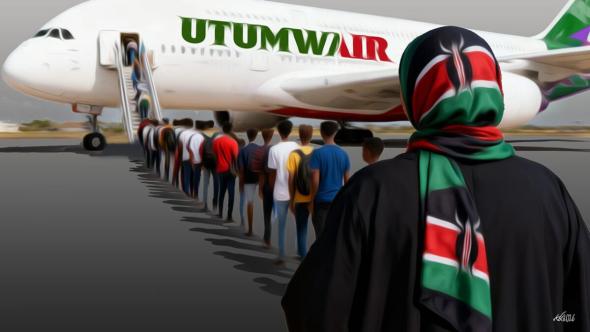
What was ironical was that, at exactly the same time as she was making these remarks, another group of young women were walking (behind her) into Terminal 1A, leaving for Saudi Arabia in search of jobs – the same jobs that Diana was advocating against.
One might wonder why these young women would willingly go to the Gulf after all the revelations about the toxic work environment when Kenyans were urging the government to intervene and rescue Diana from her brutal employer. Wouldn’t the rational option have been to remain and try (just a little bit more) to make a living in Kenya?
It is while thinking about this that I remembered Warsan Shire’s poem Home: “No one leaves home, unless home is the mouth of a shark.” Diana’s story exemplifies this best, offering us the perspective that we lack.
A student at Meru University, Diana was struggling to pay her fees. She had needed KSh33,000 to pay for her first semester but when all attempts to secure financial aid failed, she resorted to doing menial jobs, starting out as a mama fua doing people’s laundry, or looking after people’s kids and tutoring them.
When Diana went into second year, jobs became hard to come by, and one evening, her mother told her that she couldn’t afford to support her while simultaneously taking her siblings through high school. Diana had to defer her studies. She had hit rock-bottom and at times would think of heading over to the Kericho-Litein highway and standing in front of oncoming traffic.
Diana’s story brings to mind Marmeladov’s observation to Raskolnikov in Fyodor Dostoyevsky’s Crime and Punishment:
“Poverty is not a vice, that’s a true saying. Yet I know too, that alcoholism is not a virtue, and that’s even truer. But destitution, dear sir, destitution is a vice. In poverty you may retain the innate nobility of your soul, but in destitution, never, no one. For in destitution, a man is not chased out of human society with a stick, but he is swept out with a broom, so as to make it as humiliating as possible; and quite right, too, for in destitution I am the first to humiliate myself.”
This is a predicament faced by many Kenyan youth. Having been raised on the aphorism that “education is the key”, what happens if you get to the building and find that the doors have a “face unlock” system instead? What do you do with your education?
Most people have had to put away their certificates. After unsuccessfully trying to secure a job, most young people have realized that they have to turn to blue-collar jobs (lately, the government has even been urging younger people to join TVETs instead of universities).
Some have attributed the problem to “elite overproduction”, blaming students for pursuing “elite” courses. Granted, at least 91,000 students graduate every year from colleges and universities and join the job market. The economy, unfortunately, hasn’t been expanding proportionately in order to accommodate all these new entrants into the market. The advice from the employed folks is for the rest of us to “create our own employment” instead of waiting to be employed. In a country with onerous regulations and bureaucratic hurdles for anyone trying to start their own business, I wonder how this advice would be useful to a broke graduate.
Noticing the trend, and the desperation among the youth, many labour agencies are now on the lookout to recruit workers to take to Gulf countries. It doesn’t help that our own Ministry of Labour has also been converted into an agency, with every one of its public announcements being a list of blue-collar jobs available in foreign countries.
It is tragic that a government that was once so invested in the education of the country’s youth that politicians of every stripe competed with each other to see who would send the most students for further studies abroad (the Western airlifts under Tom Mboya and Gikonyo Kiano vs the Eastern airlifts under Oginga Odinga and Argwings Kodhek) is now sending its young people abroad as slaves. If anything, this is a very apt representation of the decline of the country’s economy over the six decades since independence.
Before the implementation of the first structural adjustment programmes in the ’80s and ’90s, the government was a big employer, almost at par with the private sector, providing at least 43 per cent of total employment compared to the private sector’s 57 per cent. By 2000, the government had cut down on employment, retrenching 25,000 civil servants under the direction of President Moi’s “Dream Team”. The civil service now accounts for just 30 per cent of total employment.
Now, with the further liberalization and forced austerity, the government is looking to trim down the civil service even further, claiming that the wage bill is too high yet the civil service is quite understaffed (think about all the schools that don’t have enough teachers, or all the clinics that don’t have enough doctors and nurses).
Where, then, shall all the university graduates go? Where shall all the teachers and doctors work? Is there really any place for them here? Or shall they all move abroad?
It is this desperation that caused Diana to go ahead and sign that contract. Like Diana, most of the youth have been cornered by poverty, and so, such opportunities seem to them like the only way out. Poverty debunks the notion of choice.
However, working in those countries isn’t the rosy opportunity advertised. Diana narrated how her passport was taken away by her employer on the first day so that she couldn’t leave. She talked about how she was denied food. She talked about how her health deteriorated. She talked about the recurring nightmare of being sent back home in a coffin. There’s a lot of suffering out there. But is home really any better? As the four Samarian Lepers in 2 Kings 7:3-20 said, “If we stay here, we shall definitely die of hunger. But if we go to the Syrian soldiers to beg for food, we might either be killed or we might get to live.”
Young people are leaving the country. They’re going to the Middle East to work as truck drivers. Or as supermarket cashiers. Or as security guards. Or as petrol station attendants. Or whatever other occupation that presents itself.
It’s quite unfortunate that we’re losing those who bear the future of our nation. What does it mean for the future of this country if there is no place in it for our youth? Have we auctioned our future to the highest bidder? And is there a share of the national cake left for the youth who’ve remained behind? Or should the rest of us leave as well? And what does it mean if our government spends billions to provide and subsidize education, all so that the educated youth leave the country and go out to provide labour for other countries? Why are we okay with spending money to educate our youth just to give them away?
As Peter Edochie said, “Let the young man in his desperation go out and hunt. If he kills the elephant, his poverty ends. If the elephant kills him, his poverty ends.” Either way, something has to be done about poverty. And the fastest way out, it seems, is to accept to become slaves in foreign lands.
Article originally published in The elephant info.


