Between journalism and public love: telling the collective in times of crises
The book Pequenas Resistências: Ideias sobre jornalismo, utopias e amor público (Small Resistance: Ideas on journalism, utopias and public love) addresses one of today’s most important issues, in a mediatic ecosystem marked by profound inequalities in visibility, power, and representation. As the title suggests, this book by Helena Amante discusses the importance and challenges of journalism and journalists in today’s societies — societies driven by neoliberalism, supported by technology, and in which threats to democracy grow stronger every day and, ironically, with every election.
Journalism is important in itself. But above all, it is important because of the ways in which it branches out and has a far-reaching impact on who we are as a society. At a time when, thanks to social media, virtually everyone can access and produce information — which is not always reliable, not always contextualized, and does not always acknowledge the complexity of reality — journalism remains irreplaceable, even though it, too, is not immune to tensions, limitations, and internal disputes. Journalism informs. But it does so in a way that no other practice does. Journalism verifies sources. It is aware of the political and social implications of what it reports and how it reports it. It is a clear window into realities and subjectivities we are unaware of. It is the best guarantee of informed citizenship. And, for that reason, it is central to the collective and deliberative process that is democracy as we know it and as we aspire to it.
Without journalism, how would we all know what is happening in Gaza? It is true that we also learn about it through social media platforms like Telegram or Instagram, but the information often reaches us through the work of journalists, including Palestinian journalists. How would we access so many stories about mental health? And how would we connect them as a significant political phenomenon? How would we learn about the cases of femicide plaguing societies? How would we know what happened in the Zambujal neighborhood? Specifically, how would we contextualize the different narratives and information? Without journalism, there would be only images and narratives shared online, without context, from partial viewpoints that are never confronted.
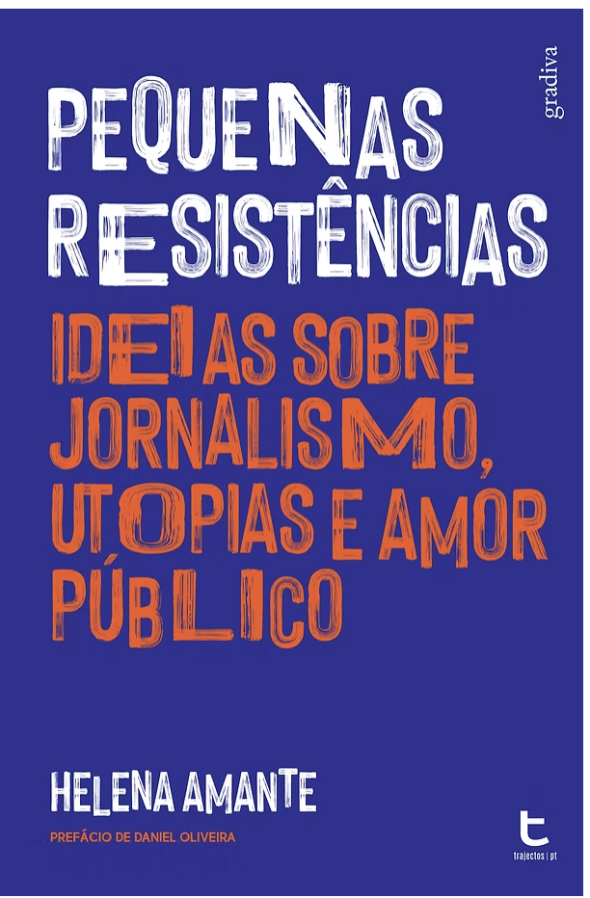
Journalism is central to this book. Yet, while central, it does not stand alone. The author pairs it with what she considers to be “public love.” If journalism is the theme, public love is both a compass and an umbrella. Together, they form the book’s structural and structuring combination. Both—so demanding, so obvious, so essential, and so at risk. Naming the very first chapter, public love is omnipresent in the book—explicitly, but above all implicitly. Helena Amante views it largely through the lens of what Rebecca Solnit proposes in her work: “this deep emotion I call public love, this sense of meaning and purpose, power, belonging to a community, a society, a city, a movement.” More than an emotion, public love emerges here as a political practice that sustains the common good and resists the fragmentation and individualism that characterize contemporary societies.
Journalism as a public act of love. In Helena’s book, this is both a statement and a question. If journalism is a public service, it depends on funding that imposes constraints—whether editorial constraints (what is reported and how it is reported) or time constraints (how long an editorial project can be sustained). And how do we reconcile public service, funding, and the need for predictability in our lives? If journalism is dedication, the truth is that it relies heavily on precarious work and demands a clear head from those who, every day, don’t know how they’ll pay the bills that month. If journalism represents everyone and is aimed at everyone, what is the place of women and people of color, for example? How are they represented in the newsroom? What decision-making roles do they hold? Everything that journalism is and could be. Everything it has offered and could offer. But without ever losing hope, determination, or the ability to question.
Helena embarks on this journey of testimony and reflection on journalism as public love, with the Fumaça project serving as both her starting point and her destination—its history, its people, its mission, and its ambitious, alternative, and dissident vision. Fumaça is presented as an embodiment of public love in journalism. A possible example of the change we wish to see. Proof that change is also driven by pure conviction. To use the author’s words: a “leap of faith—a faith that has nothing to do with religion” (p. 51). Helena arrives at the Fumaça newsroom in the “early summer” of 2020 to begin gathering material for a documentary that ultimately never happened and that, in fact, takes form in this book. Perhaps that is why the book’s style is so unique: a blend of reporting, interviews, chronicles, and essays (p. 16), which makes it very captivating for readers.
Helena’s writing is serene yet intense; detailed without being tedious; intimate and, at the same time, journalistic. Among the passages describing daily life in the Fumaça newsroom, interviews with those who work there, as well as with other professionals connected to journalism, it is not uncommon for her to share her feelings, her thoughts, and her state of mind — as a journalist, essayist, activist, left-wing woman, and author of this work. In fact, while reporting, chronicling, and writing essays on alternative media, Helena reflects on her own book — its democratic, horizontal, transparent, fair, and informative nature.
In the book, we move chronologically, but in gentle leaps, like doors opening and closing. Helena plays various games with the scenes she reports on and incorporates into her reflections. The inside and the outside, reporting and reflection, the city and journalism are parallels and ever-present metaphors. As we read in a passage from the beginning of the book — upon arriving at the Fumaça newsroom, she recounts: “It is old Lisbon, so touristy today, but on its slope the street retreats: the chaos lives next door, here cars don’t pass, few people circulate (…). In Bairro Alto, which once belonged to the newspapers, as the street names attest — Rua do Diário de Notícias — they are now the only representatives, they and a sports newspaper, A Bola.” (p. 23). It shows how the transformation of the city also reflects the transformation of journalism.
Fumaça is the central story to which we always return. And I say “return” because the journeys Helena takes us on in the book actually go far beyond it. It discusses other alternative media projects (The Correspondent, Investigate Europe, Mediapart, Divergente, Setenta e Quatro, A Mensagem de Lisboa, Afrolis, O Corvo, among others), from the more general issue of funding—advertising, project-based contributions, pay-for-news models, structural grants, etc. — and of how difficult it is to think long-term in journalism; of precariousness; of misinformation; of women in newsrooms; of the issue of impartiality in journalism and how problematic it can be; of the time of journalism; and of social media as both a source and a competitor.
And, above all, I believe that Helena Amante’s book is about the collective. The collective of public love. It is, essentially, the idea of the collective—what drives it, how it moves, what it is made of, and what it achieves — that leaves the deepest impression on readers. Helena begins precisely by sharing the difficulty of telling collective stories — whether that difficulty stems from pragmatic issues, such as time, or emotional ones, such as the empathy facilitated by a single story and unique faces. As she herself states: “There is a reason why the hero’s narrative works so well: we sympathize with the particular, with the individual. That is why the disappearance of a single person can make headlines for longer than the death of thousands — it appeals to our emotions. In a narrative, it is harder to follow the journey of many characters. The more characters there are, the less able we are to become emotionally invested in what happens to them. Collective narratives take more time. They demand more time” (p. 32).
Often, collectives call for exceptional figures. But there are no individual heroes. There are no homogeneous collectives. There are no grand horizons resulting from a single leap. As Helena shows, through the balance between individual interviews and collective dynamics, collectives are made up mostly of ordinary moments rather than great moments. They are diverse in their paths, in their sensibilities, in their subjectivities. They are multifaceted.
To speak of the collective while highlighting the individual, made up of people and their life stories, yet without falling into the neoliberal fallacy of “you are the change”— this is what the book questions and does so well. Because in every story lies the connecting thread that ties society, democracy, politics, and reality together — and that can be journalism, but is also, with a decisive force, “public love.” That is where we are headed — and perhaps that is precisely what is at stake today
Translation by: Elen Diaz Ribeiro
by Sofia José Santos
To read | 29 Abril 2026 | journalism, resistance, utopia


