Writing the radical hospitality of dance
About Dança Fora de Si. A Obra Coreográfica de Marlene Monteiro Freitas, by Alexandra Balona. (Dance beyond yourself. The Choreography Work of Marlene Monteiro Freitas).
The show ended: more than an hour of precise, intense gestures, a rhythm that contaminated and urged us with the strength and persistence of the applause. The dancer thanked, generous, present, like he was the entire duration of the dance that he delivered. At a certain point, he interrupted us. Israel Galván, the extraordinary contemporary flamenco dancer and choreographer, now thanked the sold-out audience in the CCB’s large auditorium with words. At the same time, he asked us to applaud, not him, but another dancer, whom he wanted to warmly honor, asking her to leave the audience, the anonymity of the crowd, and come up on stage. A woman gets up from the seat in front of me and joins him, with a broad, recognisable smile. It was Marlene Monteiro de Freitas, he also applauded. This happened maybe around ten years ago. Long before Théâtre de la Ville Paris and the Festival d’Automne finally welcomed RITE in 2022, a collaboration that brought these two artists together on stage. I could begin this text describing the numerous intense feelings and reflections that arouse from the experience of Freitas’ work, but I am sharing it here because, while reading Dança Fora de Si. A Obra Coreográfica de Marlene Monteiro Freitas, it was the movement present in this book of ‘radical hospitality’ that stayed with me throughout my reading, like a key. A hospitality that opens spaces, gives way to the stage, deflects recognition, creates networks of affection, emotions, creation, research, and socialisation.
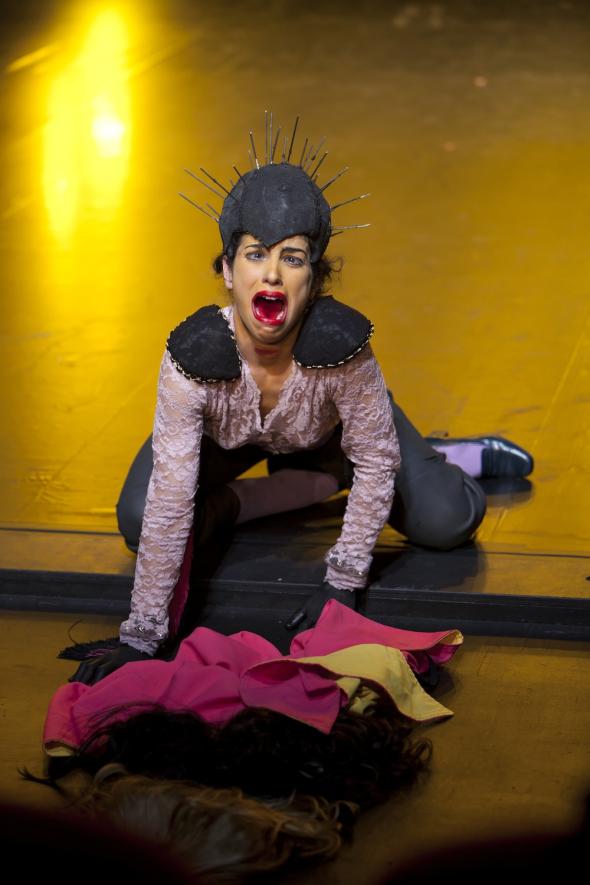 Marlene Monteiro Freitas
The overview of publications on Portuguese contemporary dance is not wide but it has been making room for itself to exist. An example, in 2024 arised Vera Mantero — Matérias. Forças. Imaginário (Vera Mantero - Materials. Strength. Imaginary), organized by Ana Pais and edited by Orfeu Negro, and Dança não dança: arqueologias da nova dança em Portugal (Dance doesn’t dance: arqueologies of the new dance in Portugal), with the edition of Ana Bigotte Vieira, Ana Dinger, Carlos Manuel Oliveira, João dos Santos Martins, by Fundação Calouste Gulbenkian, tracing genealogies of dance in Portugal between XX century and early XXI. In 2019 and 2022, Hugo Calhim Cristóvão e Joana Von Mayer Trindade published, in the friction between dance, philosophy and other arts, Dos suicidados – O vício de Humilhar a Imortalidade (The Suicides – The Addiction to Humiliate Immortality),e Fecundação e Alívio Neste Chão Irredutível onde Com Gozo me Insurjo (Fecundation and Relief on This Irreducible Ground Where I Rebel with Joy), ed. Nuisis Zobop and Institute of Philosophy/UP, among others, and in English. It is also estimated the publication of the catalogue book of the exhibition INTROSPECTIVA, dedicated to João Fiadeiro’s work, and presented in 2024 in the galleries, and MAC/CCB auditorium. Since 2023, the Revista Estud(i)os de Dança (RED), a scientific publication edited by The Institute of Ethnomusicology – Centre for Studies in Music and Dance (INET-md), center of the Faculty of Human Kinetics of Lisbon University, in collaboration with the Center for the Performative Arts Studies, began to be published more frequently, allowing for more regular dissemination of theoretical research in this area.
It is in this context that Dança Fora de Si. A Obra Coreográfica de Marlene Monteiro Freitas is registered, by the investigator, independent curator, and professor Alexandra Balona, published in September 2025 by Dafne Editora and, in the English version by Lenz Press, a gesture that follows the international circulation of Marlene Monteiro Freitas`s work. Taking on the demanding task of putting into writing an experience that so often escapes this format of sharing, Balona immediately acknowledges the challenge, presenting her book as an essay that seeks to reflect on dance through writing that is capable of ‘accompanying’ without fixing, the singular metamorphosis of the work of Marlene Monteiro Freitas — a distinguished choreographer and dancer, awarded the Silver Lion at the Venice Dance Biennale in 2018.
It is noticeable that this book is the result of a long process of observation: on the one hand, of Marlene Monteiro Freitas’ work, her presentations and the places where her imagination was nurtured — Cape Verde stated as one of the affective and imaginary matrices; on the other hand, the author’s own feelings, her transformative experience as a spectator, which prompted her to write and unfolded into academic research culminating in a doctoral thesis, before taking editorial form. Balona begins the book by describing the “amazement” she felt upon meeting Paraíso — Coleção Privada, one of the reviewed pieces. Crossing readings of Guintche (2010), Paraíso — Coleção Privada (2012), Jaguar (2015), Bacantes — prelúdio para uma purga (2017) and Mal — embriaguez divina (2020), the reader is gradually drawn into the constellations that compose Marlene Monteiro Freitas’s choreographic universe, without Alexandra Balona’s own writing and thinking ever dissolving or fading into the background.
This amazement is accepted as a metamorphic force: it transforms who sees it, but also guides the approach to research. How might one write from a place of felt emotions? How might one incorporate astonishment into a singular method capable of giving rise to the study and construction of a critical language? As she herself observes, the author allows herself to be carried along by the experience of the work on a journey she describes as a movement from astonishment to study. The amazement moves and touches, it puts strength in action and creates a desire to keep them alive throughout the writing, preventing the experience from losing its vitality. Hence the insistence on a style of writing that does not set things in stone: when Balona identifies Freitas’s work as structured around the terms “openness, impurity and intensity”, it becomes clear that these are not rigid categories, but words that explore possible points of entry into the complexity of this choreographic work.
The need to put dance into writing is emphasised right from the outset by Gabriele Brandstetter, the book’s foreword writer, and a leading researcher in performance and dance studies at the Free University of Berlin. By situating the preface in the triad of “Translation, Creole Metamorphosis” and, drawing on Édouard Glissant, the “Poetics of Relation”, Brandstetter employs the notion of “Creole metamorphosis” to situate Marlene Monteiro Freitas’s work in a zone of friction between cultures, languages and imaginaries. The “Poetics of Relation”, in turn, allows us to understand dance as a space of circulation, contamination and transcultural openness. Translation, meanwhile, emerges as a paradoxical yet inevitable task: translating the unspeakable choreographic into the materiality of written language.
In this context, Brandstetter recalls the thoughts of the Senegalese philosopher Bachir Diagne, which attributes ethical, political and epistemological value to translation through the notion of “the hospitality of translation”. Diagne, one of the leading voices in contemporary African philosophy, has reflected on universality from the perspective of the African experience, calling for the construction of a “common sense of humanity” and understanding translation as a means of overcoming colonial legacies, and as an act of welcoming the other.
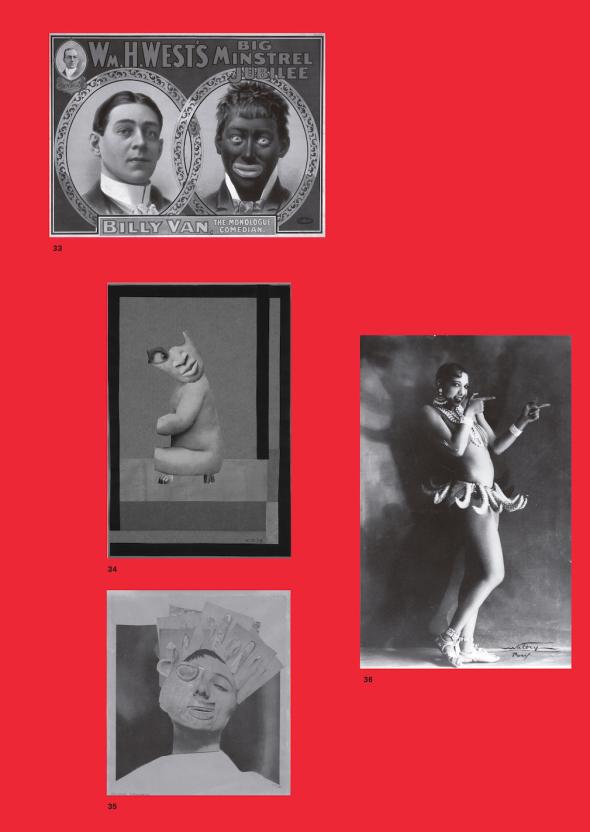
Both Marlene Monteiro Freitas`s work and Alexandra Balona`s writing create spaces in which translation means opening up to the heterogeneous without absorbing or dominating it, but rather by enhancing the encounter and the intensities that arise from it. They are “spaces of strangeness and contradiction”, where bodies and materials in diaspora are transformed in the search for multiple meanings. Beyond the critical analyses, Balona compiles the choreographer’s personal archive and places it in dialogue with works from art history, constructing an interpretation that functions as a true “Atlas”, capable of supporting multiple references and imaginaries. The book also provides a close examination of the methods, processes and mechanisms that shape choreographic creation, offering the reader small “critical tools for reading the unreadable”.
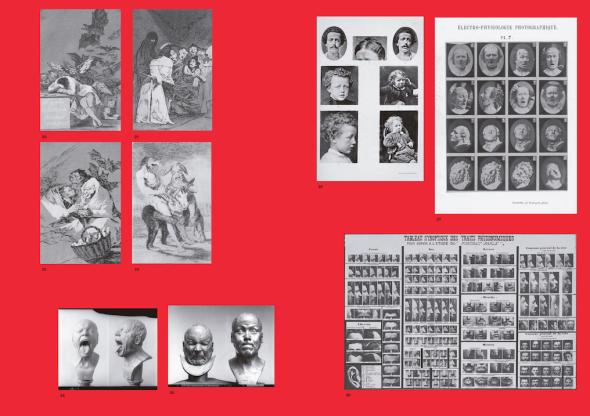
The book can be explored through many ways: a linear reading, a random browse through the chapters, or through the image galleries. It works as a space of circulation and shock between images, theoric fragments, musical references, film clips and rehearsal notes, involving studies in performance, art history, philosophy and psychoanalysis, amongst other fields. Balona structures the chapters like constellations, in the manner of Aby Warburg’s “Atlas Mnemosyne”, interpreting the book as a “workbench” where connections, ramifications and multiple evocations are explored, based on Marlene Monteiro Freitas`s work. This structure, moreover, reflects the artist’s own choreographic writing processes and conveys an interest in the saturation of elements and the power of composite and hybrid universes that result from the aggregation of disparate materials.
It is particularly noteworthy how the interplay between aesthetic worlds characterises both Marlene Monteiro Freitas’s artworks and Balona’s writing: covering Cape Verde and its cultural and religious syncretism; exploring Western and non-Western legacies; articulating references ranging from opera to pop, from flamenco to puppetry, from dreamlike spaces (referencing Freud and Lacan) to peripheral and dominant social imaginaries. In this context, Balona does not restrict to writing formal intensities, but analyzes the ways in which this manifests itself as political forces in the encounter between stage and audience, viewing bodies as “living entities”, “where alternative forms of existence and communality are explored, with the potential to catalyse processes of subjectivation” (Balona, 2025 p.18). It dialogues with philosophers such as Giorgio Agamben (and concepts like The Open, and the reflection about humans and animals), Georges Bataille (in the way he approached the concepts of eroticism and the formless).
A particularly illustrative example of this hybridity can be seen in the interplay between Greek-influenced culture and Cape Verdean culture, in the convergence of the Bacchantes’s procession and Tabanca music, which was banned during the colonial period. Native to the island of Santiago, Tabanca combines music, dance, singing and ritual performance with a strong Dionysian character, reflecting processes of resistance, creativity and cultural syncretism. Balona also connects these forces from the past — the Bacchantes, Warburg’s nymphs, colonial memory — with the present, evoking a poem by Pasolini read in the play, which Balona describes as ‘(…) a force from the past does not mean merely dwelling on or identifying with the past, but rather being alive in the present, recognising that gestures repeated over the ages capture the feelings of those generations and perpetuate them’ (Balona, 2025, p. 200). The question that arises is this: what do we wish to preserve of these forces that have now become visible and are open to experience?
In terms of choreography methodology, Balona highlights the prevalence of fiction, the influence of historiographical methods inspired by Aby Warburg’s way of thinking through images and the centrality of the concept of the Figure. The figure arises as a recurring presence - monstrous, hybrid, unstable - referring to Warburg as well as to anthropology and popular theatricality. These are composite, ambivalent and powerful figures — and here, Balona recalls Tadeusz Kantor’s concept of the ‘bio-object’ in relation to the figure of the puppet: “(…) a fusion of living and artificial elements to create a figurative artistic form that breaks down the distinctions and hierarchies between the animate and the inanimate, the past and the present.” (Balona, 2025, p. 146). Mythological figures also operate beyond fixed dichotomies: mortal to immortal, rational to irrational, permissible to forbidden, sacred to profane. On Paraíso — Coleção Privada, for example, these hybrid figures remain in a state of constant instability, resisting any interpretation based on linearity or coherence.
How to embrace these unstable forms, breaking out of other times? To conclude, it is worth returning to the concept of “critical hospitality” mentioned by Brandstetter in the preface. Alexandra Balona puts this concept into practice through the creation of an essayistic methodology and a critical writing that works by approximation and through engagement with the artwork, seeking to remain hospitable to its intensity.
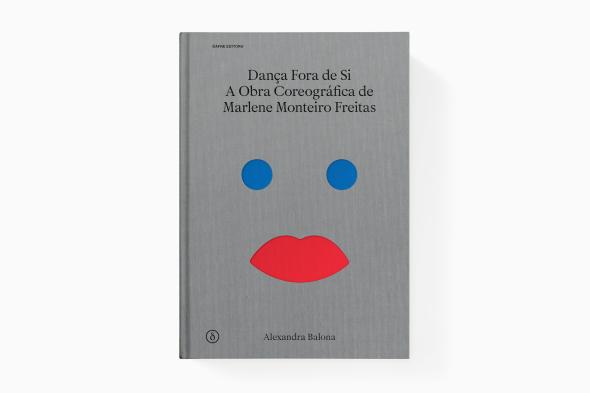
Dança Fora de Si. A Obra Coreográfica de Marlene Monteiro Freitas establishes itself, then, as a rigorous book that is a choreographic object — a book that has us dancing with our thoughts and senses.


