“Nothing stopped them. In the greatest adversities, in the most difficult situations", Women of the Revolution, by Raquel Freire
Women of the Revolution debuts in Indielisboa with two awards
In a time of fierce competition for historical memory, in which the most extreme forces on the right try to rewrite what fascism was, the film Women of the Revolution, by Raquel Freire, is a moment of truth, a point of order at the table. Who tells our story? Who guesses the joys and the sufferings, the griefs, and the charms? Who knows what was in the heart of a child who was killed along with their family in Gaza? Who hears the birds in the morning feeling what overflows the life that fits us?
Cinema can, as a collective exercise, highlight the director about the work process that is a time to be together, in a community. And for this reason, imbued with care, with the team and with the women protagonists who participated in the documentary. I saw the movie with about two hundred high school students. Adolescents with their teachers, outside school and with the natural insolence of being young and taken to an activity. The instructions from the front of the room, to take out a student who did not give up their lollipop. The introductions and turning off the lights with the uneasy and shrill soliloquies anticipated the possibility that the volume of sound would not be enough for my second attempt to see the film. Dashed predictions. The youth audience remained silent and attentive to the reports of some old women about their lives during the dictatorship yoke. Greater victory and proof that Women of the Revolution has something to say to the present.
It is from the present that Raquel Freire’s film talks to us. They are not packaged interviews of people sitting in their homes surrounded by their memories. Where we can preserve relics and testimonials from something so distant and incredible that it seems implausible.
Based on her experience with the trilogy “Histórias das Mulheres do Meu País” (Stories of Women from My Country) and drawing inspiration from the work of Maria Lamas to create a possible portrait in 2019, the filmmaker was experimenting with documenting life stories. From the perspective of a woman from the generation born around April, on the contemporary country looking at other women, focusing her attention on a recent and growing recovery in the last few decades of the overlooked history of minorities, in which women are classified as a social category. Women of the Revolution is not a feminist theoretical manifesto or about erasures. However, it does not stop putting them into evidence. It is a story about Portuguese fascism and the forms of fight and resistance against it, here and in Africa, where the preparation of the military coup of April 25, 1974, began. The multiple forms take place through the voices of Margarida Tengarrinha, Julieta Rocha, Ana Maria Cabral, Isabel do Carmo, Maria Emília Brederode Santos, Luísa Sarsfield Cabral, Teresa Loff Fernandes, Zezinha Chantre, Helena Neves and Ruth Rodrigues. Seven Portuguese and three Africans with roots in Cape Verde and Guinea Bissau with diaspora relations in Angola, S. Tomé, Timor, and India.
The Portuguese colonial empire wove the web that allows the gathering and crossing of the history of these women in the same struggle. If the resistance to fascism was as long and tenacious as its duration, the beginning of the colonial war or African wars accelerates in a common tuning fork the group of resistance, from communists to Catholics, democrats, and leftists. It was necessary, however, to wait 13 years with thousands of deaths everywhere, with Portugal isolated internationally with sanctions from the United Nations, including emerging nations, so that the Portuguese military confronted essentially with an impossible victory on the African land, organized to depose the regime.
The Revolution that we celebrate today, the founding of the democratic regime we have, came with the country and the people on the street and everywhere. It was the armed resistance of the African peoples that pushed and forced the Portuguese army, prevented from negotiating a surrender and independence, to organize the coup, expected and widely supported by the peoples of both continents. As Amílcar Cabral had announced, the fight against colonialism and for the independence of its countries was the same as the Portuguese people’s fight against fascism. Ana Cabral, his wife, tells us in the movie how she met Amílcar in an already released Conacry Guinea, after writing from Germany to the leader of the PAIGC who would become her husband, offering to be part of the party’s ranks. She also tells us how she watched his murder on her doorstep, how unreal it seemed for a long time. About how the countries that conquered their independence are not to a great extent what they expected or what they fought for, but they are autonomous in deciding on their destiny.
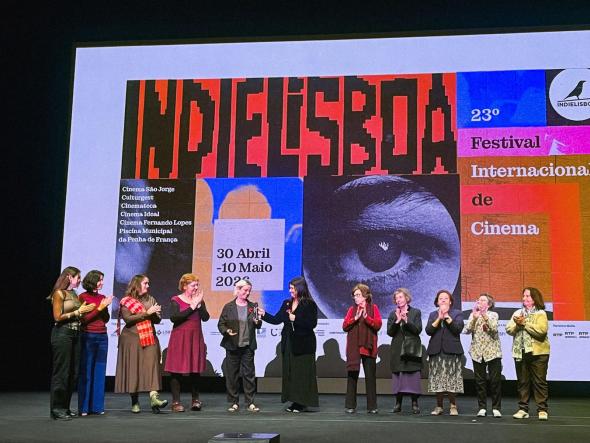
“Those men didn’t harm anyone, they can’t go to prison. Let’s take them out of there. The GNR came, I have the scar, the first hit I took broke all these teeth,” Julieta Rocha, cannery worker since age eight. She didn’t know what fascism was when she decided to go to the GNR squad to know about the fishermen arrested for having complained about the salary to the shipowner, who paid more than two hundred fishermen, including her husband, to who he made decisions at any given moment, and not what had been agreed upon. A life of hard work and sacrifice accentuated by the inequity and violence of the regime made Julieta, now at 86, the fighter who has complained and celebrated freedom since 1974 with the greatest happiness and full ownership. She was at the film’s premiere at the Lisbon Indie Film Festival on May 1 in the packed auditorium at Culturgest, alongside five of Ana Cabral’s friends and family members, listening to the room’s commotion as it chanted in unison, at the end of the long-standing ovation, “April 25 Fascism Never Again.”
Everything also has an urgency because from the filming to now, Margarida Tengarrinha, Teresa Loff Fernandes, and Maria Brederode Santos, to whom the film is particularly dedicated, have died.
“Nothing stopped them. In the greatest adversities, in the most difficult situations. We’re talking about women who had to give up their comfort, their families, their daughters to fight, and never lost hope. They are of enormous generosity. There is no bitterness in what they say,” the director tells the Sapo channel. “For Raquel Freire, recording with her mother was “an incredibly beautiful reunion” because she grew up surrounded by resistance stories: Her great-grandmother was among the first women to study and to refuse her husband’s name, her grandmother and mother clandestinely founded a teachers’ union in 1969” in the same interview.
Dealing with time and memory, the narrative is built at a fast pace, intertwining various voices and anchored in strong physical settings, whether it be the island of Santo Antão, the bay of Cidade da Praia, the Tejo River, or the streets of a neighborhood in Portugal or Cape Verde. It is at the present time full of open, musical, and free spaces. It is only later that the narrative is condensed and the rhythm slows down to enter this dark night where we hear what each one did and what they went through.
Filmed between 2023 and 2025 by an entirely female team, with production of Madame Filmes, suggests a demanding preparation, in which not only the choice of witnesses thought about the diversity of their socioeconomic or political inscription but also the way in which to bring their necessary presence to the public space. Raquel Freire anticipated this need and filmed with the generosity that recognizes these women, making herself and us her accomplices.
MUTIM
Raquel Freire co-founded MUTIM – the association of Women Workers of Images in Motion – in 2022, with the aim of correcting inequalities in film in Portugal. “Women continue to receive less and continue to have less chance of working,” she explains. The association brings together more than 400 workers and will present a quota proposal to the sector this year. A good practice manual is available for safe and respectful filming environments. To Raquel Freire, the idea can be summed up in one sentence: “For collective problems, collective solutions.”


