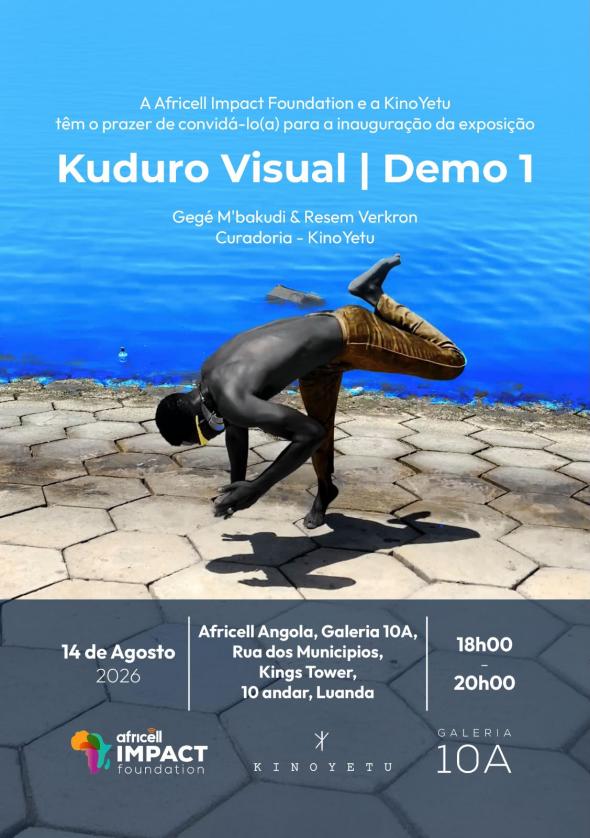
Kuduro Visual | Demo 1
Kuduro Visual | Demo 1
As Kiluanji Kia Henda (2024) writes: “More than creating music videos, Visual Kuduro would be the bold act of producing images capable of intervening in the history of art. The history of art that was never told to us, or from which we were systematically excluded. Drawing on the spontaneity, improvisation and rebelliousness of kuduro, the artist would claim their place in the sun, confronting the entire hierarchical and conservative structure of the art world. In my view, art only fulfils its true role when it is capable of creating ruptures.”
Kuduro simply is.
It requires no explanation and offers few possibilities for decoding. It is a practice constantly nourished by the urgency of life itself.
It was precisely this force that led Gegé Mbakudi and Resem Verkron to develop the concept of Visual Kuduro. From the artists’ perspective, it means bringing kuduro into the realm of the visual arts while recognising that it has always produced images and imaginaries. Their proposal is to shift this repertoire into the exhibition space, allowing photography, video and performance to reveal what the rhythm has always carried within it: a visual language.
If kuduro had a single purpose, perhaps it would be this: to be seen.
Visibility is a right from which many other rights emerge, and the makers of kuduro, as an artistic practice, know this well. Through the empirical experience of survival, they have learned the formula of existence. This exhibition is about exactly that.
History has taught us to view cultural expressions produced on the margins merely as responses to structures of power, as though their existence depended solely on what they resist. Kuduro Visual - Demo 1 acknowledges this logic, yet proposes its reversal.
Gegé Mbakudi and Resem Verkron do not make art simply because they resist. They make art because they were born artists. Because imagination is also a right. Because creation exceeds every condition of survival. In seeking to uncover the image of kuduro, they do not assign it a definitive meaning; rather, they reveal its infinite capacity to generate forms, affects, fictions and FUTURES. Kuduro ceases to exist merely as music, dance or performance and asserts itself instead as an aesthetic mode of thought and a technology of invention.
In this Demo, the artists bring past and present together to reveal that the body never dances apart from history. Choreographic gestures, sayings transformed into codes of movement, everyday objects, and the very notion of performance become devices of memory and social existence.
Rather than offering definitive answers, Gegé Mbakudi and Resem Verkron invite us to recognise kuduro as a space where trauma and celebration coexist. A space where life unfolds.
While the body preserves the marks of violence and forgetting, it continues to rise, insisting on creation as an exercise of freedom.
Pepinooo!
About KinoYetu
Founded in 2019 by Kiluanji Kia Henda, Rómulo Peixoto and Orlando Sérgio, KinoYetu is a non-profit cultural association dedicated to artistic development and the promotion of the visual arts. Our mission is to foster platforms where cinema and visual arts become vehicles for knowledge production.
We support and fund specific artistic projects while building strategic partnerships to develop initiatives that strengthen the visual arts sector. Through our programmes, we seek to empower artists by promoting new pedagogical models, innovative forms of artistic production, and sustainable creative practices.
KinoYetu means “Our Cinema.” The name embodies the association’s vision: to reaffirm the importance of Angolan cinema while encouraging the emergence of new artistic languages within the country’s film landscape.
Our values are grounded in artistic excellence, social transformation, and the creation of a new cycle of cultural production. We have chosen to bring together what is most powerful in contemporary Africa: autonomy, artistic expression, and creative production.
KinoYetu is an invitation to imagine new possibilities. We firmly believe that cinema is a powerful tool for social change, and we have chosen to make it our instrument for cultural impact.