Is there really a brand-new wave of Portuguese cinema?
Here we look at three debut Portuguese films premiering at IndieLisboa, in search of identities, entry and vanishing points.
Indie cinema serves as a good barometer of the current state of Portuguese cinema. However, in an age of extreme cosmopolitanism, gentrification and global thinking, where intellectual, spiritual and physical boundaries are becoming blurred, populations are fluid and fundraising strategies are increasingly creative and multinational, one question arises: what criteria govern selection (or exclusion) for the national competition? What makes a film Portuguese? The nationality of the producer? Or the director? A ratio of the technical and artistic staff? The place where it was filmed? The idiom? The theme? Maybe a mixed criteria, like the quota for Portuguese music on the radio?
The majority of Portuguese filmmakers would say there is no such thing as Portuguese cinema in the sense of a school or a movement; there is merely a disparate collection of individual aspirations and conflicting identities, which just happen to share the same country as their point of reference.
The goal of this text is not to redefine the selection criteria of Indie — it’s like the orthographic agreement, as long as there’s a rule, it works. Rather, it serves as a pretext for exploring the origins of a brand-new Portuguese cinema, in search of those lost roots, that movement, that unity, even if fragile. This is despite the fact that, in a globalised world, we are all inevitably influenced on a global scale. Nevertheless, one should not underestimate the potential of one’s immediate neighbour.
If there is no well defined structure to characterize Portuguese cinema, with a little goodwill, there are at least schools, tendencies and movements — some of them probably unintentional, but which, without meaning to, take shape.
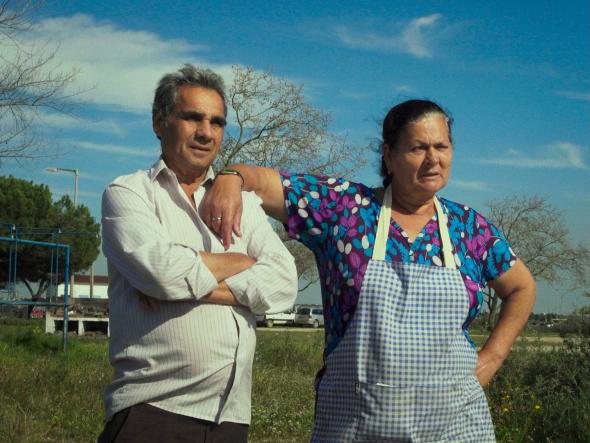 Cochena, by Diogo Allen
Perhaps one of the clearest examples is Terratreme. The production company is also a cooperative of filmmakers, in which, in a sense, have taken control of the means of production to make their own films. This collective mode of production has an impact on the works created and seems to be relatively deliberate. It is, in fact, something that resembles a school or a movement. As with other schools or movements, we can identify common threads — we can almost guess the films produced by Terratreme — despite the different voices of the filmmakers. They have not produced a dogma, as in Lars von Trier’s school, but, even if it is not entirely conscious or intentional, in practice it comes close. There is indeed an aesthetic, sensory and emotional affinity between the films of Pedro Pinho, Tiago Hespanha and Susana Nobre. A very particular language of the real, in search of boundary zones, which appeals to festivals but does not fill cinemas. The question is whether this language is inevitable.
Cochena, Diogo Allen`s first full-length film, fits in politically and ideologically with Terratreme’s field of action, but in some ways diverges from it in formal or aesthetic terms, in key details regarding its approach.
Although it is a hybrid documentary, the areas of ambiguity or uncertainty are treated differently from what we see in Pedro Pinho or Susana Nobre. Instead of a certain roughness in capturing the moment, with room for improvisation or chance, Allen’s film is immaculate, a kind of simulated perfection, emphasised by the 4:3 digital format. This self-imposed aesthetic limitation — likely linked to a practical necessity — distances the film from cinematic dazzle, from lending grand framing to the filmed subjects. In this respect, too, it differs from Leonor Teles’s “Terra Franca” — which might be seen as an alternative point of reference: there is a certain complicity in the lingering portrayal of the subject, but not that particular photographic glimpse, although this does not mean the shots and situations are rough or rudimentary. On the contrary, Allen’s hybridity, even more so than in Teles’s work, stems from the fact that everything is so perfect and crystalline that it is hard to believe it is not fabricated. If it is not strictly a mockumentary — like those in the featured section of this issue of Indie — perhaps it could be a mockfiction: a documentary filmed in such a controlled manner that it resembles fiction.
Perhaps the most fascinating and valuable aspect is the political gesture itself. Allen films a gypsy community in Ribatejo, focusing on an elderly couple. He films from the inside out, creating a complex web of complicity that is only possible with a great deal of time: time spent prior to filming, living alongside them and adopting an intrusive approach, to the point of making the camera part of the scene. When watching the film, we do not feel as though we are looking at a gypsy community, thereby dispelling any preconceptions; rather, we feel, for an hour and a half, as though we are part of it. And that is as difficult to achieve as it is valuable.
Paradoxically, Allen’s political gesture is achieved by distancing himself from politics. Social prejudice against the gypsies is not addressed in a single scene. There is not a single instance of conflict with the “outside world”, neither from the inside out, nor from the outside in. It is not a subject. It’s as though, in the face of social tension, the director has chosen to show only another side, a slice of life, an idyll, and, from there, to provide viewers with grounds for a more balanced perspective — their existence cannot be defined by opposition or as an exception within the social fabric.
In fact, what Allen presents us is a way of life. A desirable and enviable model, in many ways close to simple, Christian and conservative ideals: a strong sense of community and family, a joy of living, a savoir-faire, with time set aside for work and leisure, for family, for friends, for rest and for the arts — above all, music. Allen’s gypsies represent a social utopia. And a way of life to aspire to. We cannot expect them to fit into our social model, with its emphasis on consumption and speed; perhaps we should be the ones learning from theirs. Their light-heartedness, which we now know intimately, is a lesson and a path to happiness.
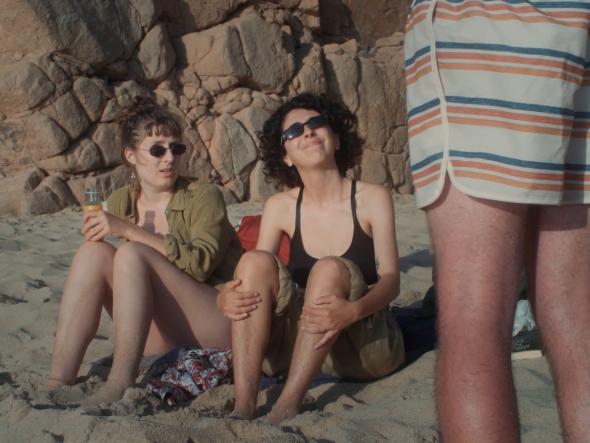 Kiss and Be Friends, by Ana Baldini and Roly Witherow
A model case for this question is Kiss and Be Friends, by Ana Baldini and Roly Witherow. The film is directed by a pair of foreign filmmakers, but it is shot in Portugal and, in a manner that is as tangible as it is depressing, depicts contemporary Lisbon.
With a bit of goodwill, we can place it within a group of films that place Lisbon at their heart, from a generational perspective, reflecting the consequences and anxieties of a lost generation caught up in gentrification. We can see this in “Baan”, by Leonor Teles, in “Amor e Avenidas Novas”, by Duarte Coimbra, or “Arrabalde”, by Frederico Serpa. Or, indeed, in an excellent more recent example (although by an older director), “A Vida Luminosa”, by João Rosas.
The issue here is perspective. In “A Vida Luminosa”, there is an attempt to salvage what remains of the city—the crumbs of gentrification—by someone who can still afford to live there. And whilst there isn’t much left, it is enough to make a happy film.
In “Kiss and Be Friends”, the metaphor of gentrification is ruthless. We meet a Portuguese woman who has emigrated to England, she returns to Lisbon for a visit, accompanied by a French friend with whom she has a sexually ambiguous relationship. Sofia is a stranger in her own city. She has only a few vague points of reference — a beach and a “Disney palace” in Sintra. She has not even emotional roots left. It is a vast void. Armandine, the bully of a friend travelling with her, takes to the city with far greater enthusiasm. It is disconcerting. They go everywhere by taxi, ride in tuk-tuks, the only thing missing is a ride on the Santa Justa lift and eating pastéis de bacalhau with Serra cheese. At a night-time party, Armandine attracts a young man, a pseudo-artist, by claiming she is setting up a gallery for emerging artists in England. In the process, she abandons the friend who brought her there and arrogantly takes over the city. In the end, after using everything and everyone, she abandons them and returns to her French ex-boyfriend who lives in England.
I don’t know if the filmmakers are fully aware of this, but what they show us is the gentrifier’s most brutal perspective, the one we all prefer to ignore: a city so transformed that not even the Portuguese can find their roots there, a city that mimics other cities and is taken over by foreigners (a Frenchwoman, in this case) who use the city and its people, employing money and false promises only to discard them afterwards. At best, the directing duo were fully aware of what they were doing when they created one of the most irritating and toxic characters in recent Portuguese cinema (which is more used to dealing with “so-so” people). Apart from that, the film has a fragile freshness, due to limitations of various kinds.
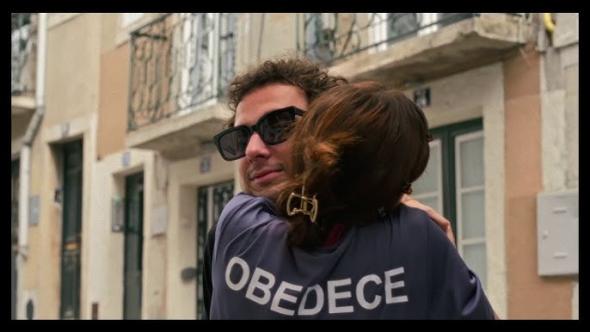 Óculos de Sol Pretos, by Pedro Ramalhete
In a nearby field is the debut feature film by Pedro Ramalhete, screenwriter of Duarte Coimbra’s “Amor e Avenidas Novas”. In “Óculos de Sol Pretos”, we more readily find a generational affinity, an almost movement-like quality, in a group of friends who left the same school, represent a generation and have things to say. Next up, though with a generational gap, is Pedro Cabeleira.
The film takes us on a rough journey into the inner workings of Portuguese cinema. It depicts a production that lacks the scale to be considered an industry, yet behaves as such, with all its quirks and habits, one that seeks to humanise, yet is inhumane in its process. Pedro studied screenwriting at film school and ended up being exploited by a production team. This behind-the-scenes look at our small film industry is far from pretty: pressure, bullying, conflicts, ups and downs, full of people at their wits’ end. There is no room for creative or artistic merit, however much Pedro seeks it. Nothing like the idyllic or inspiring atmosphere of the backstage of a play in José Álvaro de Morais’ “O Bobo”.
The world of cinema is anti-cinema. The worst of all worlds. And here lies a critique, almost in the form of a soul-searching exercise — a call for reflection, for the means of production to be reinvented.
In this bold and incisive work, crafted with a deceptively light touch, lies a generational parable: of those who dream of writing screenplays and end up serving coffee. This is something shared with other films that are easily grouped together by the same sense of urgency in their critique: the best-educated generation of all time has no career prospects. In this dystopian portrait, one glimpses a call for change, a claim to a space, a generational cry, from someone who says: we are here, clear the way, for we have things to say.


