Serbian political uprsing 2024-2026
Walter Benjamin wrote that the most dangerous form of violence is not spectacular violence, but violence that becomes normalized — embedded in law, institutions, and everyday governance. Violence reaches its most degenerate form when it no longer appears as violence at all. I recognize it in our everyday livning under capitalism. And this is why we could look from distance, phisical and moral, what happens in Gaza, Ukraine, Sudan, Congo, Afganistan, Iraq, Venezuela, and also in Rojava right now, in all the wars near and far, because we internalized violence and thus allowed fascism to slowly take over.
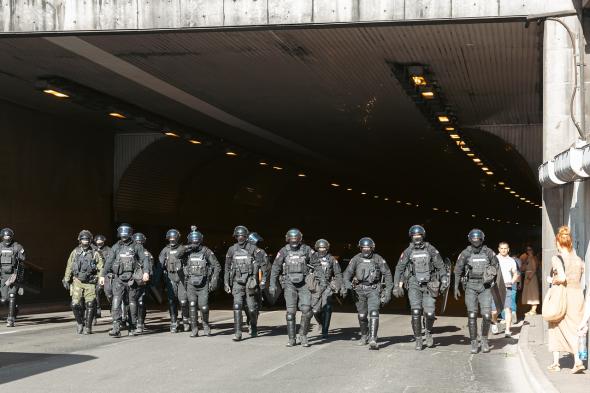 Photo by Gavrilo Andrić
Here, I want to speak about the case of current events in Serbia — about how structural violence, social disintegration, and authoritarian power have shaped its current situtation, and how collective action and collective intelligence can interrupt that trajectory.
Everything began with the destruction of socialist Yugoslavia and its political and social order. That order was based on a clear social contract: antifascism, secularism, non-alignment, and the idea that key resources belong to society as a whole.
The role of the state was to guarantee free and accessible healthcare, education, housing, and culture. The socio-economic model relied on workers’ self-management — imperfect, but real. Participation in the res publica was multilayered and organized in depth and width, producing political agency and social mobility.
Tonight, however, I speak about Serbia — one of the six republics of former Yugoslavia, one of the seven states created after its collapse, and one of the few still trapped in a toxic combination of nationalism, neoliberal capitalism, and mass privatization.
This trap has produced a loss of collective orientation and dignity, and an almost complete absence of social consensus on any meaningful public question.
For more than 35 years, Serbian society has been in a state of continuous disintegration. Almost nothing functions as it should. The wealth that had been collectively produced during Yugoslav times, was systematically privatized, creating a narrow elite of multimillionaires and billionaires whose power is rooted almost entirely in the capture of public resources and state-funded projects.
This accelerated disintegration pushed the political system toward a proto-fascist form. Nationalism first served as a pretext for destroying socialism, equality, and working-class participation in decision-making. Later, that same nationalism was repurposed as a technology of internal control — a point Michel Foucault helps us understand when he shows how power operates not only through repression, but through the management of populations, resources, and fear.
The current ruling party has mastered this system over the last 14 years. Many of today’s most powerful figures — including the president and the minister of police — were already active participants in the devastating and lethal political project of the 1990s.
From this experience, we can clearly see the tight connection between nationalist, xenophobic, homophobic, misogynistic, and anti-intellectual narratives on the one hand, and neoliberal capitalist control of public resources on the other — including the media, which has been transformed into a profit-making propaganda infrastructure.
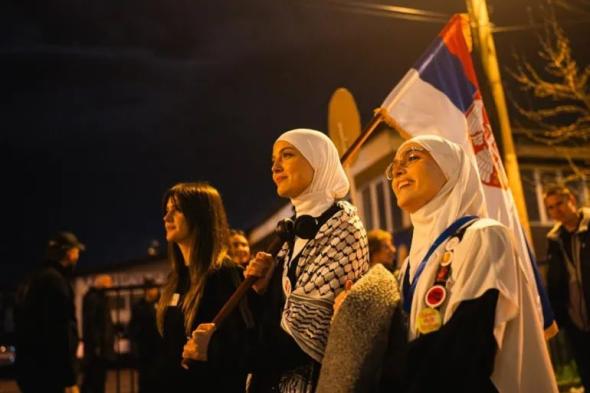 Photo by Uros-Arsic-Lunja
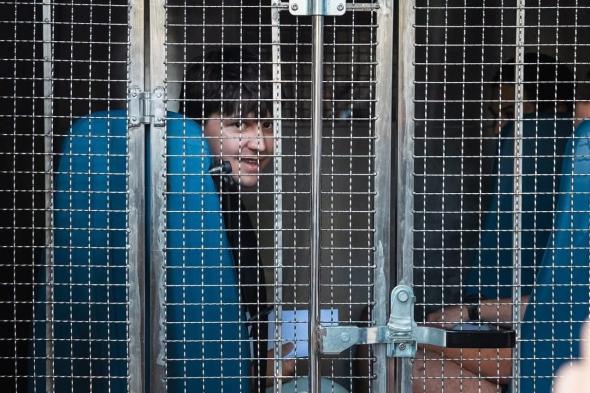 Photo by Gavrilo Andrić
For 14 years now, the regime has subjugated nearly all institutions. Corruption is not a deviation — it is the governing method.
Then corruption became visible in the most brutal way.
The canopy of the railway station in Novi Sad collapsed in November 2024, killing 16 people and permanently injuring others. For a brief moment, everything stopped. Corruption revealed itself not as abstraction, but as a lethal weapon.
Students were the first to respond. They blocked and occupied their universities. What followed were months of intense collective life: fear and excitement, strategic thinking, care, and organization under constant surveillance.
They made a decisive choice: to organize through direct democracy — through plenums.
Plenums allowed students to overcome ideological differences and to deliberate collectively about demands towards the government, safety, communication, and internal organization.
The students declared: we do not want to change the government; we want to change the system.
They also rejected representation. There were no leaders, no public faces. This directly disarmed the regime’s usual techniques of discreditation and media lynching.
Here, we can clearly see what Antonio Negri calls constituent power: a form of collective agency that precedes and exceeds institutional politics.
Over the following months, the student movement addressed every form of injustice: police violence, arrests, repression; attacks on minorities; violence against LGBTQ+ people; the degradation of agricultural workers; the firing of teachers for striking; the abandonment of poor and vulnerable families, impunity for cruelty to animals.
Each case was met with calls for solidarity and mutual support.
At the same time, the mainstream media landscape remained violently controlled. Students were portrayed as criminals and enemies of the state. In response, the student movement turned to social media — short, precise statements demanding public accountability.
The students also moved physically across the country — marching through towns and villages, speaking directly with people, building affective alliances. Once these alliances formed, fear stopped working. The regime’s power began to crack.
One of the most important shifts occurred in relations between the Serbian majority and the Muslim Bosniak minority in Sandžak. For the first time in decades, young Bosniaks publicly stated that they felt like equal citizens. This was not symbolic — it was transformative.
Strikes spread across agriculture, education, culture, and professional associations. Large state-controlled systems remained paralyzed by fear. Recognizing this limit, students proposed a new form of organization: ZBOR — local citizens’ councils.
Within weeks, Serbia was interwoven with a dense network of ZBORs. Protests multiplied beyond the capacity of police control. Last summer, there were no holidays — only streets. More than 95,000 protests took place. Repression intensified: beatings, tear gas, arrests, dismissals.
The student and civil movement adapted again — in May 2025 they demanded early elections and beginning to articulate a political program.
 Photo by Gavrilo Andrić
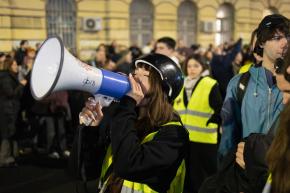 Photo by Gavrilo Andrić
Through large internal consultations, students and their allies are now drafting a program for systemic change. This process is slow, exhausting, and deeply and massivly politically engaging. From it has emerged a remarkable political maturity — what we can call collective intelligence.
The program is still unfinished. It will include radical innovations and unavoidable compromises. But its foundation is clear: direct democracy. ZBORs as part of decision-making; protection of public resources; an end to privatization; punishment of corruption; civic control of police; social justice; labor and unions reform.
Crucially, it recognizes education, universities, research, and culture as the true infrastructure of democracy — and as priorities of public policy.
And this is where the role of us, artists, cutlural workers, thinkers, academics, researchers becomes essential: to contribute our knowledge, experience, and resources — tangible and intangible — to help build a platform that reinforces critical thinking and collective understanding of what democracy is, what the powers of a citizen are, and how to recognize authoritarianism, nationalism, and capitalist mechanisms of domination.
Finally, what is being built today by the student and civil movement is not only resistance. It is a new social immagination and the re-emergence of politics itself.
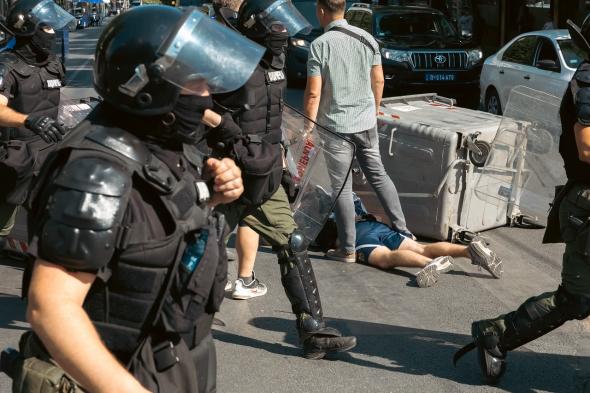 Photo Gavrilo Andrić
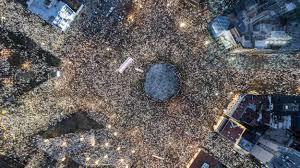 Protest in Belgrade March 2025


