Rhythm & Civilization: Fashion, Death and Other Trends of Capitalist Romanticism
PRELUDE Who’s Afraid of Conviviality?
I
The scene repeats itself under different guises, in different proportions, yet always seeking the same atmosphere. In the most famous of these instances, we are immediately made into indiscreet intruders upon a generalization of indifference; the composition is exemplary of a modern pictorial displacement. Presenting the setting: we observe a painting divided into a 4x4 proportion, within which the materiality of a traditional diner is textured. The diner’s role is to occupy three-quarters of the space reserved for the painting’s full scene; the final quarter of the canvas situates the diner on a dark and inhospitable night street. As spectators, echoing what has already been mentioned, we are relegated to the role of intruders in the composition of this scene; the dark street is empty, so from where do we observe? What (un)suspected position is this of ours that allows the dramatic unfolding of the scene arranged in the painting as if in all its opaque performative intentions? Permeated by ontological doubts regarding our own perspective possibilities in that space, which is frankly frightening in its lonely darkness, the artist then forces us to question our own loneliness as spectators; for these sensations, refracted onto his characters, will be the structuring component of his scene, of his art. Having no other alternative, we draw closer to the light. The painting does not seek to construct a traditional Renaissance-style vanishing point; however, the commercial establishment composing the scene is illuminated and seems to contain other subjects — characters in a show we watch somewhat unintentionally. That point of light thus becomes a magnet for our gaze and captures our reckless attention. Under the focal light from within the establishment, we can see four human figures, almost a mirror of the painting’s proportional cut in its materiality — it would even be possible, here, to point to a type of meta-composition in the painter’s work, for we become implicated, along with him, in the quaternary cutout that his creation entails. Lingering there is the attendant, an older man dressed in what everything suggests is the establishment’s uniform, hunched over with a gaze that seems to lose its way, semi-intentionally finding the empty space between the other compositional parts of the scene. On one side, to the left of our indiscreet and expectant gaze, sits a man, perhaps middle-aged, alone with what appears to be a cup of coffee. The man wears the customary business casual attire for what, as contextual elements indicate, would be the era — around 1940 — with a blazer, tailored trousers, and a fedora-style hat to complete the suit. To the right of the attendant’s wandering and indirect gaze, which we share, sits what we can understand to be a couple. The man is also dressed in a typical business suit of his time; the lady matches her red hair with a pinkish dress, painted in a tone that disguises its pitch so that, from some perspective, it might appear red. She establishes a doubt in the canvas’s narrative: who might this woman be? Could that dress be a shade of red, the tone of a passionate, perhaps even forbidden, encounter? Or is that dress nothing more than the pale pink of an ordinary nocturnal moment without great intentions? Once the doubt is established, it hovers in the back of our attention, suspended like something we wanted to say and forgot at the last instant. Nonetheless, we still observe the scene; both members of the supposed couple hold cigarettes in their hands and are, like the other supposed customer, accompanied by a cup that we almost naturally assume to be filled with coffee, even though the context around us announces the lateness of the night. This element is yet one more that contributes to the feeling that the entire scene arranged there is disconcerting, without the reason for it ever being made explicit. It is as if the inescapable loneliness of the night street into which we were inserted — and which, in turn, came to inhabit us while fulfilling its role of occupying one quarter of the scenery of this pictorial universe and unceremoniously introducing us to a private spectacle — took on a longing for dominance and invaded the other three-quarters of the canvas, making any semblance of a relation impossible for the characters there depicted. They are all, in this scene, absolutely alone. In another work by the artist, a beautiful young woman is seated alone on what appears to be her bed; the sun illuminates her room with the wide entrance of the morning, but the young woman does not seem to find a rhyme in the light invading the environment. Instead, it is in the corner of the room — positioned masterfully by the painter precisely in the space behind the young woman’s face, framing her in her dark solitude — where the lady seems to find enough comfort to linger. In yet another visual creation by this same artist, we are, once again, forced to invade the privacy of the artist’s characters; in this case, they inhabit a room in New York City. As spectators, we then come face to face with a scene of bodily repulsion toward connubial life when we watch what appears to be a couple leaning ostentatiously away from each other with what can only seem to be a silent urgency or a mute scream, so to speak.
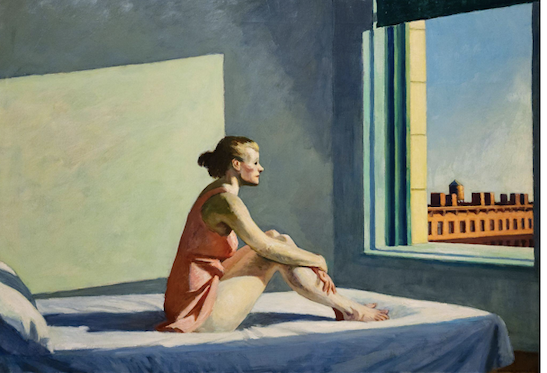 Edward Hopper, Morning Sun (1952)
All three of the scenes narrated above come from the pictorial work of the celebrated American artist Edward Hopper — the first one is titled Nighthawks, from 1942; the second was named Morning sun and first presented ten years later, in 1952, while the third one, in order of appearance, was actually the first one painted, the scene Room in New York, from 1932; the extended period of three decades between the works serves, at least to me, as sedimentation of Hoppers themes and artistic preoccupations. It is not my place here to provide an account of Hopper’s biography; for this is not that kind of book. It is sufficient for us to know that, should any contextual information be of thematic importance, it will be introduced. For now, it is enough to know that Hopper is an excellent painter and that his status as a celebrated artist was no accident; it stems from various justifications of aesthetics, knowledge, and style. However, the reason I chose Hopper’s works for such an important position as the opening of this book was his unique ability to illustrate what I understand as the solipsistic paradigm of the fantasy we usually call “capitalist civilization” — and how, in doing so, Hopper reveals the ways in which such solipsism weakens the subject and, consequently, the society that this subject shapes (and informs).
Faced with the beginning of this saga into which we are about to plunge, we find ourselves within something very similar to the mystical atmosphere of solipsistic subjectivities that become visible through the compositions of Edward Hopper’s pictorial universe. In this situation, only one thing could emerge as a metamorphic spark, a particle, to shake the compass of our (dis)attentions. To this thing, here, we shall give the name Gesture. Let us be more creative and specific by imagining an encounter between two strangers, a man and a woman. In this encounter, the trigger for the metamorphic spark is, let us say, her gesture — the gesture of an Other. The gesture here, in elective affinity with the theorist Vilém Flusser’s view on the subject, has the function of materialized freedom. And, in the symbolic imaginary act of our scene, her gesture — the way she waltzed across the wide room to approach the solitary man sitting with his book, with the sole and sincere intent of weaving a brief compliment regarding that man’s style and demeanor, and, with that, perhaps, provoke a fleeting, smiling flash of color on his face — broke the structure of the symbolic discourse inhabiting that solitary reader (a creature practically cut out of a Hopper canvas), and opened the possibility of a true and genuine relation. A conversation begins and, with it, a universe is born; the allegorical implications that linger in the occurrence of this brief narrative of ours are what, in the symbolic course that will compose our saga from this point on, shall be understood as Conviviality. And it is about this, about Conviviality, that we shall attempt to converse, and with it elaborate on the collapse of the comfortable lie the West has been calling “civilization” for quite some time now. Perhaps the differential flash for lighting the fuse of the desire for conviviality is frozen in time, lingering, enamored by the observation of the moment when, without reservation, a beautiful young woman extended a compliment to a beautiful young man sitting before her, only lightly concentrated on the book upon his lap. Therein lies, perhaps, the Dialectical Image of Walter Benjamin; the Pathosformel of Aby Warburg; the Event of Alain Badiou; the Real of Jacques Lacan; the Love of bell hooks, Roland Barthes, and so many other thinkers; in short: therein lies Art. And it is precisely through there that we will begin our book.
CHAPTER ONE Fashion and Death: Capitalist Romanticism and Its Unconscious Trends.
I
Were I ever asked, at any point, to answer which, among all those I’ve had the good fortune to ever read, is de factum my favorite Novel, I would certainly fall into immediate panicked doubt. After all, there are so many options — so many different aspects to considerate in gauging such an existential probing of someone’s soul. If the inquiry, nonetheless, were more insistent and vehemently sought an answer, I would first perform an exercise of separation — perhaps after a somewhat, but not really, brief mental inventory. Obviously, this would be an indescribably painful process. Each Novel, in its own particular way, is a bit of my favorite; but this relentless hypothetical inquisitor is completely uncompromising and demands an answer, they seek a definite tonal resolution: no deconstructed, ambiguous responses are allowed in their purview. The simple glance assured me that my first conceived attempt — which would be to present three considerably different Novels (The Passion According to G.H., by Clarice Lispector; Jazz, by Toni Morrison; and Another Country, by James Baldwin) would not have the desired effect on their obsessed investigation. I’d reflect intensely, thinking about different literary and personal values, but the impatience — perhaps, at this point, justified — of my interlocutor would quickly lead him to threaten violence, and it would be then, all of a sudden, as a form of symbolic and material shield, that my lips would probably let it slip, almost unbeknownst to even myself, the so intensely sought after answer: Another Country. I would then repeat, a little bit more sure of the word I’d be enunciating: “James Baldwin’s Another Country” The imaginary exercise aside, I think I can pick this work of Baldwin in this manner because his Novel has the power to expand in its narrative all the possible pains and delights of living in conviviality — to be existences that witness and experience one another. Another Country is like a work about running the risk of conviving at all costs, so that one can understand oneself as a subject who bets, body and soul, aesthetically and ethically, on difference and deviation as pathways to an existence that is rooted in harmony and, therefore, contains the power of causing changes in what has been given to us by the general discursive order of Capitalism and its colonialist ways. In Baldwin’s Novel, just before the halfway point, the narrative sets out to explore the subjective traits that are part of the foundation of one of its characters, Eric, in his relationship with his own fantasy: his desires and his fears. Informed of this context, we can then read the following passage as it is intended:
And what fears were these? They were buried under the impossible language of that time, they lived in the subterranean cavern where nearly every true feeling of those years lay vengefully fermenting. Precisely because they were impossible to express, these fears were potent; precisely because they lived in the dark, their shapes were obscene. And because the taste for obscenity is universal and the appetite for reality rare and hard to cultivate, Eric had nearly perished in the basement of his private life. Or, more precisely, his fantasies (BALDWIN, 1962)
I think I would choose Another Country as my favorite Novel because of the unique ability James Baldwin demonstrates in the work to face the facets of difference in what they simultaneously possess of the constructive and the destructive. And perhaps also because I understand that in Another Country, that which frightens us is confronted head-on, and that there, in the book, every subject is a singularity, and every singularity is a difference (another country). Harmony can only exist among the differences that we are when we, as subjects, place ourselves at the risk of living together in another country — in conviviality. This is also why I believe the narrative context of this novel is the best way for us to begin this piece.
I say this because I believe that it is in the understanding of these interand intra-subjective paradoxes of the fashion that informs and shapes that which lines our subject, that unspeakable element that molds our fears and desires; only in the active attempt to understand these deviant things can we place ourselves, as Baldwin radically exposes in his work, under the perspective of the fear and desires of others, of each universe that inhabits that another country walking, day after day, by our sides. Only in this way can we live with the strangest, most foreign difference. And, in living together, sustain the courage to accept and bear witness to the heavy existences of that which always eludes us: the unspoken desire of the other. This, and only this, will bring something of a freedom to our imaginations. And this freedom will be necessary for us on our journey. For, from now on, we will have to run the risk of living with and in the experiences of people who are without a shadow of a doubt radically shaped as another country.
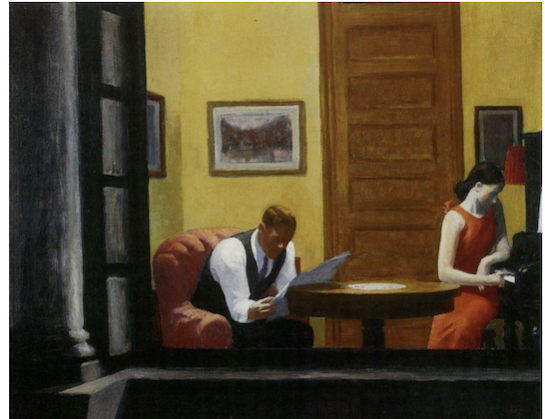 Edward Hoper, Room in New York (1932)
II
It was in an inherent dialogue with this demand for the courage to bewith, I believe, that in 2009, the philosopher Mark Fisher published, to some immediate success, his book Capitalist Realism: Is There No Alternative?, a book that would ultimately become his most mentioned work, and the one with the greatest impact on the philosophical ambience of academic debate in the times that followed. In it, Fisher draws upon explicit references — both thematic and stylistic — from the philosopher Slavoj Žižek and, for this very reason, undertakes the development of his arguments in a manner that is simultaneously playful — connected with cultural mainstream media pieces that, as a rule, elude academic discourse — and highly rigorous — paying sharp attention to the developments and roots of his concepts’ constitutions.
Fisher’s argument could be well summarized in the question that serves as the work’s subtitle and the formulation that develops the presentation of its problem — a question, credited at times to Fredric Jameson and at others to Slavoj Zizek, that ultimately became a subcultural motto within certain intellectual spaces of what today seems to remain of what is understood as the Left: ‘Is there alternative?’ or ‘Is it easier to imagine the end of the world than the end of capitalism?’ In the axis of these questions that in reality are one and the same, Fisher immediately brings to the fore and confronts his readers with the limits of the contemporary political imagination, understanding the discursive order of neoliberalism as a founding element of both the parameters ‘of the possible’ for this imagination and its blockages. Capitalist realism is a form of cynicism directed against what one could call revolutionary fantasy, it is a confrontation with an ‘immutable reality’. Precisely that is what Fisher attempts to break through within the arguments that sustain his book.
In reflecting on the way the very modern philosopher presents his ideas, however, something prompted me to shift this supposed ‘realism’ toward a different kind of discursive touchstone. Far from establishing this cynicism as realistic, I simply always tend to perceive in this process so well articulated by Fisher a certain kind of Romantic and Idealistic instrumentalization; something that, I would argue, adds complexity to the way social fantasy is interpreted within the current order of our social discourse. Thus, it is in this sense that I begin to consider the displaced idea of a contemporary paradigm that feeds on the discursive processes of neoliberal control to construct a new type of subject — a new subjective mode, a new fashion-of-the-being, so to speak — which, in the present essay, I have chosen to call, in direct dialogue with Fisher’s Capitalist Realism, Capitalist Romanticism. This idea would serve not as a counterpoint to Fisher’s notion, but more fundamentally as an archaeological exploration of the roots of what emerges as an enunciated realism. In a way, there is a proposal here for a romantic investigation into the assertion of an inescapable form of neoliberal realism, and, therefore, an exploration of the fantasy that solidifies the supposed image of capitalism’s ‘unavoidable reality’ as a social fact.
However, to consider how this fantasy was able to engender itself in such a way that today it can not only present itself as realism but also be widely accepted as such, I propose that we first consider ‘what kind of romanticism’ is being discussed here, as well as turn our attention to how exactly the answer to this question can, in turn, provide more depth to the present debate. Seeking to connect the supposed image of a capitalist realism — in which the present order is unavoidable — with the fantastical foundation that romantically underpins it requires an understanding of the engendering of the Romantic movement and its ethical trajectory that is considerably more detailed and intricate than what one might attempt to perceive in the ways the notion of romanticism emerges vulgarly within the discursive common sense of our time — even if there are traceable links between the simplistic representation and the complex understanding. It is, nonetheless, highly important to understand the way romantic discourse is, admittedly, simplified in our discursive common sense, and how this simplification precisely tends to serve an ideological instrumentalization of romanticism’s (aes)thetic proposals, which then strips these proposals of their most complex nuances. It is precisely by exploring some of these proposed — and elided — complexities that we will be able to map an itinerary of our social fantasy’s passage through the capitalist realism that exists in a feedback loop with its subjective complement: the Romantic-Capitalist Subject. With that in mind, I propose, then, that we begin this very important tracking.
1.1 – The Time of the Modern
I imagine it is impossible to think about aesthetics today without, generally speaking, passing through some form of reflection on the thought of the Modern — or of Modernity. This, of course, is meant in the purest sense of the term modern. The word, after all — as, it should be noted, is often forgotten within the signifying currents of common sense — has as its original meaning the matter of the time of the now. The signifier, which derives from the Latin term modernus — a term that, should interest us, also aligns with the Latin origin of the signifier ‘fashion’ (moda) — has as its original meaning something like ‘that which is contemporary, which belongs to our days.’ The idea of the modern, then, is the idea of a direct relationship between the so-called modern and the time in which it is so named. Thus, attempting to feel today — or rather, to place oneself in a modern aesthetic disposition — would contain within itself the lines of force of what is understood as ‘feeling’ in the present time; which, therefore, brings us full circle back to the statement that thinking about aesthetics today would, in one way or another, involve thinking about the modern.
This brief conclusion then imposes upon us, in the desire for an intellectually responsible work, the need to — at least briefly — examine the discussion that underpins our time’s discourse on modernity, so that the propositions laid out in this essay can establish a greater affinity with the lines that weave the symbolic order governing us. In this manner, I believe it is of some value to begin the course of this essay posing what I understand to be a question of utmost importance: What might be the tendencies of the modern, it’s unconscious trends, so to speak? And, perhaps a bit deeper, what would then be the trends of the subject who simultaneously inhabits and composes this modern time, one feeding into the other?
When thinking about the intellectual discourse that reflects on the modern, there is absolutely no scarcity of authors, perspectives, and bibliographies from which to borrow certain propositions — the theme, after all, has been of acute theoretical importance for quite some time. It would therefore be a frivolous exaggeration to try to exhaustively comment on the different ways in which this theme has already been approached across the most diverse theoretical lines — and this is not, in fact, the intention of the work I wish to undertake. Here, I will simply take some of these analyses and elaborations as a kind of root upon which my arguments can flourish. That affirmation, though, makes space for me to explicitly acknowledge from the outset the inevitable lack with which every essay must confront itself: the cut.
In this spirit, one of the propositions that reaches us as a form of intellectual heritage, and which I judge to be among the most thoughtprovoking regarding the modern and modernity, is the one developed by the poet and theorist Octavio Paz in his book Children of the Mire. It is also largely from the perspective put forward by Paz in this book concerning modern tendencies that the ideas giving life to the present chapter ultimately emerged as important elements in how I came to understand the compositional lines that shape contemporary society.
Paz begins his book by positing to his readers that a certain kind of tradition — we could call it a kind of fashion or mode — exists within every processes proposed by the movements that advance a certain idea of modernity — such as Romanticism or the Avant-Garde movements of the beginning of the 20th Century. For the poet, this phenomenon can be understood as a sort of ‘tradition of rupture.’ Thus, the drives to cut ties with tradition that appear as the calling card of any historically modern disposition are, in Paz’s view, also a form of tradition, ‘another tradition,’ a traditional deviation of what came before; a tendency that appears as a marker confirming an aesthetic of the time of its present. Indeed, Paz comments that the theme of his book ‘[…] is the modern tradition of poetry. This expression means not only that there is a modern poetry but also that the modern is a tradition. A tradition made of interruptions and in which each rupture is a beginning’
The questions that Paz poses when introducing his book — and which he elaborates throughout the rest of the work — are quite powerful, especially if we consider how the aesthetic arrangements bound up with modern thought influence the flow of discourses governing our social order. From this point of view, it is crucial to understand the impact of Paz’s statement. Not far ahead of the quote above, in the very next paragraph, the poet makes another strong assertion that sets the tone for his proposed thinking and serves as the initial movement for the reflections presented here, stating that “[m]odernity is never itself: it is always other.” For him, “the modern is not characterized solely by novelty, but by heterogeneity”; it forms a “tradition of the heterogeneous, or of heterogeneity.” Thus, Paz believes that modernity is “condemned to plurality,” because while “the ancient tradition was always the same, the modern is always different”.
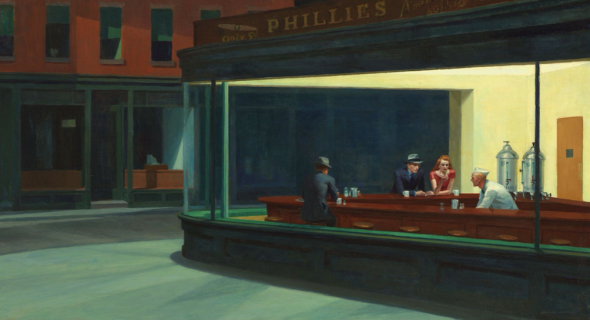 Edward Hopper, Nighthawks (1942)
It is not difficult, in fact, to find instances where Paz’s ideas can be substantiated. We can take as an initial example the aesthetic movements of the early 20th century that became known as the Historical Vanguards — Cubism, Dadaism, Surrealism and so on. It is a well-known fact — made obvious, in truth, by the plural form that characterizes the name of these movements — how wide a variety of interpretations were made available during the rupture demanded by the crisis that characterized the turn of the 20th century. At that time, with political tensions culminating in war and terror, with people’s faith in the liberal institutions formed over a century prior faltering daily, and with the increasing interest in building some type of alternative, it was not at all rare for one to embrace this demand for rupture and put on it their own singular spin. In this manner, we can observe several movements developing across distinct territories throughout the European continent — and beyond — each with distinct ways of visualizing, verbalizing, and concretizing this so-called rupture, which means to say: each with its own deviated path for inventing the modern, and on it bring about creative deviation.
The German theorist Peter Bürger develops a highly compelling reading of the lines of force that shaped these different inventive perspectives in his Theory of the Avant-Garde. In this work, supported by thinkers from the Frankfurt School in a debate regarding the importance of the avant-garde as an aesthetic-social historical element, Bürger reaches a point — drawing from a reading of the concept of allegory proposed by Walter Benjamin — where he successfully articulates a distinction of disposition concerning avant-garde artists. For Bürger, “the classicist treats his material as a totality, while the avant-gardist tears his from the totality of life, isolating it, fragmenting it.” This fragmentation, which may very well constitute the tradition of the modern as Paz conceived it and which undoubtedly arrives today as an essential procedure for understanding the discourses circulating in society, becomes something of extreme importance when we begin to ponder the formation tendencies of these discourses; when we dare to pose the question of what would be our Trend or Fashion, so to speak.
Further complexifying the theoretical tools at our disposal to read these phenomena — our fashion and the aesthetics born from it — the critic Hal Foster, in his work The Return of the Real, proposes adding a chronicle twist to the way we deal with the modern tradition, perhaps providing an excellent interpretive key to make palpable the possible continuity of a tradition of rupture. Upon encountering the idea of the neo-avant-garde and attempting to debate with and elaborate it, Foster utilizes the Freudian notion of “deferred action” (Nachträglichkeit). For Foster, the relationship between the Historical Avant-Gardes of the 1920s and the Neo-Avant-Gardes of the 1960s is a matter of understanding how to project this particular Freudian concept. Foster states that to think through the historical relationship between the avant-garde movements, one must understand that “[d]ifferent models of causality, temporality, and narrativity are required; too much is at stake in practice, pedagogy, and politics to leave established obscurantist models unchallenged.” In other words: it is necessary to understand the tension-filled relationship that is always established in this proposed historical game of repetition in order to found its (always other) tradition in the era that calls itself modern. This category of chronic relationship between discourses understands that “an event is only registered through another that recodes it; we only become who we are through deferred action.” At this point, Foster makes use of the statement by French psychoanalyst Jean Laplanche: “[i]t always takes two traumas to make a trauma.”
Modernity is therefore, inescapably, a disposition constructed in conviviality with time, an event suspended between temporalities. It constitutes itself as a way of understanding the movements of history, capturing within the fragments belonging to its elements of aesthetic (dis)organization: ways of inventing an(other) mode of being, an(other) fashion.
This process, which seems to be at odds with the pathway we can follow through Bürger to Foster, has an affinity with an aesthetic thinking that carries within itself the need to deal with time as a foundational category of its own elaboration. Tuned into the core of this perspective, the art critic and historian Georges Didi-Huberman has, throughout his work, been unweaving the web of lines that constitute the central tangle of the hegemonic historical perspective regarding aesthetics, attempting, along the way, to make it so that some other, maybe any other, deviant lines to follow in distinct ways of embroidering history can finally show themselves to us.
By addressing here the semantic field of fashion in relation to the idea of modernity, I intent for us to take into consideration how this aesthetic form — the art of fashion — relates to the very notion of modernity from its beginning. Fashion is that which constructs symbolic conformity with the present time, with the modern; it is the line that keeps modernity suspended between temporalities, connecting them. Thus, I think it is somewhat inescapable that a thought on modernity — and on the possible cracks and pores existing in the structure that sustains our contemporary world — passes through a reflection on this particular artform. The discourse of fashion, after all, permeates human relations in registers that range from the most conscious to the most unconscious — with everything in between.
In a scene from the movie The Devil Wears Prada, the character, brilliantly played by Meryl Streep, Miranda Priestly, delivers a speech aimed at reprimanding her new secretary, Andrea (the main character of the film, played by Anne Hathaway), making it clear that the alleged indifference Andrea thought she had towards the work of a fashion magazine — of which Miranda is the editor-in-chief — is, in fact, the product of a delicate chain of marketing and discursive events that cause Andrea to buy, wear, and even behave precisely the way she does. This awareness of the forms of control implied in the discourse of fashion and its aesthetic path is perhaps one of the most interesting things about the film, insofar as it gives us a path to understand the impact of this form aesthetic expression on our symbolic daily life — that is, on our modernity.
However, before considering how fashion actively participates in the construction of modern subjectivity, I think it is valid for us to look, even if only briefly, at the origins of fashion as an aesthetic form and seek, within said history, the ways in which it quickly associates itself with the aforementioned subjective constitution.
1.1.1 – Fashion: An Archeological Problem
In Fashion History: A Global View — a work of bold scope that nonetheless delivers meticulous, carefully researched insight into fashion history as a globally significant element in both economic and psychosocial spheres — US authors Linda Walters and Abby Lillethun undertake a substantial effort to position the aesthetic form known as “fashion” as a key factor in the debate regarding the constitution of the subject. The authors present an overview that, while generous in its breadth, opens up new ways of considering the subject matter. They emphatically assert the importance of viewing the fashion phenomenon from a perspective that transcends the Eurocentrism that has historically characterized fashion studies; to this end, the book highlights temporal and geographical contexts that diverge from the established conventional wisdom within the — very young — field of study. This endeavor is significant because it establishes a relational link between subjective practices and the dynamics of fashion as an aesthetic form, thereby offering a new way to interpret certain historical trends in the relationship between subjectivity and fashion.
Such an argument by the authors, however, should not be taken without remembering that historical events and historical development in their dialectical form will, without a shadow of a doubt, have to be taken into consideration — not only in the study of fashion, but in the study of any subjective disposition in history. This notion is important because part of the central argument in Welters and Lillethun’s work is that there is evidence in the most remote historical records of something in the selfconstruction of the subject, of the social bein, that can be termed a ‘fashion impulse’ [or ‘modal impulse’], a demand to transmit a symbolic message about oneself through the distinct forms of clothing and accessories one chooses to wear. Taking this argument into consideration is interesting because it causes the discourse on fashion, and the way it is instrumentalized in capitalist modernity, to bring forth a certain symptomatic trace of modernity itself.
Welters and Lillethun argue that the origins of fashion as a process were, in fact, concurrent with the origins of human social organization, given that the impulse to represent oneself symbolically through the aesthetic form of dress would be a way for the subject to navigate the relationship and communication demanded by living in a world shared with others — the fashion impulse could be viewed, from this perspective, as an element of conviviality. Based primarily on the ideas of Aubrey Cannon and Jennifer Craik, the authors contend that the perspective of fashion studies has been lacking regarding the historicity of its object, limiting it to an element born out of the modern era and capitalism. In their book, the authors bring to light Cannon’s assertion, in which he notes his belief that ‘fashion’ can be traced, in some way, to the earliest adornments used by humans in the Paleolithic period, stating that ‘although the processes of fashion comparison, emulation, and differentiation are more noticeably apparent in the rapid changes that characterize systems of industrial production’, he also considers that ‘the same processes are observable, or at least inferable, in most cultures.’
The authors then tell us, regarding the Canadian anthropologist, that he “understood fashion as a process driven by the human need for selfidentity and social comparison, as well as by the desire to differentiate oneself visually”. Cannon seems to think that restricting “the definition of fashion to a continuous process, like that found in Western industrial societies […] excludes the systematic changes in style that occur in all cultures, including indigenous ones”. Indeed, by thinking that “smallscale societies may experience only sporadic changes in style in response to a specific set of circumstances” and subsequently asserting that such style changes nonetheless “constitute the same process as fashion in Western cultures”, Cannon seems to pinpoint a matter highly symptomatic of Fashion’s relationship with modernity in the so-called “Western culture” and its tendency toward death: a point related to the exacerbated acceleration of fashion’s metamorphic cycle
In addition to Cannon’s thought-provoking ideas, which are substantiated by how the anthropologist meticulously researched documents and primary fonts proving that Native American tribes had the custom of changing the type of fur and the color of their garments long before the colonizer’s influence, the authors bring back the idea of a ‘fashion impulse’ [or ‘modal impulse’] coined by Jennifer Craik and recall that Craik states that ‘fashion is not the exclusive domain of modern culture and its concerns with individualism, class, civilization, and consumption.”
However, the authors’ need to firmly establish their argumentative ground regarding this issue is, at the very least, a symptom that something allows this type of Eurocentric and superficial assertion to hold a certain hegemony in the eyes of fashion historians throughout the development of this — as previously mentioned — still quite young field of study. Indeed, a large part of the first half of Welters and Lillethun’s book is dedicated to demonstrating how the field of fashion historiography was born and developed. In this section of the work, the authors show they understand that there is currently an ongoing shift regarding this perspective — one of which they themselves are a part — but that for a long time, the idea of ‘fashion’ was restricted to a mindset that localized it within the domain of what we understand as ‘Western culture’ starting from colonial voyages within and in accordance with the capitalist system.
The immediate consequence that I think arises from the perception of this symptom is that something in the relationship between fashion, the modern era, and capitalism is of paramount importance for the way fashion as an aesthetic form plays its discursive role in the symbolic order in which we live. This is perhaps, effectively, a symptom that points directly to how the critical consciousness demonstrated so acutely by the film The Devil Wears Prada found its object of critique. Something appears here, therefore, that raises the question: what is the relationship between fashion as a discursive and aesthetic system, the social influence it exerts, and the interests that shape ‘Western culture’?
1.1.2 – Leopardi’s Fashion
In the first half of the 19th century, in 1827, the Italian poet Giacomo Leopardi published, in his work Operette Morali, an operetta titled Dialogo della Moda e della Morte (Dialogue between Fashion and Death). In this short dialogue, the poet developed a beautiful conversation between the two entities — Fashion and Death — representing them as distant sisters who were finally reuniting. Fashion then introduced herself to her sister Death, demonstrating the countless ways in which, over the years, she had contributed to her sister’s work while carrying out her own. Here I transcribe the translation made by Charles Edwardes of the dialogue:
Fashion: Madam Death, Madam Death!
Death: Wait until your time comes, and then I will appear without being called by you.
Fashion: Madam Death!
Death: Go to the devil. I will come when you least expect me.
Fashion: As if I were not immortal!
Death: Immortal? “Already has passed the thousandth year,” since the age of immortals ended.
Fashion: Madam is as much a Petrarchist as if she were an Italian poet of the fifteenth or eighteenth century.
Death: I like Petrarch because he composed my triumph, and because he refers so often to me. But I must be moving.
Fashion: Stay! For the love you bear to the seven cardinal sins, stop a moment and look at me.
Death: Well. I am looking. Fashion: Do you not recognise me?
Death: You must know that I have bad sight, and am without spectacles. The English make none to suit me; and if they did, I should not know where to put them.
Fashion: I am Fashion, your sister.
Death: My sister?
Fashion: Yes. Do you not remember we are both born of Decay?
Death: As if I, who am the chief enemy of Memory, should recollect it!
Fashion: But I do. I know also that we both equally profit by the incessant change and destruction of things here below, although you do so in one way, and I in another.
Death: Unless you are speaking to yourself, or to some one inside your throat, raise your voice, and pronounce your words more distinctly. If you go mumbling between your teeth with that thin spider-voice of yours, I shall never understand you; because you ought to know that my hearing serves me no better than my sight.
Fashion: Although it be contrary to custom, for in France they do not speak to be heard, yet, since we are sisters, I will speak as you wish, for we can dispense with ceremony between ourselves. I say then that our common nature and custom is to incessantly renew the world. You attack the life of man, and overthrow all people and nations from beginning to end; whereas I content myself for the most part with influencing beards, head-dresses, costumes, furniture, houses, and the like. It is true, I do some things comparable to your supreme action. I pierce ears, lips, and noses, and cause them to be torn by the ornaments I suspend from them. I impress men’s skin with hot iron stamps, under the pretence of adornment. I compress the heads of children with tight bandages and other contrivances; and make it customary for all men of a country to have heads of the same shape, as in parts of America and Asia. I torture and cripple people with small shoes. I stifle women with stays so tight, that their eyes start from their heads; and I play a thousand similar pranks. I also frequently persuade and force men of refinement to bear daily numberless fatigues and discomforts, and often real sufferings; and some even die gloriously for love of me. I will say nothing of the headaches, colds, inflammations of all kinds, fevers—daily, tertian, and quartan—which men gain by their obedience to me. They are content to shiver with cold, or melt with heat, simply because it is my will that they cover their shoulders with wool, and their breasts with cotton. In fact, they do everything in my way, regardless of their own injury.
Death: In truth, I believe you are my sister; the testimony of a birth certificate could scarcely make me surer of it. But standing still paralyses me, so if you can, let us run; only you must not creep, because I go at a great pace. As we proceed you can tell me what you want. If you cannot keep up with me, on account of our relationship I promise when I die to bequeath you all my clothes and effects as a New Year’s gift.
Fashion: If we ran a race together, I hardly know which of us would win. For if you run, I gallop, and standing still, which paralyses you, is death to me. So let us run, and we will chat as we go along.
Death: So be it then. Since your mother was mine, you ought to serve me in some way, and assist me in my business. Fashion: I have already done so—more than you,—imagine. Above all, I, who annul and transform other customs unceasingly, have nowhere changed the custom of death; for this reason it has prevailed from the beginning of the world until now.
Death: A great miracle forsooth, that you have never done what you could not do!
Fashion: Why cannot I do it? You show how ignorant you are of the power of Fashion.
Death: Well, well: time enough to talk of this when you introduce the custom of not dying. But at present, I want you, like a good sister, to aid me in rendering my task more easy and expeditious than it has hitherto been.
Fashion: I have already mentioned some of my labours which are a source of profit to you. But they are trifling in comparison with those of which I will now tell you. Little by little, and especially in modern times, I have brought into disuse and discredit those exertions and exercises which promote bodily health; and have substituted numberless others which enfeeble the body in a thousand ways, and shorten life. Besides, I have introduced customs and manners, which render existence a thing more dead than alive, whether regarded from a physical or mental point of view; so that this century may be aptly termed the century of death. And whereas formerly you had no other possessions except graves and vaults, where you sowed bones and dust, which are but a barren seed, now you have fine landed properties, and people who are a sort of freehold possession of yours as soon as they are born, though not then claimed by you. And more, you, who used formerly to be hated and vituperated, are in the present day, thanks to me, valued and lauded by all men of genius. Such an one prefers you to life itself, and holds you in such high esteem that he invokes you, and looks to you as his greatest hope. But this is not all. I perceived that men had some vague idea of an after-life, which they called immortality. They imagined they lived in the memory of their fellows, and this remembrance they sought after eagerly. Of course this was in reality mere fancy, since what could it matter to them when dead, that they lived in the minds of men? As well might they dread contamination in the grave! Yet, fearing lest this chimera might be prejudicial to you, in seeming to diminish your honour and reputation, I have abolished the fashion of seeking immortality, and its concession, even when merited. So that now, whoever dies may assure himself that he is dead altogether, and that every bit of him goes into the ground, just as a little fish is swallowed, bones and all. These important things my love for you has prompted me to effect. I have also succeeded in my endeavour to increase your power on earth. I am more than ever desirous of continuing this work. Indeed, my object in seeking you today was to make a proposal that for the future we should not separate, but jointly might scheme and execute for the furtherance of our respective designs.
Death: You speak reasonably, and I am willing to do as you propose.
The Leopardian dialogue is worthy of our attention for a variety of reasons. In it, we can notice, for instance, how Leopardi was already tuned into the demand that Welters and Lillethun claim to be attending to — that of deviating from Europe as the sole locus of fashion — since the poet does not fail to mention Asia and America in the persuasive speech his Fashion delivers to his Death, even if the tone there is one of scathing criticism toward fashion as a process. However, what first captures my attention is its publication date and the way it seems to me that, in this short and powerful dialogue, the poet competently managed to outline the context that was, at the time, shaping the development of modern literature and aesthetics; what in reality just means that it was shaping modernity itself. Such an affinity, tuned in by Leopardi, would mean that his Dialogue between Fashion and Death could only happen inside modernity, while, to a certain extent, it synthesizes this very modernity within itself.
In order to really, then, think about this dialogue that Leopardi places at our disposal, we would first have to examine the relationship between fashion and modernity — insofar as it seems to be a consensus that the latter institutionalized the former. Leopardi speaks as a modern poet in the 19th century, the century many would argue was the century of Romanticism and a century that was, consequently, marked by movements of pronounced individualism and death. His Fashion demonstrates a rather pessimistic, even morbid, understanding of her time; she and her sister Death are, after all, daughters of Decay. However, one must understand that the critique that lies there is not exactly aimed at the process or even the aesthetic form of Fashion itself, but rather at the way it is socially transposed in the time of the poem. For in the same dialogue where he holds Fashion responsible for diseases, fevers, pains, discomforts, and torments, the poet does not fail to recall that both sisters agree that their ‘nature and common use is to continually renew the world.’ With this in mind, the disposition of his characters would not be inherently good or bad in and of itself, but would instead depend on where this renewal would lead.
In Fashion History: A Global View, the authors seem to point us toward a path of elaboration for these questions when they mention the figure of Walter Benjamin and his reflections on Charles Baudelaire. This is a path that allows us to tune into this relationship between fashion and modernity and, in doing so, better elaborate our understanding on how Leopardi manages to align these two ideas of Fashion and Death in such a fraternal way.
In the section of the book titled “Fashion Systems,” Walters and Lillethun address the relationship Walter Benjamin developed between fashion and modernity in his reading of Baudelaire. Noting that “upon his death in 1940, the German essayist Walter Benjamin was preparing notes on fashion,” the authors point out how — both in his essays on Baudelaire and modernity and in the Arcades Project — Benjamin devotes paragraphs to the relationship between historicism and fashion. They draw attention to the Benjaminian concept of Tigersprung (tiger’s leap) and the way the historical-relational dialectical leap it describes translates into how fashion incorporates stylistic trends from different historical moments into its modern — and, because modern, everpresent — discourse. As the authors rightly observe,
Benjamin examined an array of fashion’s aspects: the influence of the group in fashion selection, imitation, and differentiation, and the sense of contingency and possibilities in modernity that contributes to feelings of ambivalence. Benjamin also discussed shopping, using the nineteenth century as the lens. Metropolitan shopping had been transformed in the nineteenth century with the appearance of department stores and their large pane glass windows. In this discussion, Benjamin analyzed Constantin Guys’s illustrations of Parisians and Charles Pierre Baudelaire’s ([1863] 1964) essay “The Painter of Modern Life,” which commented on Guys’s works as “the painter,” as well as on shopping. Benjamin was intrigued by Baudelaire’s commentary on commodity culture that resonated in the 1930s and which continues today (Evans 2013). Baudelaire connected the experience of modernity to fashion. Fashion, for Baudelaire and Benjamin alike, expressed the everfleeting present, bringing into focus the current moment. Benjamin also played with Baudelaire’s fashionable strolling couple, the flȃneur and flȃneuse who were envisioned in Guys’s ink sketches. They walked the boulevards of Paris, enjoying the social process of seeing and being seen in their fashionable attire.
Now, it is quite interesting that it is precisely Walter Benjamin and Charles Baudelaire whom the authors choose as thinkers who reflected acutely on the relationship between fashion and modernity, insofar as it is within Walter Benjamin’s thoughts on modernity that some of the lines extending toward the formulation of the Leopardian dialogue seem to linger.
The section titled ‘Fashion’ in Walter Benjamin’s Arcades Project opens with two epigraphs: the first is precisely the opening line of Leopardi’s dialogue, ‘FASHION: Madam Death, Madam Death,’ which is followed by a quote from Honoré de Balzac that reads, ‘Nothing dies, everything is transformed.’ Furthermore, the first entry of the section chosen by Benjamin states the following: ‘And boredom is the lattice before which the courtesan teases death.’ I do not think much more than this is needed to point out that Walter Benjamin understood — and made sure to solidify in his most ambitious work on the psychosocial constitution of the modern subject — the intimate relationship between fashion and death within the womb of the nascent modernity he observed. It is, therefore, this relationship that we will have to examine next.
1.2 – Death as Fashion
Let us begin, therefore, by elaborating on some of Walter Benjamin’s reflections on fashion, understanding the fact that these serve in some hefty way as a foundational piece for the movements intended ahead. In his grandiose and incomplete thought-collage of conceptual excerpts and eventual commentary that received in its English version the name of Arcades Project, Benjamin seems to pair fashion with a series of companions — dance partners, so to speak. Fashion, within the lines organized and composed by the curator-philosopher-essayist-criticeditor, relates to a variety of ideas, and through these ideas it is possible to identify — or at least construct a strong notion of — how Benjamin perceived fashion as an Art, in all its aesthetic form. One could, and would be very right in doing so, notice that Benjamin connects fashion with key signifiers of modern discourse such as sex, the market, and death. In a way, these three signifiers appear synthesized in a passage where Benjamin relates Fashion, Revolution, and Love in the layout developed for his work, which begins by stating: ‘Here fashion opened the dialectical exchange between woman and commodity — between desire and the corpse’. Indeed, in order to elaborate a reading here that unfolds from an interpretation of Benjamin’s signifying choices, we can observe that fashion is placed by the philosopher within the fulcral space that constitutes the materiality of desire. And it is precisely from this space, the overall notion of the materiality of desire that I believe it would be the most fruitful for us to proceed in our train of thought.
1.2.1 – Fashion and Desire
Connecting fashion with modernity, Benjamin makes the following observation in a reading of the author Alphonse Karr’s theorizations on this aesthetic form:
For the philosopher [Karr], the most interesting thing about fashion is its extraordinary anticipation. It is well known that art will often-for example, in pictures-precede the perceptible reality by years. It was possible to see streets or rooms that shone in all sorts of fiery colours long before technology, by means of illuminated signs and other arrangements, actually set them under such a light. Moreover, the sensitivity of the individual artist to what is to coming certainly far exceeds that of the grande dame. Yet fashion is in much steadier, much more precise contact with the coming thing, thanks to the incomparable nose which the feminine collective has for what lies waiting in the future. Each season brings, in its newest creations, various secret signals of things to come. Whoever understands how to read these semaphores would know in advance not only about new currents in the arts but also about new legal codes, wars and revolutions.-Here, surely lies the greatest charm of fashion, but also the difficulty of making the charming fruitful.
Benjamin cuts out this passage as if to solidify how much he considers Fashion to be a space of true potential. In it, he believes he has effectively found the modern epitome — if we return to the idea that the modern is that which aligns itself with its own time. However, sharpening the modern proposition further, Benjamin does not merely attribute to this aesthetic form the capacity to read the time of the now with sharp perception; he identifies within it an ability to offer a vision of what is to come. Indeed, the author goes so far as to position fashion as a type of synthesis of what he understands as the dialectical image, telling us that ‘what sets the tone is always what is newest, but only where this emerges among the oldest, most past, most habitual things.’ For him, the movement in which ‘what is entirely new forms itself out of what has passed’ characterizes ‘the true dialectical spectacle of fashion.’ Benjamin believed that in his century — and I think we can say that the permanence of this characteristic can still be observed in our daily lives — ‘all the dream energy of a society took refuge with double vehemence in the hazy, silent, and impenetrable realm of fashion, where the understanding cannot follow it.’ This is what led the philosopher to state that ‘fashion is the precursor, no, it is the eternal surrogate of Surrealism.’
Such a statement carries great significance and revolutionary force coming from Walter Benjamin, given that he asserted in his essay On Surrealism that that particular avant-garde movement was the one that best understood Marx and Engels’s Communist Manifesto, placing a truly revolutionary power within the dream-like provocative proposals of surrealist aesthetics. It is not surprising, therefore, that the author delegates a very similar force to the Art of fashion — an Art form that can travel through the waves of the unconscious and predict desires.
And that is precisely why the conceiveing thought of a revolution must take fashion, as an agent of this desire, into consideration. If we think of fashion as an aesthetic form that is intimately related to death as an allegory — something that both Benjamin and Leopardi seem to place at our disposal — then we must consider what kind of death shares these fraternal bonds with the modern being’s fashion impulse. Benjamin recalls the place of fantasy in fashion’s relationship with desire when he says that
In fetishism, sex abolishes the barriers between the organic and the inorganic world. Clothing and jewelry are its allies. It is as much at home in the inert world as in that of the flesh. The latter points the way for it to establish itself in the former. Hair is a territory located between the two realms of sex. Another opens to it in the intoxication of passion: the landscapes of the body. These are no longer even alive, but are still accessible to the gaze, which, the more distant it is, the more it transfers to touch or smell the journey through these realms of death. In the dream, however, it is not uncommon for breasts to swell, which, like the earth, are entirely clothed in forests and crags, and gazes have submerged their life at the bottom of mirrors of water sleeping in valleys. These landscapes traverse paths that accompany sex to the world of the inorganic. Fashion itself is only another means that attracts it even more deeply into the world of matter.
The semantic field in which, above, Benjamin places fashion is, once again, the semantic field where fashion is intertwined, inseparably, with desire and death. Finding meaning in the way that, positioned as a material element of fantasy, it stands as a threshold between the two. In a certain way, this threshold position of fashion appears as a kind of characteristic of the poetic form itself: it is the threshold that enables fashion to relate so intimately to the temporal flow that Benjamin conceptualizes in the dialectical image; it is also the thread with which Fashion temporally sustains modernity itself and may very well also be the reason why, in its relationship with death, Fashion still contains a certain potential upon which we must necessarily reflect.
During his teaching, the French psychoanalyst Jacques Lacan dedicated a large part of his reflections to thinking about the registers that shape, in his view, subjective constitution. The subject is formed, from the Lacanian perspective, in relation to the three registers proposed by him. The names given by Lacan to these registers are: the Real, which Lacan defines as ‘that which does not cease not to write itself,’ which would mean something akin to the unrepresentable; the Symbolic, which was proposed by the psychoanalyst as the place of language, the realm in which social relations can be constructed; and the Imaginary, the place of fantasy, interpretation, and the construction of meaning for the subject.
When Benjamin so intriguingly relates the aesthetic form of fashion to death and desire, based on the possibility that such an aesthetic form has of moving between the ‘organic’ and the ‘inorganic,’ what he seems to be doing is a movement that would echo a thought, in a Lacanian key, that the elements of fashion manifest a dance between the registers, having the capability to superimpose the symbolic with the imaginary and, perhaps, mobilizing, in the subject and in the Other, something, a almost-reachable trace, of the Real — producing, thus, an unique contact with desire at its root.
The contribution of Lacanian thought to the issues contained in the present essay, however, is not limited to the way the psychoanalyst proposes to organize subjective experience, but rather in the way Lacan elaborates on two important concepts of psychoanalytic thought: the death drive and the jouissance. For it is in the possibility of bringing the intricacies of these two concepts into an openly social conversation — of refracting the tensions present in these psychoanalytic notions within society — that fashion best serves as a core element of the construction of a thought on the modern subject and their conflicts.
The death drive was initially proposed in Freudian thought to account for the idea of an instinctive aggressiveness within the subject. Lacan, in turn, reinterpreted this concept to view the death drive as an unconscious element — present in the symbolic order — that constitutes the subject, insofar as it is by elaborating the symbolic knowledge of death that the ‘ego’ [or ‘I’] is formed. The death drive is conceptualized by Lacan as the paradigmatic point of all drives. It is also an element that, as foundational to subjective formation itself, underlies the actions of every subject in their own singularity.
It is in the course of elaborating the concept of the death drive that the French psychoanalyst proposes his idea of jouissance. Lacanian jouissance is characterized, in psychoanalysis, as a substance of the subject. This substance is characterized by the constitution of a contradictory relationship between the subject’s angst and his unconscious satisfaction. In this way, jouissance, which is characterized by the repetition of the signifier within the subject, has to do with the distinction between conscious pleasure and unconscious angst — and vice versa.
These concepts developed by Lacan throughout his psychoanalytic teaching serve us here to help bring into play the ways in which the construction of society, and its trends (or fashions), are shaped — in a relationship of dialectical tension — by its deeply distinct and contradictory discourses. At the same time, they serve to help us understand that aesthetic forms, the arts, are an underlying part of these discourses, insofar as it is precisely through aesthetics that Lacan proposes the elaboration of both the death drive and jouissance. This line of thought, however, unavoidably brings to light the demand that we bring forward a lingering question that, in reality, has followed along with us nearly the entire way through this textual reflexion up to this point: what is the social element, symbolically mobilized in our discursive order, that causes fashion to relate so intimately to death? What kind of aesthetics is this that constructs itself within the morbidity of the inherent construction of its own end? And what would be the reason for this movement to occur apparently as a consequence of the birth of the so-called ‘Modern Era’?
1.2.2 – Modernity: Capitalism and Appropriation
The Modern Era is described as having taken place during the period between the years 1453 and 1789; thus, its occurrence is documented as spanning from the end of the Middle Ages in the 15th century to the beginning of the so-called Age of Revolutions in the 18th century. The era is characteristically demarcated by the discursive composition of a distinct subject, what we can, in a general manner, understand as the modern subject. In the theoretical field of literature, it is not uncommon for us to associate the Modern Era with the birth of the modern novel — usually pointing to Cervantes’ Don Quixote as paradigmatic of this type of text and of that particular moment in literary history — and the appearance of the Modern Hero, who is seen as the individual possessing the power of choice over their own destiny. Perhaps the most important hallmark of the Modern Era, however, is the occurrence of colonialism, the so-called ‘Age of Discovery’ [or ‘great navigations’], and what Karl Marx identified as the origin of the primitive accumulation of capital in his magnum opus — Das Kapital.
Colonialism as a historical event can, and must, be seen as a structuring element of modernity, and it is crucial that this element be thoroughly elaborated here; for, in light of the relationship Marx points out between colonialism and the hegemonic advancement of capitalism, the relationship we have highlighted throughout this chapter between Fashion, Death, and Modernity takes on substantially more compelling contours.
If we can postulate, with the bibliografical support that has sustained us up to this point, the idea of a fashion impulse — that is, of a sociosubjective tendency to compose one’s symbolic adornments through their clothing and accessories in order to understand oneself as a singular being that exists as a manifestation of their own difference and engages in conviviality within their distinct contexts — and we can draw from this the idea that the aesthetic form of fashion does not strictly depend on the notion of modernity and capitalism, the remaining question is, then, for what reason has fashion always been associated with the advancement of both.
This association seems to arise from the absorption of fashion as a device of control, precisely over the mechanisms that make up the capitalist production system as a symbolic structure. Not infrequently, thoughts on fashion have been linked to a kind of construction of elitism, class superiority, and hegemonic distinction — as thought of by sociologist Pierre Bourdieu. This construction of superiority and hegemony relegated to fashion is, however, based on the premises we have assumed and developed earlier in this essay, a type of symbolic imposition of capital and is far from being an inherent element of fashion as a process, an Art, or an aesthetic form; for it does not align with the poetics of fashion, but only with its use.
It would, therefore, be the role of any critical thought aiming to find a revolutionary interpretive key inside the discursive notion of fashion and the idea of a fashion impulse — as Benjamin proposes — to consider how to construct a detour from these appropriations and, consequently, rescue, within this poetic practice, its metamorphic power for society
1.2.3 – Disrupting the System
Fashion as a capitalist device of control seems to be well established as a common discursive line regarding the understanding of Fashion in our society. It is precisely this perception that causes the previously mentioned scene from The Devil Wears Prada to resonate so intensely with our perception of the social organization of customs and symbolic elements that belong to the realm of Fashion as an industry.
Within this paradigm of absorption to which fashion is subjected by the capitalist symbolic order from modernity onward, the fashion impulse becomes an element of fundamental importance for the functioning of capital’s ideological construction. This is because if the fashion impulse exists as a way for a person to symbolically point to themselves and differentiate themselves — meaning it is sustained by the idea of change, alteration, and difference in tune with the rhythm of the subject’s relationship with their social sphere — all the capitalist symbolic order would need to do with this impulse is exacerbate it to make it a kind of paradigm for the functioning of capital’s procedures.
In this way, fashion becomes a point of excellence for capitalist ideology, because its internal demand for change, caught within the intricacies of capital’s mechanism, is raised to the highest degree, thereby instating a death wish for subjectivity itself based on systemic capitalist interests. It is precisely from this particular symbolic landscape that Leopardi and Benjamin — as well as Baudelaire and various other theorists who conceptualize fashion as already inscribed within capitalist discourse — can relate it so closely, so fraternally, to the idea of death. This adoption of the fashion impulse by capitalism is, in this sense, what generates a problem in how the subject must deal with fashion as an aesthetic form and social element, for capitalist ideology is an ideology of nothing but an endless end. It is an ideology that elevates certain symbolic elements in order to enlarge them and, then, immediatly implode them, thereby increasing profit capacity through this movement. Both the subjective constitution and the expression of forms of behavior, understanding, and even life that the fashion impulse originally served within the constitution of one’s personality and self are relegated to the background; in this specific situation, fashion is taken as a kind of structural and symbolic element of the biased imposition of this capitalist enlargement and implosion. The direct consequence of this is that the speed of cyclical alteration — the social rhythm that communicates with the desire for change within one’s self — of fashion as a discourse, within this ideological framework, increases exponentially, insofar as the capitalist order demands the growth of profit possibilities and, in the same proportion, constructs a disregard for the affective and aesthetic relationship anyone has — or can have — with the expression of themselves.
Understanding this is what leads me to affirm that the importance of thinking about Fashion as an artistic and aesthetic form lies in the fact that I still believe it is possible to postulate that every discursive element present in the symbolic order that is appropriated and elevated to the status of a standard-bearer of capitalist ideology contains within itself the power to destroy it. I believe, in fact, that it is precisely in tune with this diagnosis that Benjamin relates fashion not only to death, but also to revolution.
The conclusion that fashion is an element arising from the relationship between the subject and society — appropriated by Capital and exacerbated by neoliberal ideology, thereby constructing a morbid aesthetics that has the end as an essential formative element — places us in a position to unfold the implications of this alleged relationship between fashion and death. Therefore, we will see ahead, how can we read the tension of death as it is related to fashion both within the neoliberal capitalist ideology — with its suicidal promotion of the ending of the self each season — and within something completely different, a construction of a revolutionary detour that stands tall and bery much outside of the reach of this ideological constriction.
One of the most impactful works in a general sense within the field of fashion studies was the book The Fashion System, written by Roland Barthes. In it, the French theorist sustains a semiotic reading of the discourse of fashion magazines and demonstrates how the aesthetic elaborations transmitted in the media come to inform society’s notions regarding the discursive forms of fashion in its time, always in a relation with the hegemonic — and therefore capitalist — discourse. This system theorized by Barthes can very well be read by us here as a form of propaganda for the neoliberal ways of accelerating the population’s customs in relation to fashion; it is the propaganda of accelerating the adaptability of the neoliberal subject to the market — and as such it has nothing to do with the poetics at play around the art form we can comprehend as Fashion.
1.3 — Aesthetics of death: Capitalist Romanticism and its detours
The dialogue in which the poet Giacomo Leopardi relates Fashion and Death, as well as the theoretical proposals that Walter Benjamin offers us in the Arcades Project, open a dual spectrum for how we can read this particular relationship. If, on the one hand, this relationship between Fashion and Death is inscribed within the discursive processes of the capitalist ideological system and, for this very reason, could be pointed out by Leopardi as a form of familial relationship; on the other hand, we can recall that Benjamin relates Fashion to another type of death, a death much closer to Lacan’s idea of jouissance — always remembering, in this sense, that jouissance in its pure sexual sense is also known in some Romance languages as the ‘little death’ [la petite mort] —, and one that carries with it an ability far more linked to transformation in life than to a definitive end: the revolutionary ability
This dual possibility in the relationship with death can be conceptualized through an important aesthetic movement that itself integrates the modern tradition of rupture theorized by Octavio Paz and was singular in its contribution to the development of modernity from the 19th century onward: Romanticism.
1.3.1 — Romanticism: Death, Power, and The Individual
Romanticism — as an aesthetic school, historical period, and political/ideological movement — was definitively a milestone in history; in fact, this movement was of paramount importance even for the construction of our very notion of history, and it would be impossible to address Romanticism entirely within the scope of this essay, nor is that the intention. Here, Romanticism appears as an important interpretive key so that we can consider the way in which, in the contemporary world, Death can appear as an element of an ambiguous and tensioned game, simultaneously bringing forth the idea of freedom and of subjection.
It is a well-known consensus that Romanticism has as one of its main formative elements the valorization of the idea of the individual — the elevation of the self, of the intellect, and of the strength of this intellect when dealing with nature. These constitutive elements of Romanticism are used at times as a way to outline a scathing critique of anything that subscribes, even if adjacently, to romantic forms of thought, and at other times to praise those who do so. Whichever the case, it seems quite safe to state that, given the influence and importance of Romanticism as a historical movement, any peremptory statement on the matter must, at the very least, have ignored some number of perspectives. The very nature of these formative elements that put value on Romanticism implies this, as they are, truth be told, quite difficult to definitively categorize as essentially good or bad.
It is the way in which the Romantic discourse is apprehended, used, and elaborated that, it seems, most causes such discourse to have effects, whether they are positive or negative. The fact remains that the Romantic movement simultaneously possessed a highly significant valorization of the construction of an Ideal, of an Absolute, and also that Death was a recurrent element throughout the entire course of Romantic thought — be it in German Romanticism, where the movement was conceived with this name, or in other places, such as France, Brazil and so on, where some of its original intelectual intentions and propositions were adopted.
Both the Ideal and Death, however, can unfold into different interpretations. And it is here that something like the importance of romanticism (or at least a watered down version of romantic sentiment) for capitalism appears. Within the intricacies of capitalist discourse and neoliberal ideology, the ideal of an individual serves perfectly to mobilize a kind of control over society’s forms of action. This happens because elevating the individual to an ideal can, if done with the correct signifiers, imply that the relationship with the Other — the possibility of a constructive dependence on the different and on difference — is of no interest to such an individual; the ideal of the individual becomes nothing more than an element of control, a trend — or modal construct. In this sense, being, as it is since conception, a master in the art of propaganda and discursive control, capitalism made abundant use of romantic ideas, constructing a solipsistic, self-absorbed, lonely, and anxious subject: The Romantic Capitalist Subject. Death, then, is a very immediate consequence, for the subject’s very relationship with the world seems to have already been severed even before the materiality of death reaches them. In an attempt to prevent the perception of Death in life, liberal discourse employs all possible strategies for simplifying and controlling pleasures. In the contemporary postpandemic social space, in a kind of material simulacrum of Huxley’s ideas in his novel Brave New World, the use of screens — such as cell phones, video games, and other forms of virtual escape from reality — has been an immensely effective strategy. It is more or less along these lines that Fashion appears, again, as a tool — yet another element in the almost obscene profusion of consumer demands that characterize the contemporary subject within the discourse that composes Capitalist Romanticism.
However, there is another way to conceptualize Romanticism in its relationship with Death. And this approach seems to allow much more room for a discursive elaboration in consonance with the fashion impulse as a relational element of the constitution of subjects, rather than as a marketing strategy for the construction of a solipsistic and anesthetic ignorance regarding the occurrence of death in life and the contexts that attempt to force the experience of the Real upon those living in the world.
1.3.2 – The Capitalist Romanticism
Based on this notion of Romanticism, and understanding the relationship that this elevation of the individual has with the inner workings of the capitalist ideological mechanism, and even taking into consideration the dialectical ambiguity of morbidity as it was utilized by Romantic theorists and artists such as Byron in England, Goethe in Germany, and Alvares de Azevedo in Brazil, it is no surprise that Romanticism is used here as a kind of touchstone for argumental elaboration. For it is perhaps possible to affirm that, much like Fashion, Romanticism occupies that very same position as a standard-bearer of the hegemonic capitalist discourse, which in turn grants it the capacity to destroy such discourse and, consequently, the system that sustains it.
Returning to Mark Fisher and the notion of Capitalist Realism, we see that the philosopher advances the idea — now quite famous, as it is often repeated — that ‘it is easier to imagine the end of the world than the end of capitalism.’ Fisher states that ‘capitalist realism can be defined as the widespread sense that not only is capitalism the only viable political and economic system, but also that it is now impossible even to imagine a coherent alternative to it.’ In that same book, however, Fisher attempts to offer us some notion of how to position ourselves against this capitalist realism — of how we might construct a kind of detour that makes available an alternative to the subjugation of Capital and to the system of death named Neoliberalism, which we now understand to have evolved, within Capitalist Romanticism, into a general anesthesia toward this endless cycling of death.
This system works by adopting a simulation that promotes a sense of freedom to the population through false choices: a thousand and one TV channels producing the same type of program, a thousand and one different packages for the same product — not infrequently produced by the exact same company — and so on. Fisher comments that the constant, bored anxiety of the subject in the neoliberal regime regarding the entertainment products they receive stems from the fact that ‘the most powerful forms of desire are precisely cravings for the strange, the unexpected, the weird’ and states that this is a search that can only be fulfilled by artists and communication professionals who are prepared to give people something different from what already satisfies them; that is, by those who are prepared to take some kind of risk.
Within Romantic discourse, death is a constant presence. But this death can be a site of sublimation in the same way it can be a site of degradation. This distinction appears powerfully in how Romanticism characterized moments of death: for it was a Romantic author, Victor Hugo, who published the novel about perhaps the most powerful uprising in European history, Les Misérables, but it was also the Romantic Mary Shelley who skillfully portrayed the painful, self-centered destruction and absolute loneliness of a solipsistic subject who does not lean toward the Real of the other inhabiting the world in her character of Victor in the novel Frankenstein. As a recurring element in both works, death appears differently in relation to these two situations, even though we could say that both are inherently Romantic.
To understand capitalist romanticism, in line with the development of this essay, is to understand that neoliberal discourse elevates the individual to a solipsistic place where coexistence with the other no longer leaves a mark. Along this line, fashion ceases to be an aesthetic experience cherished by the formation of the subject and becomes an instrument of discursive control and a device for market-driven brand elevation. However, it is possible to understand that the Romantic logic itself already offered an indication of how not to fall into that trap, and that indication was precisely conviviality: experiencing life as it is shared with the other, with the absolute singularity that is the difference of another being, and accepting all the risks that it entails. And it is also the other that best explains the pre-modern existence of a fashion impulse, for it is in the relationship with the other that the subject asserts themselves, begins to differentiate themselves, and, in rhythm with the changes of this relationship, alters their own expression.
Far different from an understanding of fashion as an element of control that serves no purpose other than to cause angst in those who do not fit into it, the fashion impulse seems to communicate much more with an ‘enigmatic need for sensations’ — as Benjamin proposed in his Arcades Project. To this ‘enigmatic need for sensations’ is added the need to be with the other, to live-with, and perhaps we can think of fashion more as a necessarily relational aesthetic element than as a device to control the deep-seeded anxieties fabricated by the algorithmic logic of the Capitalist Romanticism system.
Thus, in the reflections I have developed here, I hope to have demonstrated the importance of taking fashion as an essential part of our aesthetic experience as a society and as subjects, because it effectively is. It would be a failing, however, toward the proposals of authors so dear to the path of this essay if, in the movement of finalizing my reflections in the present chapter, I did not turn myself (in a very modern way) toward the materiality of our days.
If Benjamin was able to relate Fashion to Revolution, it is precisely because the former is embedded in our aesthetic experiences in such a radical way that our very subjective constitution can be altered with a mere critical movement — a movement I admittedly have put myself here to perform — of thoroughly observing the discourse of this artistic universe we call fashion. Through this path I could perceive that, as an art and aesthetic form, Fashion is indeed revolutionary, it is a movement of jouissance — a little death — that can twist and distort society and its desires. However, this twisting is a movement that must be deployed by subjects in conviviality. Fashion loses its revolutionary potential when it is absorbed by the hyper-individualistic liberal line, when its effects are propagandized as self-centered and solipsistic, and when it functions as a mere tool of an ideology of death.
Recalling the readings of the Benjaminian dispositions we undertook earlier, we can think that it is by surrendering its unique power of access to the desire to be with the other that the aesthetic form of Fashion best serves the subject, constructing plurality, mobilizing within itself imaginary and symbolic, fantasy and body, based on the singularity of each unique self: creating within the risk of conviviality.
Thus, yielding to fashion should not be a choice, since fashion is a construction of people within their discourses; it is — or at least it should be — an element of conversation between bodies, an element that comes into existence only through the possibility of a loving contact with the other. It constructs a notion of the time of the now — of the modern — that contains the past within itself and takes into account the future of an alternative world to be imagined and created, together, in conviviality.
After all, in building his reflections on modernity based on Fashion and the paintings of Constantin Guys, Baudelaire gave us as a symbol the flâneur — the man of the crowd, the one who participates in Fashion by moving his body through it while observing others covered by it. The flâneur bumps into others walking on the street because he too is there; he is a being in full conviviality. The flâneur risks his subjectivity, for it is on the street and in the body that modernity, fashion, and revolution materialize. I believe it is no exaggeration at all to imagine that this was the disposition offered to us by Walter Benjamin when he chose Balzac’s phrase as the second epigraph to the ‘Fashion’ section of his Arcades Project: ‘Nothing dies, everything is transformed.’ It would, in fact, be quite interesting to interpret this phrase in a Revolutionary key: a type of metamorphic death, necessary death, a death that happens in flux, and is, then, a healthy death — as it breathes renewal. This should always be the only form of Death that our Fashion would be grateful to call a sister.


