Dance Not Dance? Let’s Dance...
Here’s how Society for American Archaeology defines their field of action: “It’s the study of the human past, old and recent, through their material remains. The archaeologists can study fossils with millions of years, of our ancestors in Africa, or they can study 20th century buildings of the city of New York.” They aren’t two archaeologies. It’s only one because the processes and the methods are the same, whether applied on the savanna or on the Empire State Building. Meanwhile, the exhibition Dance Not Dance open to the public at the headquarters of Calouste Gulbenkian Foundation, has as a subtitle “archaeologies of new dance in Portugal”. Archaeologies, in plural.
It is not a curatorial freedom exercised by Ana Bigotte Vieira, Ana Dinger, Carlos Manuel Oliveira and João dos Santos Martins to justify the diversity and breadth of archaeological fields that are covered by this seventh edition of the work-in-progress For a Timeline To Be. There is something more that appears to explain it implicitly: The relation with archaeology as a science of the past, distant or close, is peaceful. However, underlying it is another understanding which, being less legible because it leads with immaterialities, makes itself felt: An archaeology of desire that is necessarily projected into the future, whether simply dreamed of, intended or prepared. The same desire that led Fredric Jameson to dedicate one of his most captivating writings to it, “Archaeologies of the Future: The Desire Called Utopia and Other Science Fictions”. And again, putting the title in plural, because – in this case looking at the question from the opposite perspective – it’s not possible to “futurize” without analysing history, as that mad genius of Pan-Africanism, Sun Ra, understood so well.
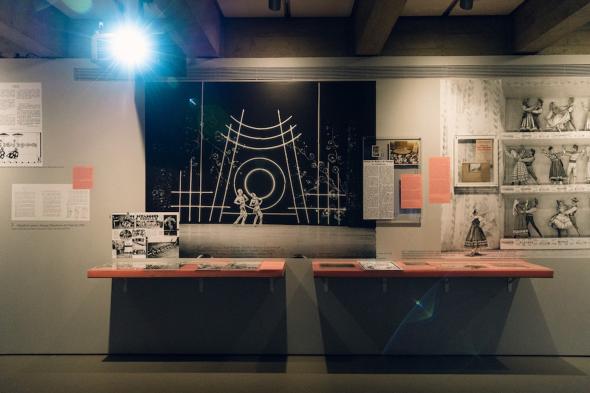

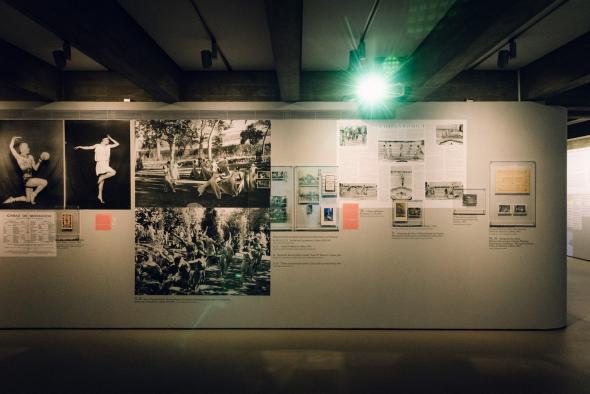
According to the logic of causality, the establishment of a timeline implies that there are paths backwards and forward. At least if we consider the time of a continuous line, but it isn’t. The cat that sits on the floor is not the same cat that jumps. Neither the intermediate cat that breaks through the air. Here is one of the most brilliant aspects of the organisation of the content of Dance Not Dance, both in the exhibition and in the catalogue. The timeline is broken and its pieces are glued in way to make the remote past appear next to it, below or above of the almost present, blending the differences between what is history and what is journalism, and hence the emphasis on clipping from articles published by the press. Added to this, at every moment, is the excess of desire and utopia that led to the new Portuguese dance and the expressions that resulted from it today. Here is another very interesting factor: from the shown archive, scrutinised, interspersed and manipulated, in the articulation of its fragments, something emerges that (still, if ever) cannot be archived: a search, an idealisation, a desire that is never fulfilled, because the future to which they tentatively point is always the future of oneself, and therefore unattainable. That is the first condition of utopianism.
That future is always multifaceted, consistent with a present that takes various directions and a past that has been varied. Because no single dance has ever existed. Dance Not Dance is many dances and non-dances. Better: it is many possibilities of movement. During one of the guided tours of the exhibition, Ana Bigotte Vieira even said that the last room of the exhibition could be seen as the first. In fact, we can start watching it in any room. Julio Cortázar, the author of the counter-novel “Hopscotch”, would certainly like to watch something so performative, since it is the audience itself that performs.
Artifice as nature
I can therefore say without exaggeration that Dance Not Dance is a work of science fiction. For all intents and purposes, this is the last refuge for the formulation of utopias and the questioning of what these utopias may have of… dystopianism. Don’t be surprised: after all, this aspect has always been at stake. Read this passage by António Ferro, quoted in the catalogue: “Women and men still have the parti pris of the human form, the form instituted by God, they are not yet completely artificialized. There are still many prejudices to be overcome before Nature is destroyed by artifice, before artifice becomes Nature…”
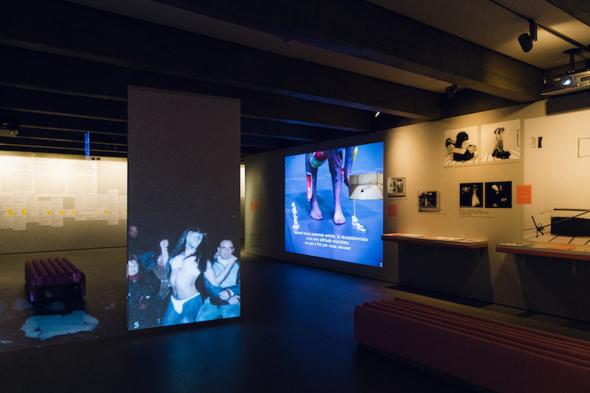
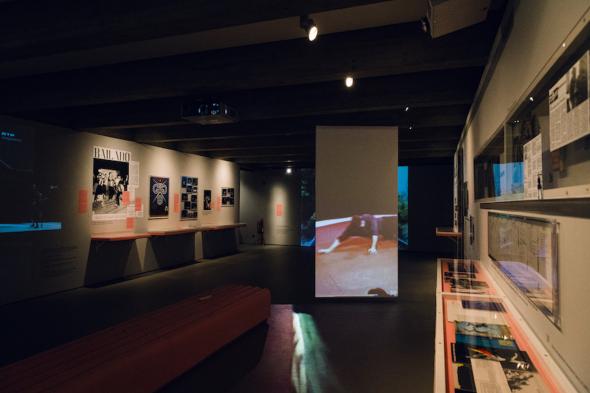
Who? António Joaquim Tavares Ferro, the man responsible for cultural policy during the Estado Novo regime. The highest authority in Salazar’s National Propaganda Secretariat, an enthusiast of Ballets Russes and responsible for the founding of the Companhia Portuguesa de Bailado Verde Gaio. In this case combining some misconceptions of modernity with the tourist glorification of national folklore. In Dance Not Dance, his ghost is everywhere, even in rejections of his legacy that we see projected diagonally on screens, on the wall behind and on the floor, giving us an illusion of three-dimensionality – bodies (for example, the bodies of Vera Mantero, João Fiadeiro, Margarida Bettencourt, Francisco Camacho, Paulo Ribeiro, Marlene Monteiro Freitas, Sónia Baptista, Diana Niepce) that move and manifest themselves as cultural constructions on the naturalness of flesh. No longer post-human artifices, but properly human extroversions and extrapolations, even when metamorphic and mutant in their becoming-animal or becoming-monster (Deleuze via José Gil).
Dance Not Dance lets ghosts circulate in their truncated transience, leaving us with the task of tying up loose ends. Another of these ghosts is Valentim de Barros, who was admitted to the Miguel Bombarda Psychiatric Hospital by the fascists with a diagnosis of “homosexual pathology”. It is one of the several disabled bodies that the new dance has recovered in its affirmation of a becoming queer and becoming crip. But in these archaeologies, some absences are also felt. Facts that never saw the light of day, that never materialised. What would have happened if Fernando Lopes-Graça had been able to apply his youthful ideas about ballet, which were broader than the place of music in it (he was unable to do so, constantly facing exclusion by António Ferro, censorship by the regime and persecution by PIDE, due to his communist militancy)? What would have changed in the “leap” of dance?
And what would dance be like today if Almada Negreiros had remained faithful to his connections with Futurism, that avant-garde with fascist connotations whose revolutionary character was recognised even by Gramsci, the communist leader, instead of presenting something as childish as “O Jardim da Pierrette” in 1918? These and other non-events also include the archive and the exhibition as spectres conducting what was not and what is because it was not. The “if”, the conjecture, the speculation that thus imposes itself is as much a matter of utopia as it is of science fiction – the new dance announced itself in the 1980s precisely as a hypothesis.
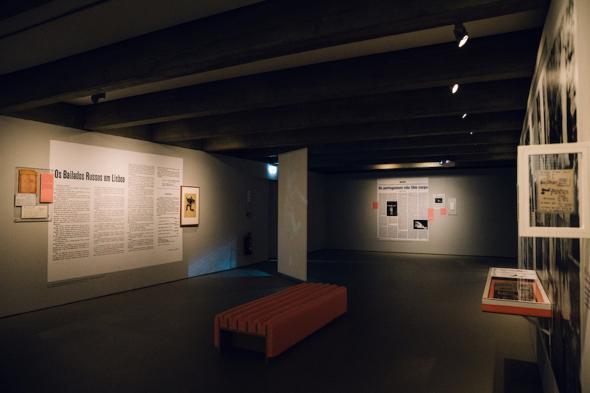
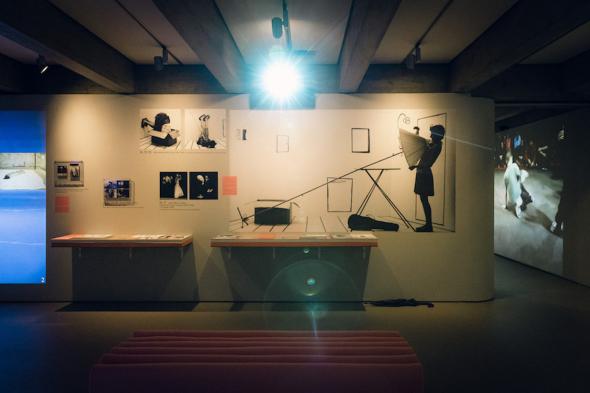
Leaving the past and present incomplete
Of course, there are other absences in Dance Not Dance, or at least presences that barely appear or appear weakly. We would like Aldara Bizarro and Sofia Neuparth, two cases among others, to be more visible, but it is difficult to be exhaustive, I know. In fact, in one of the texts in the book accompanying this exhibition, “Glossary: Permanent Essay”, Carlos Manuel Oliveira e Paula Caspão quote Ariella Azoulay when she argues that it is necessary to “keep the past incomplete”, given that the present is incomplete by definition and the future is not quite clear when it began. After all, this timeline is undergoing reformulation, and the focus has varied since the project began in 2016. But one fundamental thing must be noted: Very little attention is given to music in this version of For a Timeline To Be. Carlos “Zíngaro” is only mentioned (and only in the catalogue, with quotes from himself) in relation to “Zoo&lógica”. We hear him in one or two videos, but there is no mention of the unique and vast body of work (for Paula Massano, Olga Roriz, Margarida Bettencourt, João Natividade, Vasco Wellenkamp, Vera Mantero), that he developed for the New Portuguese Dance. This is strange, considering that this is the same “Zíngaro” who, in the debate “Anos 80. Lastro e Rasto” (2007) held at the Serralves Foundation, was named by António Pinto Ribeiro as the icon representing that decade.
Nuno Rebelo’s music is also detectable in the exhibition’s audio for those who remember it, but the only written references to it are about a trip to Cape Verde and a documentary inclusion in a technical file, not about his collaborations with Paulo Ribeiro, Vera Mantero, João Fiadeiro or Aldara Bizarro. It is as if Lopes-Graça’s unfinished work has been on repeat since those days in 1930. Even if only because there is no recognition of what was done. However,… what if there had been no Carlos “Zíngaro”, no Nuno Rebelo, what other turns would the new dance have taken? What other desires would it have had? We already know how the utopias danced in the post-Lopes-Graça era became intertwined with the critical and theoretical prose that the composer left us in publications such as Seara Nova, Presença and Vértice, and only through them. However, the contributions of “Zíngaro” and Rebelo are yet to be evaluated. Even though they belong to the archive, and even though there are physical objects available such as the albums “Musiques de Scène” (AnAnAnA, 1993), by the former, or “On the Edge” (Raka, 2002), the result of the latter’s partnership with a personality admired by so many Portuguese choreographers, Mark Tompkins.
As far as spectralities are concerned, there is more to note. Knowing that several of the protagonists of the new dance have devoted themselves or devote themselves in parallel to performance art, it is surprising that the wall between dance and so-called performance is not torn down in Dance Not Dance. Even though this decision seems to be implied by the “not Dance” part of the title. This leaves out figures such as Susana Mendes Silva, Ritó Natálio – although he was included in a previous edition -, Mário Afonso, the sisters Andresa and Lígia Soares, Fernando Eugénio or Rafa Jacinto. Brazilian artist are also left out – with the exception of Gaya Medeiros, who, together with Ary Zara, revisited the artistic nudes of the early 20th century in a performance – immigrants in Portugal who have contributed greatly to recent developments in this field of the performing arts, such as Daniel Pizamiglio, Joana Levi, Gustavo Ciríaco, Tita Maravilha, Tony Omolu and Rezmorah. We still need to mention Yael Karavan, a dancer and performer born in Israel and raised in Florence and Paris, who has established between us a unique body of work based on butoh. Any archaeology of movement out here will eventually have to include them, but this was not the time: the deadline of this archaeological study was set in 2011. Furthermore, given the relevance of dance theatre within the complex of the New Portuguese Dance, we are still unaware of a link between dance and theatre. The legacy of the group Os Cómicos, in its break with recited theatre (Ricardo Pais in “As Cuecas”, 1975) remains to be explored. These omissions, I am sure, will be covered in future editions of For a Timeline To Be, because they are bodies that matter, to paraphrase Judith Butler.
Conflicting placement
But let us move on. In the archaeologies brokered by Dance Not Dance, we encounter a welcome breakdown of the boundaries between the high culture of classical European ballet and popular culture in its many forms, some of them imported from the United States, and not only because the new dance draws on both sources. There is something in this placement in X that comes before any epistemological and ontological attempt to define what new dance is, and something imminently political, which is the construction of a radical democratic thinking in the terms that Chantal Mouffe has been putting it: the full acceptance of that it is conflict, disagreement, and not the search for consensus, that should guide a society that claims to be free and equal. Dance Not Dance is an embodied staging of this conflict. The practices and concepts portrayed are brought into confrontation, including through the way they spread and distribute throughout the exhibition space.
There are intersections, oppositions, overlaps, tangentialities and scenic mirrorings that are deliberately intended to raise questions. Each formula brought to the stage is thus relativised, but it is through this relativisation of each creative nexus that the questions implied by a global and collective vision of what this “New Portuguese Dance” is, emerges. Questions that never receive a definitive answer: inquiries from the past and present are left hanging, directed towards the other side of the archaeological arc, that of the future, of unfulfilled, unmet desire.
The tools of this gaze towards the rear and towards the feet of the moment with meaning in beyond are intersectional, and yes, it is feminist intersectionality that was continued by queer theory, decolonial and antipatriarchal intersectionality that challenges ableism, racism, misogyny and homotransphobia, sparks of a normativity in decline – “falling”, toppling statues, unbalancing and horizontalizing bodies (André Lepecki in “Exhausting Dance”) is, in fact, a choreographic resource introduced by new dance. A negative operation that aims to make way for what may come when – wishful thinking – what is denied finally collapses.
Dance Not Dance incorporates the cultural genealogies of African dances and those of the black diaspora in the Americas, travelling from Josephine Baker to the National Ballet of Guinea-Bissau – which was discussed in a debate – and from Charleston to breakdancing. The exhibition observes the process of contamination of the Western (and Portuguese) coloniser by colonised and neocolonised Africa after independence, in a very clear proposal to change mentalities in the very cradle of the slave-based and imperialist origins of capitalism, Lisbon – urgent at a time when the West itself, including Portugal, is witnessing a resurgence of fascism. The most dangerous among them is a form of fascism that seeks the survival of Capital in a time after the increasingly anticipated apocalypse. A time when a bionic and genetically or technologically modified entity will supposedly replace humans, the artificial body imagined by António Ferro. This is the venture of Elon Musk, the CEO of Tesla Motors and Space X, who is Trump’s main ally, preparing a scenario of intergalactic escape and settler colonialism on other planets. How could we not talk about science fiction, if reality has taken on such contours?
The good virus that Dance Not Dance opens up to is Afrofuturist, from that philosophical and aesthetic lineage that is offering us an alternative history and a different conception of science, influenced by magical realism, removing the potentiality of a future that is not white supremacist. The exhibition also echoes Samuel R. Delany, Octavia Butler, Jean-Michel Basquiat, Robert Springett, Funkadelic, Earth, Wind and Fire, Lil Nas X, Afrika Bambaataa, Herbie Hancock and Sun Ra, already mentioned in these lines, with their visionary blend of Egyptology and UFO mysticism. And it echoes the exaltation of blackness by Leopold Senghor, Frantz Fanon, Malcolm X, Amílcar Cabral, Agostinho Neto, Angela Davis, Audre Lorde, Leroy Jones aka Amira Baraka, James Baldwin, bell hooks. None of this is mapped out or explained, but it is sensed as a meta-narrative. A meta-narrative with people inside, bodies, existences. It must be mentioned.
It is not the end
I cannot recall ever having considered what it means to be Portuguese with such a psychotherapeutic and transformative predisposition. If this type of curatorial work on ruins is clearly postmodern, it does not condone the catastrophism (or the desire for redemption) that we identify with postmodernity, which solemnly declares the end of art, the end of ideology and the end of the world, a theme that also occupied Fredric Jameson in “Postmodernism or the Cultural Logic of Late Capitalism”. And we find even less irony, the irony that Lyotard identifies with postmodernism turned into a primer, although there is humour. Dance Not Dance is a breath of fresh air that contemporary dance in this country badly needed, because it proves that nothing is over, that more will happen, although we don’t know what, among so many clues, that it wasn’t just a celebration of death, that there will be opportunities later on to sew together other joints and conjunctures, the ones that are missing. It is a repositioning, a reactivation.
Now let’s dance, because “If I can’t dance, I don’t want to be part of your revolution” (Emma Goldman).
Photographs ©Maria Abranches – Calouste Gulbenkian Foundation


