Penha de França, Bairro das Novas Nações, Olivais: Colonial toponyms in Lisbon
All political regimes prior to April 25, 1974, each in its own way (with the Estado Novo playing a particularly prominent role), sought to transform the Empire into a timeless and eternal substance, with the colonies coexisting in harmonious articulation. But it was during the Estado Novo that national toponymy played the most active role in the policy of preserving the empire and maintaining control over the African and Asian colonies. Particularly the power structures that served a rhetorical and ideological function incorporated into their propaganda networks the tangle of streets, avenues, and squares, whose names today give material form to the history and legend of Portuguese colonialism.
All over the country, we find traces of the colonial past that extend from the urban grid to statues, monuments, and even commerce itself. The map of Lisbon, in particular, once the capital of the Portuguese empire, contains hundreds of names and geographical references that not only point to the country’s various colonial pasts but also highlight the imperial state’s insistence on building a national identity based on the assertion of colonial power.
Evolution of the Colonial Toponym
The transformation of Lisbon’s morphology throughout the 20th century, with the creation of new neighborhoods (in Arroios and Olivais, in particular) and the expansion of the streets, was accompanied by a symbolic, practical, and meticulous investment in the imperial imagination. The goals were very clear and were adapted to each situation, though at their core lay a deeply ideological reiteration of the ideas of empire and colonial exploitation.
In an initial phase, with the Bairro das Colónias and the parish of Penha de França serving as its foundation and content, the authorities sought to infuse the urban environment of the capital (and its daily life) with a commemorative vision of the Portuguese “epic” and its supposedly “civilizing” work.
Later, in a second phase, marked fundamentally by the start of the Colonial War (1961), official policy shifted toponymic activity toward the memorialization of the so-called “heroes who died in the service of the nation. The most interesting case to note in this context is the Olivais neighborhood, as it exemplifies the extent to which the regime used the capital’s toponymy to legitimize the decision to send the Portuguese Army “quickly and in force” to the colonies, essentially maintaining, but in a more vehement manner, the project to preserve the Empire.
Bairro das Colónias
In Lisbon, we can identify around 250 streets that, in one way or another, have colonial associations. The names given to these streets not only reflect the city’s changes but also constitute a linguistic, cultural, and political legacy of European expansion and, in particular, of Portuguese colonialism. This connection between Lisbon’s toponymy and the legitimization of the state, whose aim was to materialize and root a certain historical memory in the population (by celebrating it), is in many ways linked to the evolution of the country’s political events.
One of the most significant moments in this toponymic policy occurred with the construction of the Bairro das Colónias (today Bairro das Novas Nações), whose foundations were laid in the 1920s on the grounds of the former Quinta da Mineira (or da Charca), then belonging to the parish of Anjos. In the following decade, the first residential buildings began to be constructed, almost all in Art Deco and Modernist styles.
The initial idea was to name the streets after prominent figures from Portuguese colonialism. However, the city council opted to give them different geographical designations, more precisely the names of the colonies (with the exception of Guinea and India), imprinting in the memory of Lisbon’s residents a map of the territories under Portugal’s control, reminding them that the country “was not small.” (Portugal, as Unamuno said, must be a very tired country, because it is always standing on tiptoe to appear larger than it is) and, in a subliminal way, offering them an image of a coherent connection between all the colonies, among themselves and between them and the metropolis.
The 1929 street plan already proposed that this new residential complex be named “Bairro das Colónias,” a designation that would not be formalized until 1933, the year marking the beginning of the Estado Novo. Financed with private capital and intended for the middle-class rental market, the Bairro das Colónias would eventually house families from different social classes.
It is worth recalling that, at the time when the Bairro das Colónias was being designed and built, the fourth government of the military dictatorship was already in power (which, having taken office in 1928, was led by General José Vicente de Freitas and had Salazar as Minister of Finance), and the “Indigenous Labor Code” (1928) in the Portuguese colonies of Africa (which maintained and reinforced the compulsory use of “indigenous labor” through a system of “forced labor” or “contract labor,” under conditions very close to slavery) had already been enacted (in 1928), just as the Colonial Act (Decree No. 18,570, of 1930), through which the programmatic and legal basis of an essentially “imperial” and centralist colonial policy was defined (and which would lead to the intensification of the exploitation and discrimination of African populations, as well as a reduction in the autonomy of the administrative and governmental structures of those territories).
Geographically divided by Rua de Angola, which serves as an axis between Avenida Almirante Reis and the then Praça do Império, below the Monte Agudo viewpoint, the Bairro das Colónias began to be built in 1930, on the site of Charca. Three years later, the municipality of Lisbon established the following place names there: Praça das Colónias and Rua de Angola, Rua de Moçambique, Rua da Guiné, Rua do Zaire, Rua da Ilha do Príncipe, Rua de Cabo Verde, Rua da Ilha de São Tomé, Rua de Macau, and Rua de Timor (and, still in the same year of 1933, Praça das Colónias was renamed Praça do Ultramar).
Starting in 1967, the names Quinta da Mineira and Sítio da Charca fell into disuse, and the area began to be called Bairro das Colónias due to popular demand.
After the April 25, on February 17, 1975, Bairro das Colónias and Praça do Império were renamed “Novas Nações”: Praça das Novas Nações and Bairro das Novas Nações. Over the years, however, the habit of calling it Bairro das Colónias has persisted to this day among residents of Lisbon. This is also the case with the Parish Council itself, at least judging by the road and pedestrian signage, as well as its website, which still bear that name today. Or as is the case with some of the neighborhood’s businesses, which have adopted the name, such as Farmácia Colonial or the Auto-Colonial auto repair shop.
Over the past decade, after losing population and vitality in the 1980s, the social structure of the Bairro das Novas Nações has undergone profound changes. On the one hand, the nationalities of the people who moved there have multiplied (turning it into a sort of dormitory for immigrants from different parts of the world), on the other hand, attracted by more affordable rents (especially compared to other historic city centers, notably Chiado and Bairro Alto), the proximity to the metro, and the redevelopment of poorer areas such as Intendente, there has been a rejuvenation of its population, with the arrival of young families who, in many cases highly educated, find themselves in precarious employment situations. Despite the neighborhood’s enormous changes, the term “colónias” (rather than the official name “Novas Nações”) has remained and persists in the collective memory.
Penha de França
On the eastern side of the city, specifically in the parish of Penha de França, the decree of March 23, 1954, established Paiva Couceiro Square, Mouzinho de Albuquerque Avenue (which runs through the Vale Escuro neighborhood, from Paiva Couceiro Square to Santa Apolónia Street), and Aires de Ornelas and Eduardo Galhardo Streets. All of them were military personnel who participated in the Mozambique Campaign which, in 1895, crushed the revolt of the African warriors led by Emperor Nguni Gungunhana (a Vátua chief, whose original name was Ngungunyane), in Chaimite.
In the same notice, the Municipal Toponymy Commission also named other streets after military personnel or civilians who, while performing official duties in the colonies, embodied Portuguese colonial policy, whether as government officials or in campaigns of exploration, occupation, and border demarcation: Avenida General Roçadas, Rua Artur de Paiva, Rua Dr. Lacerda e Almeida, Rua Francisco Pedro Curado, Rua Teixeira Pinto, Rua Eduardo da Costa, Praça Aires de Ornelas, Praça João de Azevedo Coutinho, Largo General Pereira de Eça, Avenida Coronel Eduardo Galhardo, Rua Coronel Ferreira do Amaral, and Largo Alferes Francisco Duarte.
Through this toponymy, the Estado Novo used Penha de França to reinforce and instill, in the collective consciousness, the idea of the glory of the Portuguese Colonial Empire.
In this part of the city, the only exception to the prevalence of military figures is Rua Dr. Lacerda e Almeida, named after a mathematician who also served as governor of Tete (Mozambique) and participated in the surveys that established the first longitude lines in Africa.
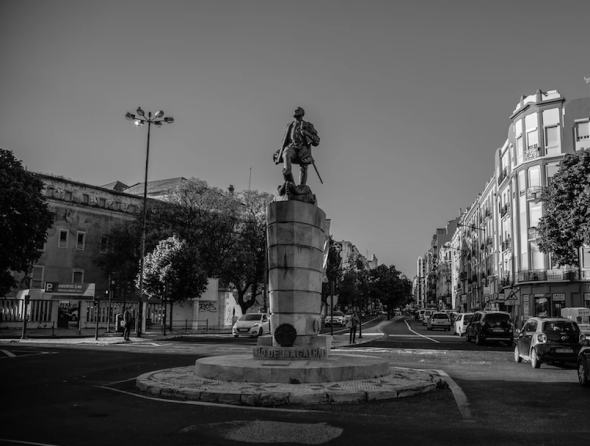 Praça do Chile Fernão de Magalhães 2021 @ Rui Sérgio Afonso
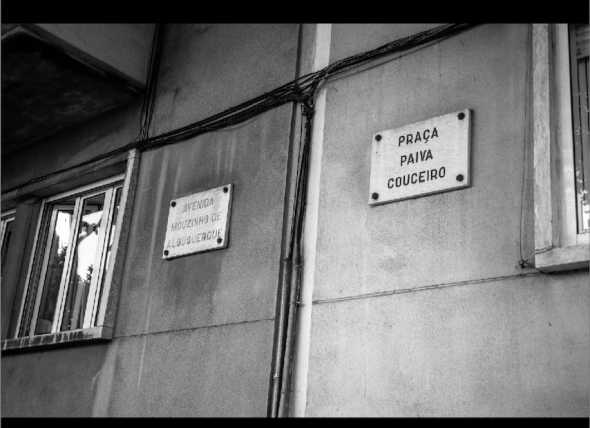 Penha de França 2021 © Rui Sérgio Afonso
Almost all the colonial place names in the parish of Penha de França pay homage to figures from the period of widespread European colonialism in the late 19th century, in particular the Portuguese. Many of them, it must be remembered, were responsible for some of the darkest chapters of our past: the campaigns of exploration and occupation of various regions of Angola and Mozambique, which led to the subjugation, punishment, and imprisonment of chiefs, rulers, and entire populations of black people, many of whom were murdered, chained, abused, subjected to forced labor, and brutally exploited.
Penha de França, where I often wander, is an instructive example of the moral ambiguity that permeates this colonial-inspired toponymy. It is still surprising that the city of Lisbon, decades after April 25, the collapse of the Empire, and the consolidation of the current democracy, continues to honor figures from the past who, having been responsible for the backbone of the empire, represent an openly racist culture.
In this area, I would like to highlight the figure of Joaquim Augusto Mouzinho de Albuquerque (1855–1902), whose name is given to the avenue that borders the Vale Escuro neighborhood on one side and the lands of Vale de Santo António on the other. For Mouzinho de Albuquerque, the cavalry officer who distinguished himself by capturing Gungunhana, but also by leading the subsequent “pacification campaign” [EXKURS] that violently subjugated local populations to Portuguese colonial authority, thereby helping to demarcate the territory of Mozambique, is a good representation of the nineteenth-century colonizer and the golden age of violent colonial conquest. A racist and proponent of social Darwinism, he considered whites a superior race and exuded an overflowing sympathy for the death penalty and corporal punishment, especially when applied to Africans.
Mozambique campaign
Should Lisbon maintain these names within its toponymy, honoring them with signs that present them as “Heroes of the African Campaigns” (General Roçadas) or “Heroes of the Overseas Territories” (Second Lieutenant Francisco Duarte)? Should Lisbon glorify men like Aires de Ornelas, who, in addition to having participated in the campaigns to conquer and pacify the colonies, and in particular in the actions that led to the arrest of Gungunhana, was an admitted admirer of the political ideas of Charles Maurras, the anti-Semite who inspired Salazar and influenced his political formation? Like Henrique de Paiva Couceiro, who served in the Military Campaign of Angola (1889–1891) and also distinguished himself in that of Mozambique (1894–1895) against Gungunhana’s forces, for which he was proclaimed a benefactor of the nation? Or perhaps like those of General João de Almeida (Ajuda/Belém), General Massano de Amorim (Ajuda), and Major Neutel de Abreu (São Domingos de Benfica), streets where they are honored, according to their respective street signs, as “Heroes of the Overseas” or “Heroes of the Occupation”?
Each in their own way, all of them figures of Portuguese colonialism who actively participated in the African campaigns of the late 19th and early 20th centuries, symbolize the values and ideals of Portuguese colonialism, as well as the retrospective imagery of violent colonial occupation and exploitation. The names of these streets are not, therefore, merely points on the cartography of the city that serve to help people navigate the physical space. They are also forms of communication and affirmation of Europe’s former dominion over its once-overseas possessions, and all of them contributed to internalizing the colonial principle and maintaining the functioning of the empire.
However, the spirit that dictated this toponymy does not align with our current standards of citizenship (standards change over time, and mechanisms for promoting citizenship must keep pace with many of these changes). The Portugal that these streets represent is not today’s Portugal, which is democratic, tolerant, and a defender of human rights. It is no longer a country that fights to preserve its colonies or identifies with the institution of colonialism.
It is time to develop a critical policy on toponymy, out of respect for the memory of the suffering, humiliation, and discrimination caused by our ancestors, but also because we must deconstruct the deplorable colonial and racist mindset deeply rooted in Portuguese society.
That said, should we cover up this mess of names, erase them from our history? Not at all. Nor is it a matter of condemning these names to oblivion, hiding them, or eliminating them, but rather of relocating them to other places where they can be properly contextualized (school textbooks, books and dictionaries on the history of Portugal, university courses, doctoral research, academic essays, museums, etc.) and treated with the critical rigor that scientific and critical research must apply to the study of the past.
It is worth remembering that many of these names, by virtue of being repeated so often in daily life, have become detached from their historical significance, becoming naturalized and normalized in our urban landscapes, thus allowing their perpetuation beyond April 25. It is, therefore, also a matter of questioning their crystallization, legitimization, and naturalization in the public sphere. And of not allowing the State and democratic public authorities to continue promoting and mythologizing them.
Bairro dos Olivais
A third phase of this colonial toponymy in Lisbon takes us to the 1960s and the entire period during which the wars of national liberation, or independence, took place. A few months after members of the MPLA attempted to attack the Military Detention Center, the PSP barracks, and the Angolan delegation of the National Broadcasting Corporation in Luanda, and in response, Portuguese police and military forces massacred more than three thousand black civilians — events of February 1961 that marked the beginning of the wars in Angola, Mozambique, and Guinea-Bissau — Salazar took over the Ministry of National Defense and ordered the reinforcement of military forces in Angola.
At the same time that the dictator proclaimed his well-known motto — “To Angola, quickly and in force!” — Lisbon intensified the toponymic enshrinement of the “Heroes of the Overseas Territories” and of those who died in the colonies “In the Service of the Fatherland.”
A classic example of this toponymic policy is the Bairro dos Olivais, today one of the city’s most populous parishes. Of its roughly 160 streets, about half have “colonial” names, embodying the peak of the Salazarist era’s tribute to the “heroes.”
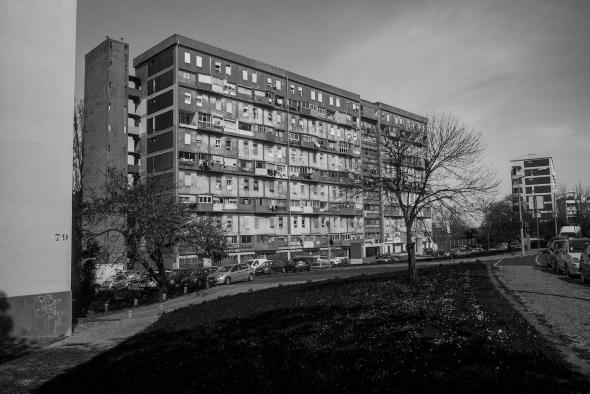 Olivais 2021 Foto Rui Sérgio Afonso
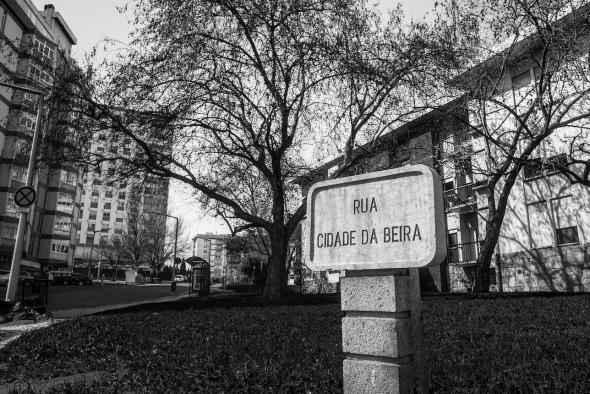 Olivais 2021 © Rui Sérgio Afonso
To get an idea of the toponymic concentration of colonial character in this area, it is enough to mention that this neighborhood includes 72 streets that directly refer to that past.
In Olivais-Norte alone, there are 18 names of individuals who distinguished themselves in those territories, divided into the categories “Overseas Hero” (6), “Hero of Timor” (1), “Hero of Guinea” (1), “Died in the Service of the Fatherland” (8), “Governor” (1), and Castro Soromenho, a literary writer; in Olivais-Sul, 54 place names were designated after localities (cities and towns) in the former possessions in Africa, India, and Timor. In this context of affirming the defense of the Colonial Empire through toponymy, mention must also be made of the names of the military personnel who died “in the Service of the Fatherland,” which make Olivais a sort of cemetery for the Portuguese victims of the Colonial War.
If the street system of Olivais-Norte derives its coherence from a succession of individuals whom the regime honored for their achievements in the colonies, the streets of Olivais-Sul were named after cities, towns, or regions of the former colonies, as can be seen in the Minute of the Municipal Toponymy Commission meeting of November 29, 1963, which refers to “the directive from His Excellency the President, requesting the Commission’s opinion on the opportunity to honor Angola by naming its cities in Lisbon’s toponymy; (…) and, likewise, whether this tribute could include cities from other overseas provinces. The Commission, considering that the Olivais-Norte area has been reserved to honor the names of military personnel who died in the service of the Fatherland, believes that the Olivais-Sul area is the best location for assigning the names of overseas cities.”
The Bairro dos Olivais, however, is based on a contradiction that fully defines the Estado Novo of those years.
On the one hand, through a propaganda campaign glorifying the Empire, which was clearly outdated given the anti-colonial stance of nearly the entire international community, the regime sought to exploit and keep its African colonies united, refusing to discuss, at all costs, any scenarios that might lead to the self-determination and independence of those territories.
On the other hand, the urban plan for the northern part of Olivais represents a pioneering project of modernity in a country that was, at the time, extremely rural. It was based entirely on the Athens Charter (1933), the urban manifesto that broke with the idea of the traditional city, composed of clusters of buildings on narrow streets, and promoted integrated and functional plans, with high-rise buildings separated by gardens, parks, and trees, thereby creating a more open and airy environment, which was to be characterized by social interaction among residents of different classes.
But we cannot fail to recognize that this modernist plan also resulted from the increasingly evident urgency to address the war efforts and damage that were taking their toll in Portugal and to respond to the demands of progress, clearly aiming at a single objective: to promote consensus around the regime, the colonial project, and the war effort.
At first glance, the Estado Novo’s policy seemed paradoxical: at this time, it was making every effort to preserve the archaic colonial world in the face of the inevitable emergence of the modern, liberal world. In this sense, the Bairro dos Olivais plan brings together the contradictions inherent in the beginning of the end of the Empire.
Rename the city
This itinerary through the toponymy of the city of Lisbon does not merely reflect Lisbon’s urban growth in the mid-20th century. It also represents a continuous temporal flow, practically without interruption. It reflects a toponymic movement that sought to objectify and crystallize a specific colonial memory. At the same time, this toponymy provides coherence and a common thread linking the different moments of ideological appropriation of Portuguese colonialism.
In the early decades of the 20th century (and even at the end of the 19th century), many believed that Portugal lacked the capacity to maintain its colonies and that, sooner or later, it would end up losing them. The Estado Novo dictatorship imposed an exclusionary principle, according to which “the Portuguese Colonial Empire is a reality that is not up for debate.” This injunction helps explain why the Estado Novo was at the forefront of the colonial toponymy movement.
Undoubtedly, it was during Salazar’s regime that a major toponymic offensive was launched with the aim of proclaiming loyalty to the Empire and asserting that Portugal would not cede a single millimeter of its colonial heritage. The fact that some of the streets mentioned here date from the late nineteenth century should not make us forget that the overwhelming majority coincide with the Estado Novo period.
However, since then, this colonial toponymy has never been doomed to disappear from the urban landscape or from cartographic representations. On the contrary, its ideology endures over time (at least implicitly), and it can thus be said that virtually all Portuguese cities preserve in their place names the memory of the “colonial enterprise.”
Does it make sense that the heart of our cities continues to feature names revered by the colonial regime, whose primary aim was the preservation of the colonies at all costs, even if that meant the sacrifice of thousands of lives, both here and there? Names rooted in principles rejected by the April 25 Revolution, but which remaining intertwined and fused in the toponymy, display — not manifestly, but latently — ideas and thoughts that reek of blood and crimes against humanity?
In my view, from the perspective of civic education and memory policies, it is a mistake not to make changes, not to at least reconsider the legitimacy of continuing to honor individuals whose past actions are no longer acceptable today, as they fail to respect the basic principles of human dignity.
Thus, a first step toward definitively taking responsibility for our history, particularly its negative aspects, would be to conduct a comprehensive survey of these streets, avenues, and squares (an inventory which need not include the geographical toponyms of the former Bairro das Colónias, as they are situated on a different level of connotation and can be seen, as is made explicit by their official name, as a celebration of the “new independent nations”). We would then begin this process of contextualization by replacing the existing signs on these streets (and installing new ones where none exist) with simple information, produced in collaboration with historians, which provides a more accurate historical framework. These names from Portugal’s history, to be sure, will not cease to exist. But it will become easier to bear them.
On behalf of the state, there must be clarity regarding the civic values it seeks to uphold in the public sphere. On the part of society, we need to reflect more deeply on the kind of political and cultural practices we want to see reflected in our streets and statues, and we should demand that they feature the names of other “heroes.” On street signs, in my view, there should be the names of those who, despite all their flaws, do not tarnish democratic values and human rights, and who embody more constructive and unifying values. As for the others, those to whom the present cannot and does not intend to confer ethical dignity, they will always continue to exist in books, in debates, in schools, in civil society groups or associations that seek to claim that legacy, etc.
There is no escaping this: maintaining this toponymy is like a thorn embedded in the conscience of our revulsion, it is a spectrum that binds us to a past we cannot and must not forget, but which we can and must stop honoring.


